
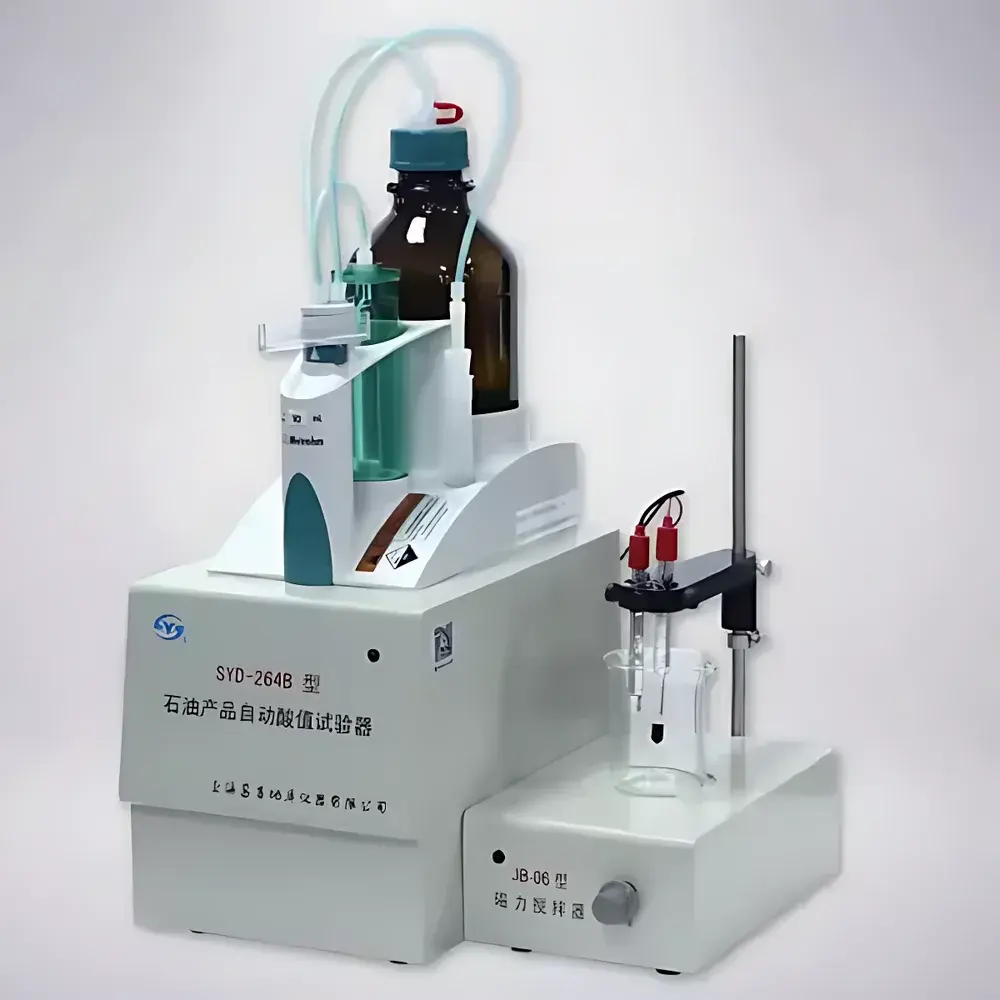
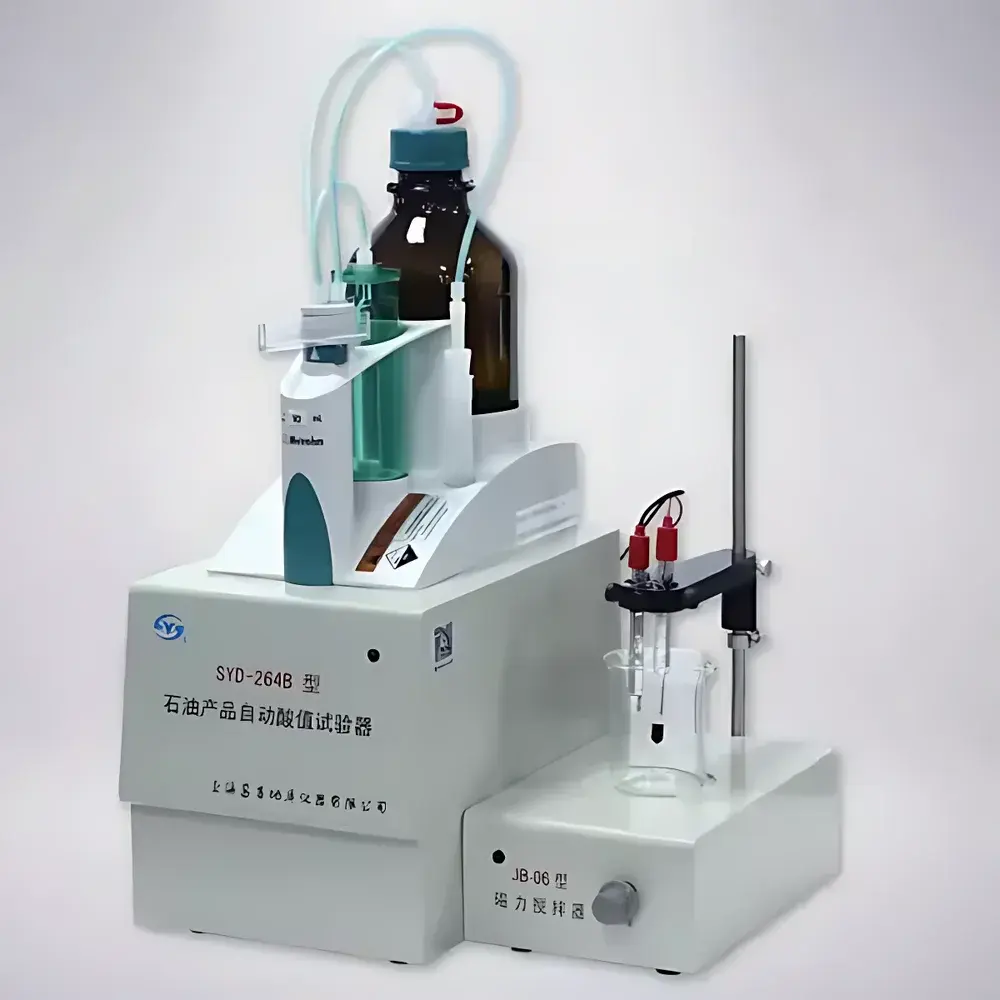
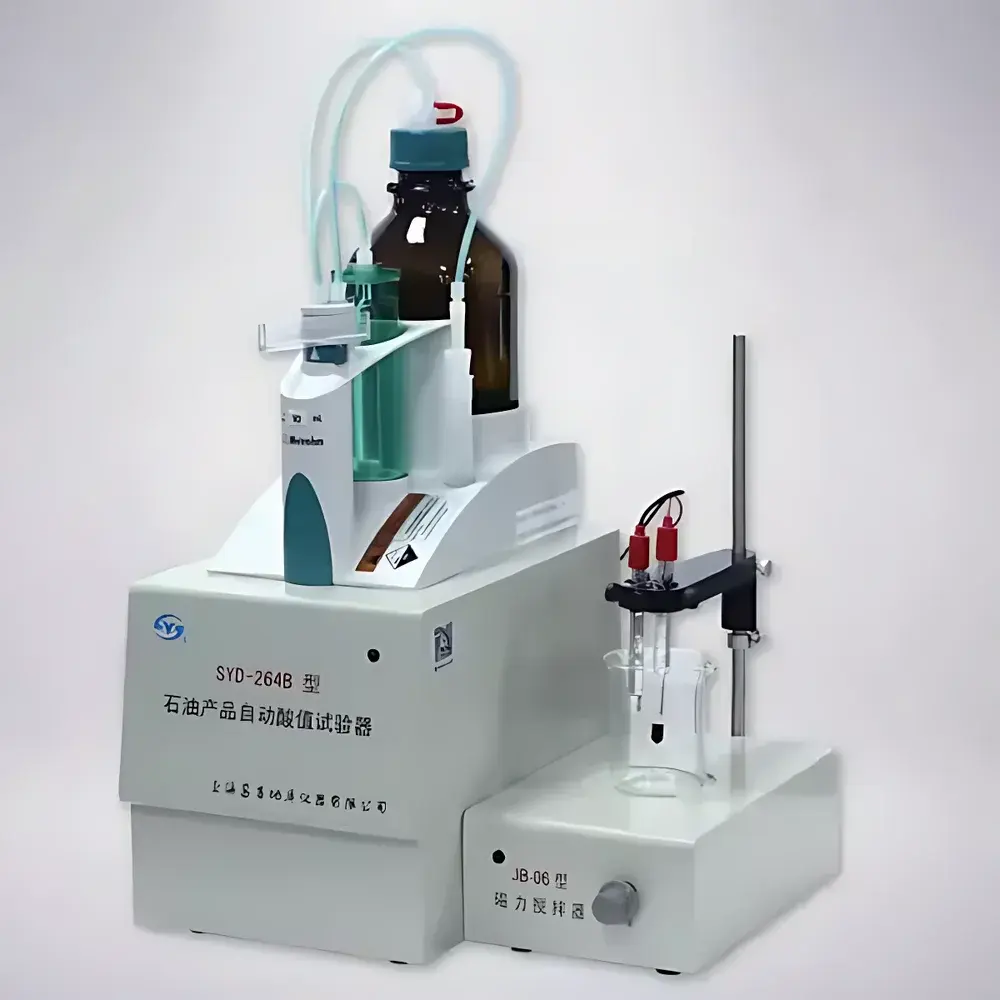
Changji Instruments SYD-264B Automatic Acid Number Titrator for Petroleum Products
| Brand | Changji Instruments |
|---|---|
| Origin | Shanghai, China |
| Manufacturer Type | Authorized Distributor |
| Origin Category | Domestic (China) |
| Model | SYD-264B |
| Power Consumption | 200 W |
| Burette Accuracy | ±0.1% F.S. |
Overview
The Changji Instruments SYD-264B Automatic Acid Number Titrator is an electrochemical potentiometric titration system engineered for precise and reproducible determination of acid number (AN) in petroleum-based fluids. It operates on the fundamental principle of potentiometric endpoint detection—measuring the potential shift across a pH-sensitive electrode pair during controlled titration with standardized alcoholic potassium hydroxide (KOH) solution. Designed in strict compliance with internationally recognized standards—including ASTM D664–2011, GB/T 7304, GB/T 18609, NB/SH/T 0836, and GB/T 258—the instrument delivers traceable, auditable results essential for quality control in transformer oil, turbine oil, insulating oil, diesel, gasoline, and crude oil applications. Its architecture integrates hardware-level signal stability, software-driven protocol automation, and full data lineage capture to support laboratory environments operating under GLP, ISO/IEC 17025, or internal QA/QC frameworks.
Key Features
- Integrated desktop workstation running Windows OS with localized Chinese-language titration software—enabling intuitive mouse-and-keyboard operation and real-time human–instrument interaction.
- Imported high-stability burette assembly with closed-loop fluid control, ensuring consistent delivery kinetics and minimized drift in potentiometric signal acquisition.
- Real-time graphical display of titration curves (E vs. volume), automatic endpoint recognition via first-derivative analysis, and immediate calculation of acid number per ASTM D664 methodology.
- Configurable data export: test reports saved directly as editable Microsoft Word documents; raw titration datasets exported in native Excel (.xlsx) format for secondary statistical analysis or LIMS integration.
- Fully automated liquid handling functions—including auto-refill, fixed-volume dispensing, and reagent priming—reducing manual intervention and operator-induced variability.
- Dual-channel electrode input supporting combination pH electrodes or separate reference/sensing electrodes, with input impedance ≥1 × 10¹² Ω to minimize loading error during low-current measurements.
Sample Compatibility & Compliance
The SYD-264B is validated for use with mineral oils, synthetic lubricants, biodiesel blends, and crude fractions where organic acid content correlates with oxidation degradation or naphthenic acid contamination. It meets functional equivalency requirements of ASTM D664–2011 (Standard Test Method for Acid Number of Petroleum Products by Potentiometric Titration), GB/T 7304 (Chinese national standard for acid number of petroleum products and lubricants), and NB/SH/T 0836 (for insulating oils). While not certified to FDA 21 CFR Part 11 out-of-the-box, its audit trail functionality—including timestamped user actions, parameter change logs, and immutable result records—can be configured to align with regulated environments requiring electronic record integrity per ALCOA+ principles.
Software & Data Management
The embedded Windows application provides role-based access control, method template storage, and customizable report headers. All titration events—including electrode calibration history, blank corrections, sample identification, ambient temperature logging, and volumetric delivery timestamps—are stored in a relational SQLite database. Exported Excel files retain full metadata (e.g., electrode ID, KOH titer, temperature-compensated mV readings), enabling traceability back to individual runs. No cloud connectivity or remote telemetry is implemented—data remains local unless explicitly exported, satisfying air-gapped lab security policies.
Applications
- Monitoring oxidative stability of transformer and turbine oils in power generation facilities.
- Assessing naphthenic acid content in crude assay workflows prior to refining.
- Verifying acid number compliance for aviation turbine fuels (Jet A-1) per ASTM D3242.
- Supporting root-cause analysis of corrosion failures in fuel storage systems.
- Quality release testing of new lubricant batches against OEM specifications (e.g., GEK 32568, Siemens TLV 9013).
- Research-grade acid profiling in alternative fuel development (e.g., hydrotreated esters and fatty acids, HEFA).
FAQ
What standards does the SYD-264B comply with?
It conforms to ASTM D664–2011, GB/T 7304, GB/T 18609, NB/SH/T 0836, and GB/T 258 for acid number and acid degree determinations.
Can it be used for non-petroleum samples such as biodiesel or bio-oils?
Yes—provided the sample dissolves fully in the prescribed isopropanol–toluene–water titration medium and exhibits a distinct potentiometric inflection point within the instrument’s measurable range (≥0.05 mg KOH/g).
Is the software compatible with LIMS integration?
Raw data exports in Excel format support manual import into most LIMS platforms; direct ODBC or API integration is not supported.
What electrode types are recommended?
A glass-body combination pH electrode with integrated Ag/AgCl reference and ceramic junction is recommended; optional double-junction electrodes may be used for high-salinity or sulfide-rich crude matrices.
Does the system include validation documentation?
Factory calibration certificates for burette accuracy and electrode response are provided; users must perform periodic verification per their internal SOPs using certified reference materials (e.g., NIST-traceable KOH solutions).




