
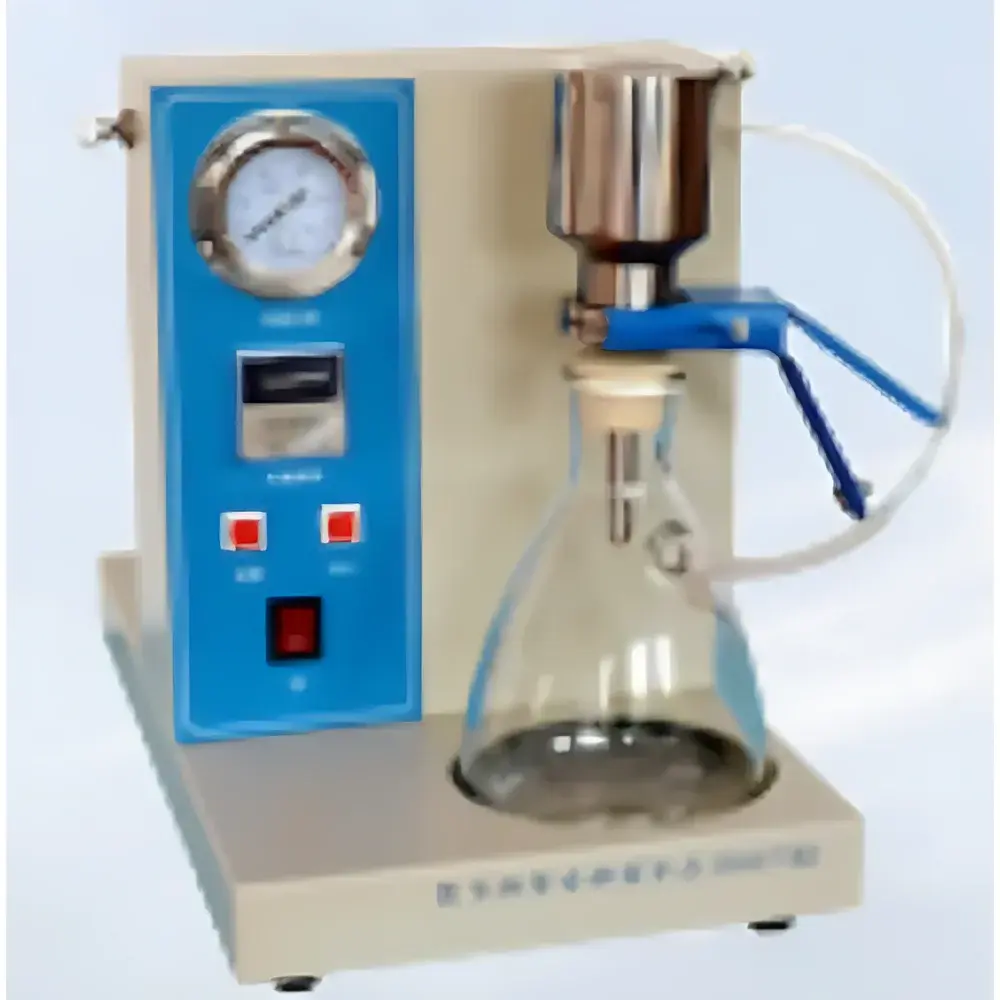
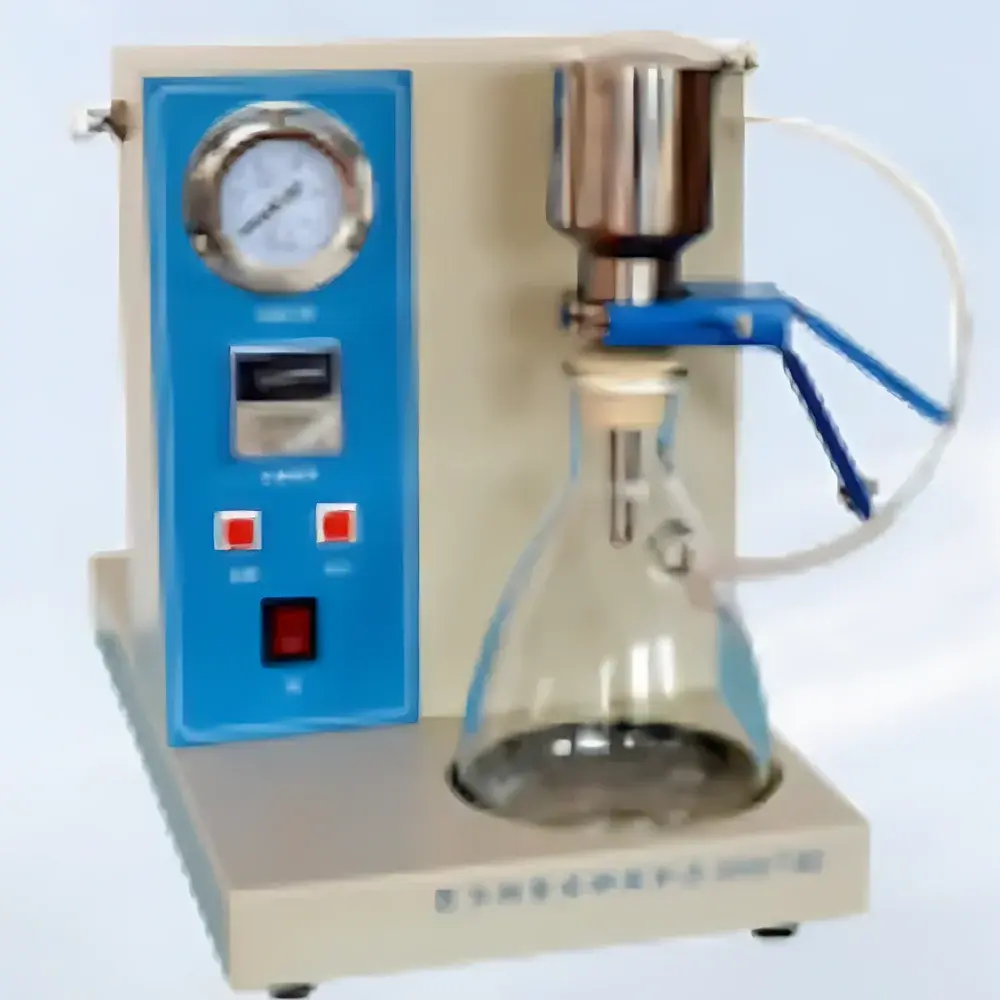
Changji Instruments SYD-33400 Total Contaminants Tester for Diesel Fuel
| Brand | Changji Instruments |
|---|---|
| Origin | Shanghai, China |
| Model | SYD-33400 |
| Power Supply | AC (220 ± 10%) V, 50 Hz |
| Vacuum Pump | Single-stage rotary vane vacuum pump |
| Vacuum Regulation | Stainless steel needle valve |
| Vacuum Gauge Range | 0 to −0.1 MPa |
| Applicable Sample Viscosity | ≤ 8 mm²/s at 20 °C or ≤ 5 mm²/s at 40 °C |
| Measuring Range for Total Contaminants | 12–30 mg/kg (per GB/T 33400) |
| Compliance Standard | GB/T 33400—2016 |
Overview
The Changji Instruments SYD-33400 Total Contaminants Tester is a precision laboratory instrument engineered for the quantitative determination of total insoluble contaminants in middle distillate fuels—including conventional diesel, biodiesel blends (FAME), and pure fatty acid methyl esters (BD100)—in strict accordance with the Chinese national standard GB/T 33400—2016, “Test Method for Determination of Total Contaminants in Middle Distillate Fuels, Diesel Fuel, and Fatty Acid Methyl Esters.” The method employs gravimetric filtration under controlled vacuum conditions: a precisely weighed sample is passed through a pre-weighed membrane filter; the retained residue is rinsed, dried under standardized conditions, and re-weighed. The mass difference yields the total contaminant concentration expressed in milligrams per kilogram (mg/kg). This principle aligns with internationally recognized particulate quantification practices used in fuel quality assurance and refinery QC laboratories.
Key Features
- Integrated benchtop design with compact footprint, optimized for routine testing in quality control labs and fuel testing centers.
- Single-stage rotary vane vacuum pump delivering stable, controllable negative pressure up to −0.1 MPa, enabling rapid and reproducible filtration kinetics across diverse fuel matrices.
- Stainless steel needle valve for precise, dual-range vacuum regulation—supporting both coarse and fine adjustment to maintain optimal filtration rate without membrane rupture or premature clogging.
- Dedicated grounding provisions integrated into both the filtration buffer bottle and filtrate receiver bottle, mitigating electrostatic charge accumulation during hydrocarbon handling—a critical safety and measurement integrity measure per ASTM D2709 and ISO 4020 protocols.
- Compliance-ready architecture: all components—including glassware, filter holders, and vacuum lines—are chemically inert to diesel and FAME solvents, minimizing leaching or adsorption artifacts that could bias low-level contaminant measurements.
Sample Compatibility & Compliance
The SYD-33400 is validated for samples meeting the physical criteria specified in GB/T 33400—2016: kinematic viscosity not exceeding 8 mm²/s at 20 °C or 5 mm²/s at 40 °C, and total contaminant concentrations between 12 mg/kg and 30 mg/kg. While the instrument may be operated outside these limits—for instance, with high-viscosity blends or ultra-low-contaminant samples—the stated precision (repeatability and reproducibility) applies only within the standard’s defined scope. For regulatory submissions or interlaboratory comparisons, adherence to the full method protocol—including certified reference materials, environmental controls (e.g., 23 ± 2 °C ambient temperature, <50% RH), and operator training—is required. The system supports traceability under GLP-compliant workflows when paired with calibrated analytical balances (0.01 mg resolution) and certified filter membranes (e.g., 0.7 µm nominal pore size, cellulose acetate or mixed ester).
Software & Data Management
The SYD-33400 operates as a standalone manual gravimetric system and does not incorporate embedded software or digital data logging. However, it is fully compatible with laboratory information management systems (LIMS) and electronic lab notebooks (ELN) via external documentation protocols. Users are advised to record raw mass values (tare, gross, post-dry), vacuum duration, and environmental parameters in accordance with ISO/IEC 17025 documentation requirements. For audit readiness, laboratories should retain original balance readouts, filter lot numbers, calibration certificates for weighing equipment, and vacuum gauge verification records—particularly where results support compliance with CNPC, Sinopec, or international fuel specifications (e.g., EN 590, ASTM D975, ASTM D7467).
Applications
- Quality control of on-spec diesel fuel prior to distribution or blending.
- Monitoring of storage tank bottom sediment and water (BS&W) contamination levels during inventory management.
- Biodiesel blend verification (B5–B30) and BD100 purity assessment in renewable fuel production facilities.
- Root cause analysis of injector fouling or filter plugging incidents in engine testing labs.
- Supporting conformance testing for procurement contracts requiring GB/T 33400–compliant reporting.
FAQ
Does the SYD-33400 comply with international standards such as ASTM D2276 or ISO 4020?
The instrument implements the gravimetric filtration principle common to multiple standards, but its validation and operational protocol are specifically aligned with GB/T 33400—2016. Cross-standard applicability requires method equivalence verification per ISO/IEC 17025 Clause 7.2.2.
Can the system be used with alternative filter membranes (e.g., PTFE or nylon)?
Only membranes explicitly qualified in GB/T 33400—2016 (typically 0.7 µm mixed cellulose ester) are recommended. Substitution requires full re-validation of recovery, blank contribution, and drying stability.
Is vacuum pump oil change frequency specified?
Per manufacturer guidance, rotary vane pump oil should be replaced after every 200 hours of cumulative operation or quarterly—whichever occurs first—to ensure consistent vacuum performance and prevent hydrocarbon vapor backstreaming.
What environmental conditions must be maintained during testing?
Testing shall occur in a draft-free environment at 23 ± 2 °C and relative humidity below 50%, with balance enclosure doors closed during all weighing steps to minimize buoyancy effects and static interference.
How is operator training addressed for method compliance?
GB/T 33400 mandates documented competency assessment—including demonstration of proper membrane handling, vacuum ramping technique, and gravimetric repeatability (<0.05 mg variation across triplicate tare weights)—prior to independent use.





