
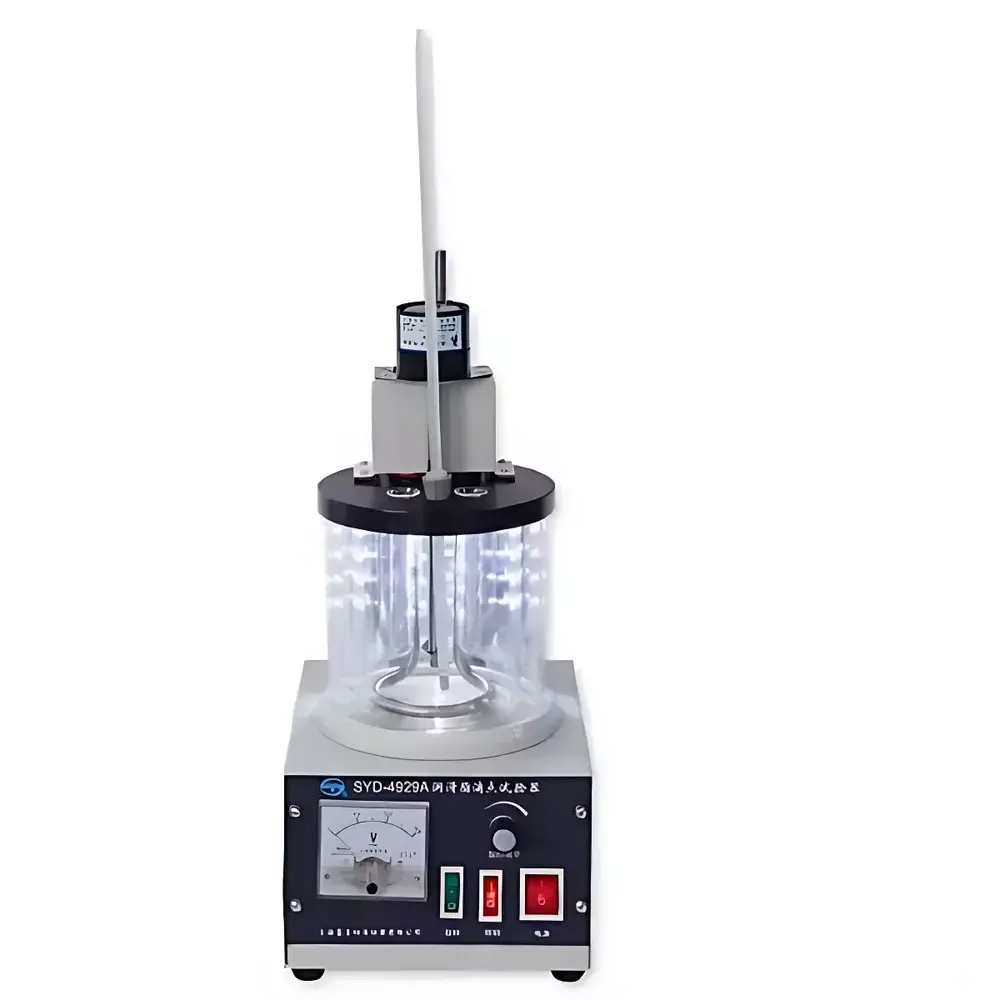
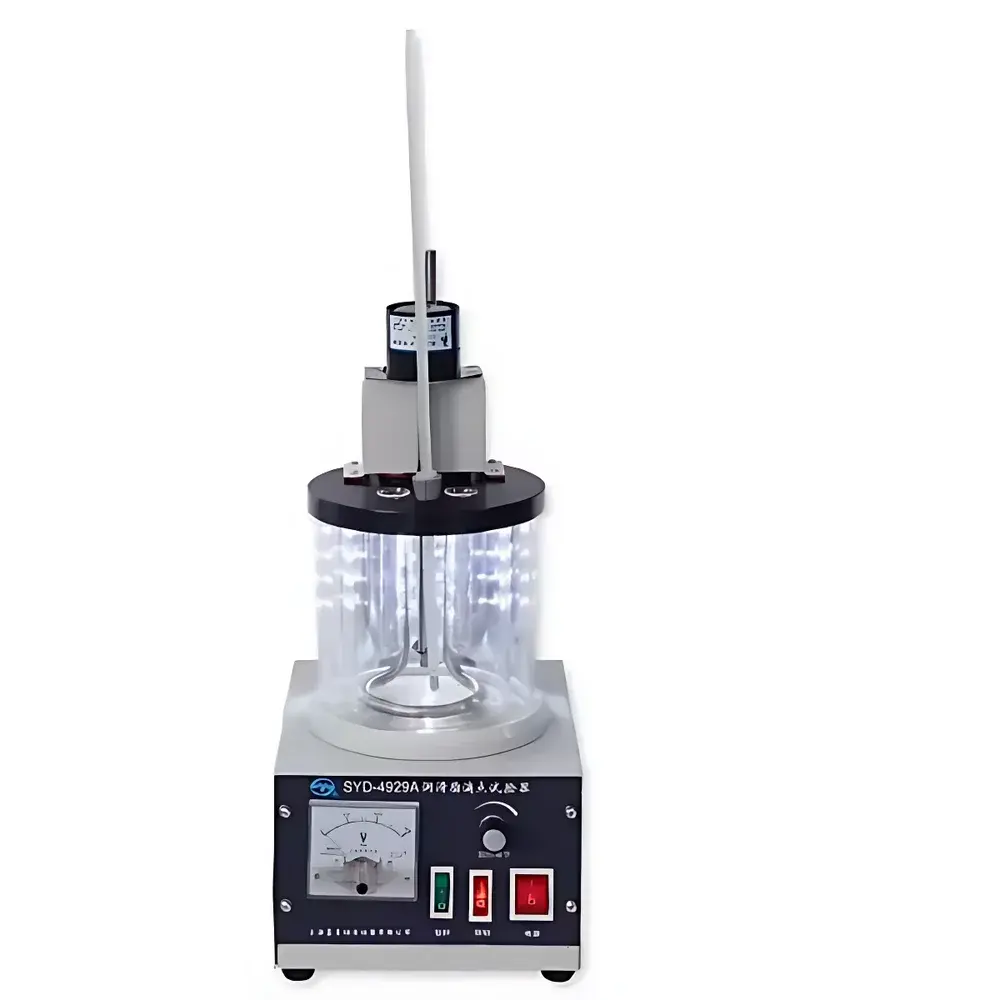
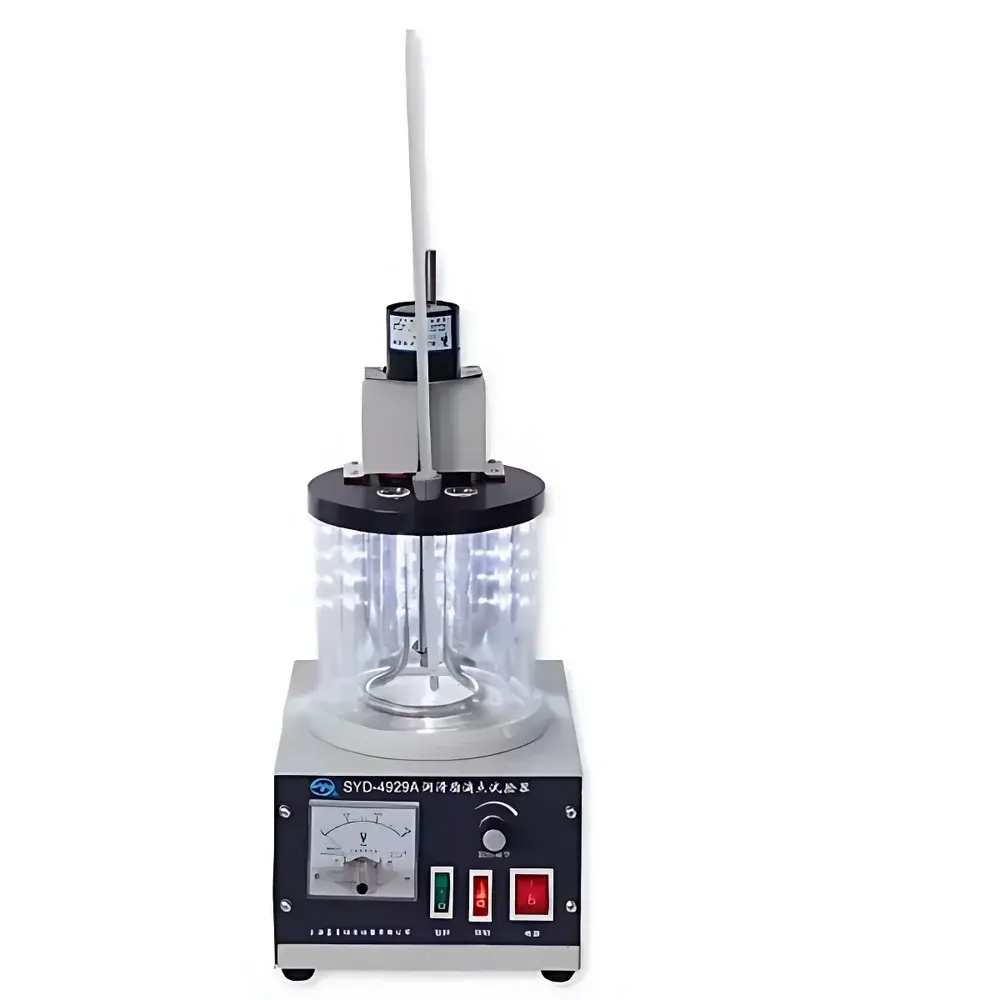
Changji Instruments SYD-4929A Lubricating Grease Dropping Point Tester
| Brand | Changji Instruments |
|---|---|
| Origin | Shanghai, China |
| Model | SYD-4929A |
| Power Supply | AC 220 V ±10%, 50 Hz |
| Oil Bath Capacity | 600 mL beaker |
| Temperature Range | –5 to 300 °C (thermometer, 1 °C graduation, immersion depth 76 mm, total length 390 mm) |
| Stirring Speed | 60 rpm |
| Heater Power | 800 W tubular heater |
| Ambient Operating Conditions | –10 to +40 °C, ≤85% RH |
| Max. Power Consumption | ≤900 W |
| Dimensions (L×W×H) | 350 × 180 × 410 mm |
Overview
The Changji Instruments SYD-4929A Lubricating Grease Dropping Point Tester is a precision benchtop instrument engineered for the standardized determination of the dropping point of lubricating greases in accordance with GB/T 4929—2010, the People’s Republic of China National Standard equivalent to ASTM D566 and ISO 2176. The dropping point is defined as the temperature at which the grease transitions from a semi-solid to a liquid state under specified heating and mechanical conditions — a critical parameter for evaluating thermal stability, consistency classification, and service temperature limits. This instrument implements the classical oil-bath method: a calibrated thermometer is immersed in a thermally uniform oil medium (contained in a 600 mL high-temperature resistant beaker), while a standardized grease sample cup is suspended within the bath. As the bath is heated at a controlled rate, the temperature at which the first drop of grease falls from the cup’s orifice is recorded as the dropping point. The SYD-4929A ensures reproducible thermal gradients and stable agitation via its continuously adjustable 800 W tubular heater and synchronized 60 rpm magnetic stirrer — essential for minimizing convection artifacts and meeting the strict temperature uniformity requirements of GB/T 4929.
Key Features
- Benchtop compact design (350 × 180 × 410 mm) optimized for laboratory space efficiency and ergonomic operation.
- High-temperature oil bath system comprising a 600 mL borosilicate glass beaker, 800 W adjustable tubular heating element, and precision-matched 60 rpm electric stirrer — ensuring uniform thermal distribution and minimal temperature stratification.
- Dedicated thermometer support fixture enabling consistent immersion depth of 76 mm — critical for compliance with GB/T 4929 and ASTM D566 calibration geometry.
- Integrated power regulation circuitry supporting stable operation within ±10% of nominal 220 V AC / 50 Hz supply; total system power draw limited to ≤900 W.
- Robust mechanical architecture with corrosion-resistant housing and thermally insulated base plate — designed for long-term reliability in QC laboratories operating under ambient conditions of –10 to +40 °C and ≤85% relative humidity.
Sample Compatibility & Compliance
The SYD-4929A accommodates standard grease sample cups per GB/T 4929 (identical in geometry to those specified in ASTM D566 and ISO 2176). It is validated for use with lithium, calcium, aluminum, polyurea, and clay-thickened greases across NLGI consistency classes 000 to 3. Instrument operation adheres strictly to the procedural constraints outlined in GB/T 4929—2010, including prescribed heating rate (≤15 °C/min prior to anticipated drop), minimum thermometer calibration traceability (NIST-traceable or national metrology institute certified), and required sample preparation protocols (e.g., homogenization, cup filling height, cooling period before test initiation). While not inherently 21 CFR Part 11 compliant (as it lacks electronic audit trail functionality), the instrument supports GLP-aligned manual data recording when used with bound laboratory notebooks and controlled temperature calibration logs.
Software & Data Management
The SYD-4929A operates as a fully manual, analog-controlled instrument with no embedded microprocessor or digital interface. Temperature measurement relies exclusively on a certified liquid-in-glass thermometer (–5 to 300 °C, 1 °C scale division), requiring operator visual observation and manual recording of the dropping point event. Consequently, data management follows traditional paper-based workflows: users are expected to document test parameters (batch ID, grease type, ambient conditions, observed dropping point, operator name, date/time) in standardized test reports compliant with internal QA procedures. For laboratories implementing LIMS integration, external digital thermometers with RS-232/USB output may be mounted adjacent to the bath — though such configurations fall outside the instrument’s certified operational scope and require independent validation per ISO/IEC 17025.
Applications
- Quality control of incoming raw materials and finished lubricating greases in manufacturing facilities.
- Batch release testing per enterprise specifications aligned with GB/T 4929, ASTM D566, or ISO 2176.
- Thermal stability screening during grease formulation development and comparative benchmarking.
- Technical support and failure analysis in tribology laboratories investigating grease degradation mechanisms.
- Educational demonstrations of rheological transition behavior in polymer-thickened colloidal systems.
FAQ
Is the SYD-4929A compatible with ASTM D566 or ISO 2176 test methods?
Yes — the physical configuration, bath geometry, thermometer specifications, and operational protocol align with the core requirements of both ASTM D566 and ISO 2176, provided users follow the respective standard’s procedural details (e.g., heating rate ramp, sample cup conditioning).
Does the instrument include a calibrated thermometer?
No — the SYD-4929A requires user-supplied, independently calibrated thermometers meeting GB/T 4929’s dimensional and accuracy criteria (–5 to 300 °C, 1 °C graduation, 76 mm immersion depth). Calibration certificates must be maintained per ISO/IEC 17025.
Can the heating rate be programmed or digitally controlled?
No — heating power is manually adjusted via a rotary potentiometer; rate control depends on operator monitoring and incremental adjustment to maintain ≤15 °C/min near the expected drop point.
What safety certifications does the instrument carry?
The SYD-4929A conforms to GB 4793.1 (equivalent to IEC 61010-1) for electrical safety in laboratory equipment; CE marking is not applicable as it is manufactured for domestic Chinese market use.
Is replacement parts support available internationally?
Changji Instruments provides spare parts (e.g., beakers, stirrer paddles, heater assemblies) through authorized regional distributors; lead times and documentation vary by jurisdiction and require direct coordination with local technical sales representatives.




