
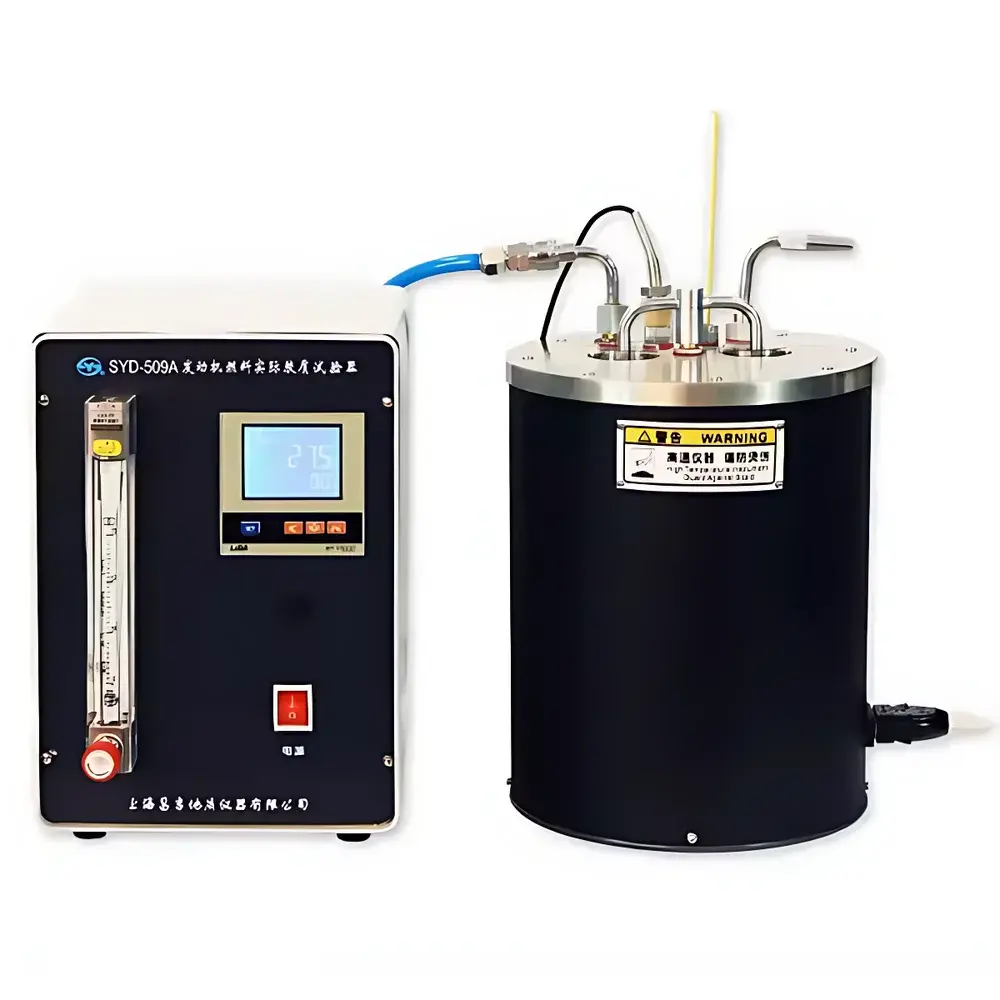
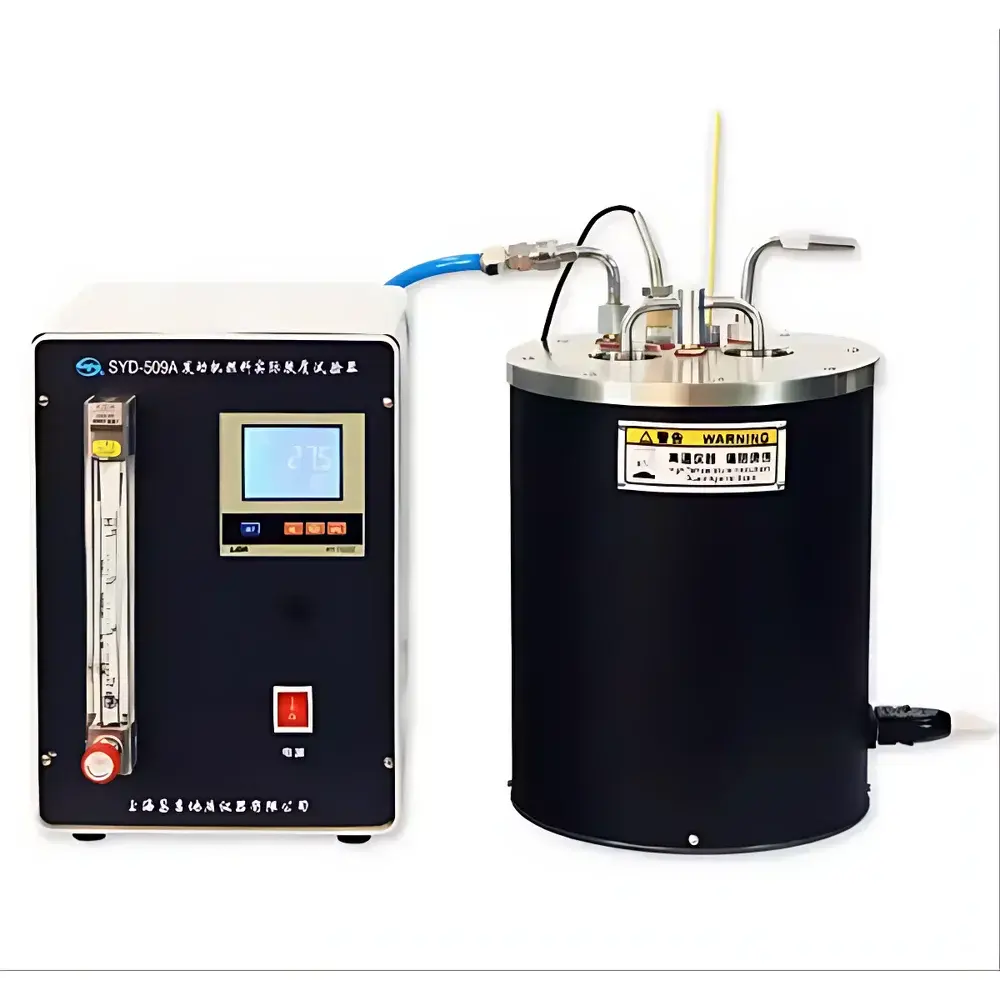
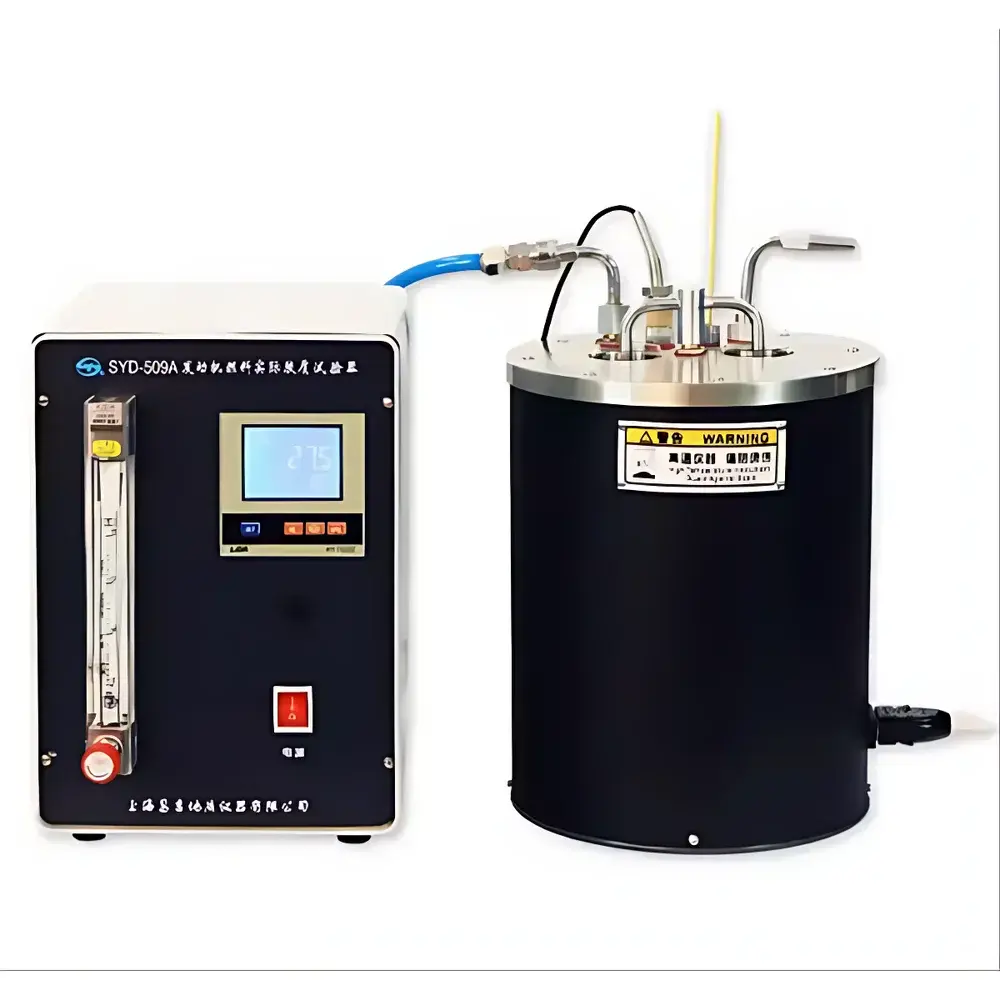
Changji Instruments SYD-509A Engine Fuel Actual Gum Tester
| Brand | Changji Instruments |
|---|---|
| Origin | Shanghai, China |
| Model | SYD-509A |
| Power Supply | AC 220 V ±10%, 50 Hz |
| Heating Power | 1000 W |
| Oil Bath Dimensions | Φ195 mm × 255 mm |
| Oil Capacity | 5000 mL ±50 mL |
| Temperature Control Range | Ambient to 250 °C |
| Temperature Accuracy | ±3 °C at 150 °C and 180 °C |
| Operating Ambient | ≤35 °C, RH ≤85% |
| Overall Power Consumption | ≤1200 W |
| Control Box Dimensions | 280 × 260 × 380 mm (L×W×H) |
| Oil Bath Dimensions | Φ250 × 450 mm (D×H) |
Overview
The Changji Instruments SYD-509A Engine Fuel Actual Gum Tester is a precision laboratory instrument engineered for the quantitative determination of actual gum content in liquid hydrocarbon fuels—specifically gasoline, kerosene, and diesel—according to the standardized thermal evaporation method specified in GB/T 509, the People’s Republic of China National Standard. This test method simulates the oxidative deposition behavior of volatile fuel fractions under controlled high-temperature, low-airflow conditions, thereby evaluating the inherent tendency of fuels to form insoluble, sticky residues (gum) during storage or engine intake system operation. The SYD-509A implements a gravimetric principle: a measured volume of fuel is evaporated under precisely regulated oil-bath heating and controlled airflow, after which the non-volatile residue is weighed to calculate gum content in mg/100 mL. Its design adheres to the fundamental thermodynamic and mass-transfer requirements of ASTM D381 (Standard Test Method for Gum Content in Fuels by Jet Evaporation), enabling cross-compatibility with international quality assurance workflows in refinery laboratories, fuel testing centers, and regulatory compliance departments.
Key Features
- Modular architecture with physically separated oil bath and control cabinet—enhancing thermal stability, operator safety, and long-term serviceability.
- Stainless-steel double-walled cylindrical oil bath (Φ195 mm × 255 mm internal; Φ250 mm × 450 mm external) with integrated 1000 W immersion heater, ensuring uniform thermal distribution and corrosion resistance.
- Precise dual-mode temperature regulation: digitally stabilized setpoints at 150 °C ±3 °C, 180 °C ±3 °C, and 250 °C ±5 °C—covering all GB/T 509 test conditions for gasoline (160–165 °C), aviation turbine fuel (250 °C), and diesel (150 °C).
- Independent airflow control circuit compatible with standard compressed air or nitrogen supply (0–10 L/min range, calibrated via rotameter), meeting GB/T 509’s requirement for consistent purge gas velocity across sample holders.
- Compact footprint (control box: 280 × 260 × 380 mm; oil bath: Φ250 × 450 mm) optimized for benchtop deployment in ISO/IEC 17025-accredited laboratories with space constraints.
- Robust electrical design compliant with IEC 61010-1 safety standards: overtemperature cutoff, grounded chassis, and surge-protected AC input (220 V ±10%, 50 Hz).
Sample Compatibility & Compliance
The SYD-509A is validated for use with transparent, homogenous liquid fuels meeting ASTM D4057 sampling protocols—including unleaded gasoline (GB 17930), jet fuel (GB 6537), and automotive diesel (GB 19147). Each test requires 50 mL of representative, filtered fuel introduced into standardized aluminum or glass evaporation dishes. The instrument supports full traceability per GLP and GMP environments when operated with documented calibration records, certified reference materials (e.g., NIST SRM 2720), and logbook-based procedural adherence. While GB/T 509 is the primary reference, test results demonstrate strong correlation with ASTM D381 and IP 131 methodologies, facilitating data acceptance in multinational fuel certification schemes. No modifications are required to meet ISO/IEC 17025 clause 6.4 (equipment verification) when accompanied by annual third-party temperature uniformity mapping and flow rate validation.
Software & Data Management
The SYD-509A operates as a standalone analog-digital hybrid system without embedded firmware or proprietary software. Temperature setpoints and airflow rates are adjusted manually via front-panel potentiometers and calibrated rotameters, ensuring operational transparency and eliminating cybersecurity or software obsolescence risks. All measurement data—including initial mass, final residue mass, ambient temperature/humidity logs, and operator ID—are recorded manually in laboratory notebooks or LIMS-integrated spreadsheets. For digital audit readiness, users may integrate optional external USB data loggers (e.g., Omega OM-DAQPRO-5300) to capture real-time bath temperature profiles synchronized with test timestamps—fully supporting FDA 21 CFR Part 11 requirements when paired with electronic signature workflows and secure data archiving.
Applications
- Refinery QC labs: Routine monitoring of finished gasoline batches for gum-forming precursors (e.g., dienes, carbonyls) pre-shipping.
- Fuel distributor QA: Verification of storage stability and additive package efficacy over extended inventory cycles.
- Engine development facilities: Correlation of gum deposition rates with intake valve coking in single-cylinder research engines.
- Regulatory testing bodies: Execution of GB/T 509-compliant reports for national fuel quality surveillance programs.
- Academic research: Investigation of oxidation kinetics in alternative fuels (e.g., bio-blends, synthetic paraffinic kerosene) under accelerated thermal stress.
FAQ
What standards does the SYD-509A comply with?
It is designed and verified for strict conformance with GB/T 509; its operational parameters also align with ASTM D381 and IP 131 test conditions.
Is the oil bath filled with a specific heat-transfer fluid?
Yes—users must employ thermally stable, oxidation-resistant silicone oil (e.g., Dow Corning 200 Fluid, viscosity grade 50 cSt) rated for continuous operation up to 250 °C.
Can the instrument be used for biodiesel or ethanol blends?
Only if the blend exhibits full miscibility and thermal stability under test conditions; phase separation or premature volatilization invalidates results per GB/T 509 Section 5.2.
How often does the temperature sensor require calibration?
Per ISO/IEC 17025, annual calibration against a NIST-traceable reference thermometer (±0.2 °C accuracy) is recommended, with interim checks before each daily test series.
What maintenance is required for long-term reliability?
Monthly cleaning of the oil bath interior with lint-free cloths, quarterly inspection of heater insulation resistance (>1 MΩ), and biannual replacement of airflow rotameter seals.





