
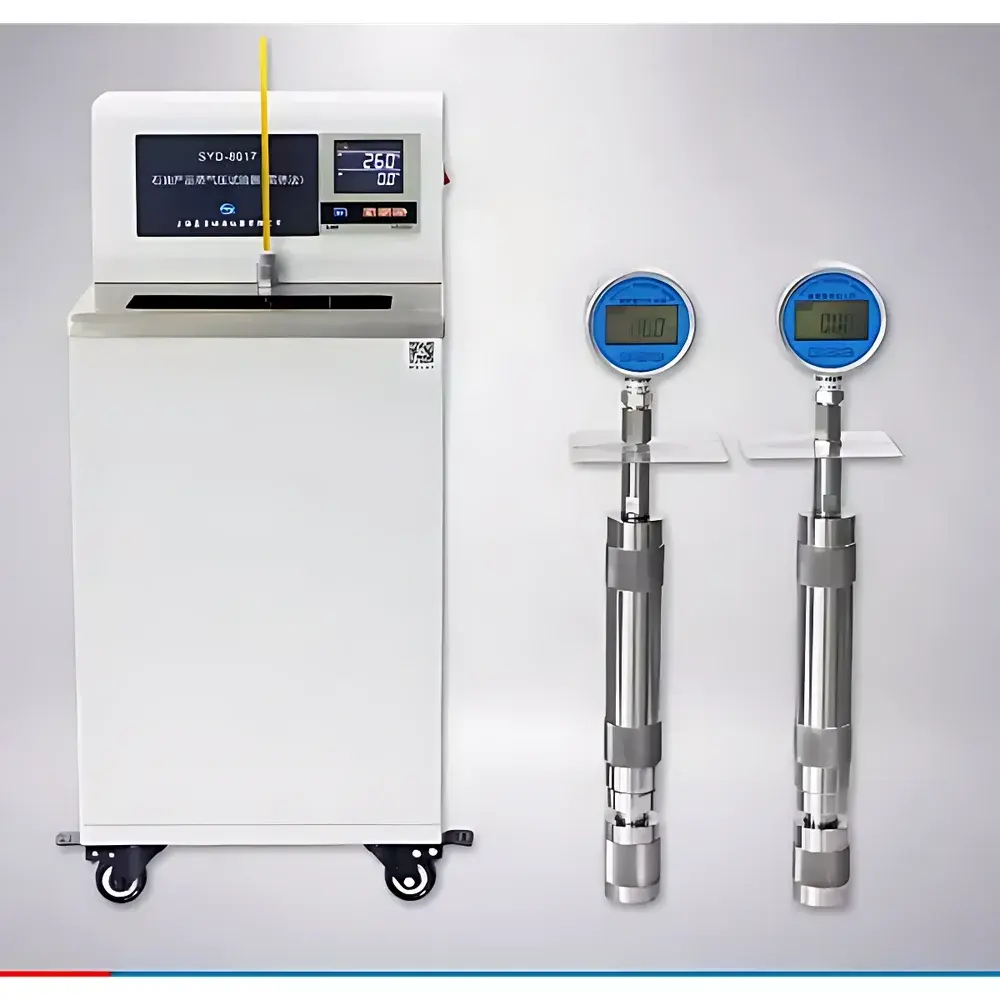
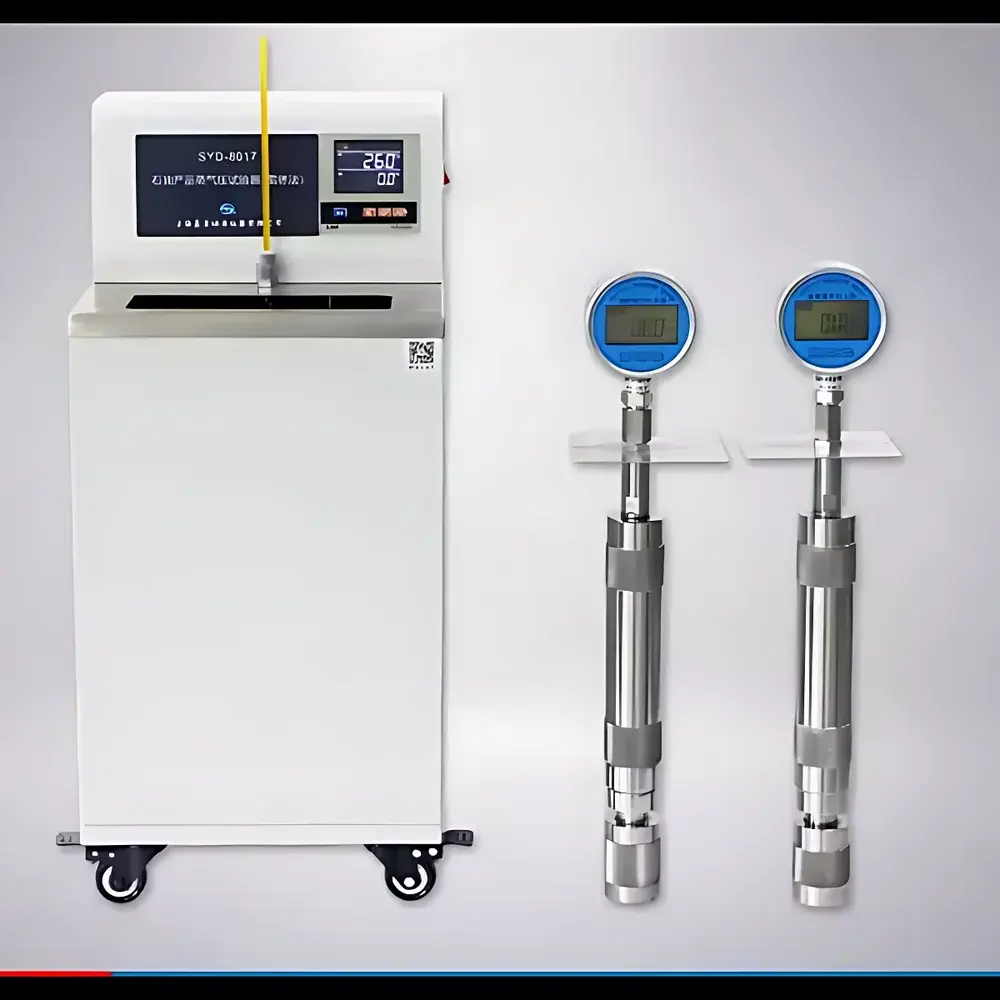
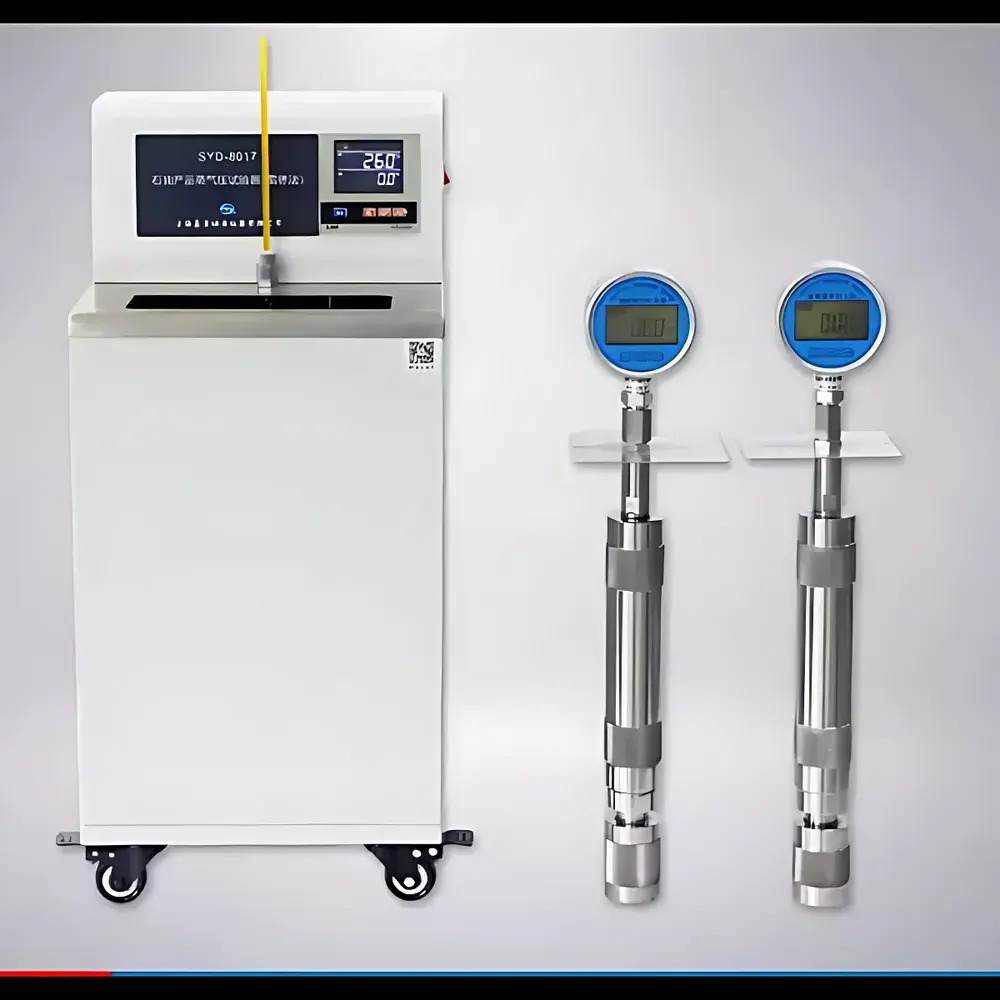
Changji Instruments SYD-8017 Reid Vapor Pressure Tester
| Brand | Changji Instruments |
|---|---|
| Origin | Shanghai, China |
| Model | SYD-8017 |
| Power Supply | AC (220 ± 10%) V, 50 Hz |
| Water Bath Temperature Range | Ambient to 90 °C |
| Temperature Control Accuracy | ±0.1 °C |
| Pressure Gauge Accuracy | ±0.4 % |
| Dual-Port Test Configuration | Yes |
| Conformance | GB/T 8017 (Reid Vapor Pressure Method) |
Overview
The Changji Instruments SYD-8017 Reid Vapor Pressure Tester is a precision laboratory instrument engineered for the quantitative determination of Reid Vapor Pressure (RVP) of volatile petroleum products—including gasoline, light crude oil, naphthas, and other hydrocarbon blends—according to the standardized methodology defined in GB/T 8017, the Chinese national implementation of the ASTM D323–22 standard. The instrument operates on the fundamental principle of measuring the absolute vapor pressure exerted by a liquid sample at 37.8 °C (100 °F) in a sealed, calibrated vapor-pressure chamber (the “Reid bomb”) after thermal equilibration under controlled atmospheric conditions. This thermodynamic measurement serves as a critical quality control parameter in refining, blending, transportation, and regulatory compliance workflows—directly influencing volatility classification, evaporative emissions estimation, and summer/winter fuel formulation.
Key Features
- Floor-standing robust architecture with stainless-steel work surface for corrosion resistance, mechanical stability, and long-term operational integrity in QC laboratories.
- Digital PID temperature control system ensuring uniform water bath heating across the full operating range (ambient to 90 °C), with high-resolution thermal regulation maintained at ±0.1 °C—meeting stringent repeatability requirements of GB/T 8017 Section 6.2.
- Two high-accuracy analog pressure gauges (±0.4 % full-scale accuracy) mounted for direct visual monitoring of vapor pressure development inside each test chamber.
- Dual independent test ports accommodating two standard single-port Reid vapor-pressure bombs (ASTM D323-compliant dimensions), enabling parallel sample analysis and improved throughput without cross-contamination risk.
- Integrated safety design including pressure-relief mechanisms, thermal cutoffs, and insulated bath enclosure to comply with ISO/IEC 17025 laboratory safety prerequisites and internal GLP operating procedures.
Sample Compatibility & Compliance
The SYD-8017 is validated for use with liquid hydrocarbon samples exhibiting initial boiling points below 120 °C and vapor pressures ranging from 30 kPa to 160 kPa (4.4 to 23.2 psi)—covering typical RVP specifications for motor gasoline (ASTM D439), aviation gasoline (ASTM D910), and reformulated blendstocks. Instrument operation adheres strictly to the procedural sequence outlined in GB/T 8017, including sample chilling to 0–1 °C prior to transfer, precise 1:4 liquid-to-vapor volume ratio maintenance, and mandatory 5–7 minute agitation period before final pressure reading. All hardware components—including bomb bodies, valve assemblies, and pressure gauge housings—are constructed from non-reactive, low-outgassing materials compatible with aggressive hydrocarbon vapors. Documentation supports traceability to national metrological standards via factory calibration certificates (NIST-traceable reference gauges available upon request).
Software & Data Management
While the base SYD-8017 model operates in manual mode with analog readouts, it is fully compatible with external digital data logging systems via optional 4–20 mA or RS-485 interfaces (available as OEM add-ons). For laboratories requiring audit-ready records, Changji offers the SYD-8017A variant—an integrated version featuring an embedded industrial PC and color touchscreen HMI. This configuration provides automated test sequencing, real-time pressure/time curve visualization, electronic signature support, and export functionality compliant with 21 CFR Part 11 requirements when deployed with validated software modules. All generated reports include timestamped metadata, operator ID, ambient barometric correction values, and raw pressure readings—facilitating seamless integration into LIMS environments.
Applications
- Quality assurance testing in petroleum refineries and terminal laboratories for batch release verification against RVP limits specified in GB 17930, EN 228, or ASTM D4814.
- Research and development of low-RVP reformulated fuels targeting reduced evaporative VOC emissions under EPA Tier 3 or EU Stage V regulatory frameworks.
- Contract testing laboratories performing third-party certification per CNAS-CL01:2018 (equivalent to ISO/IEC 17025:2017) accreditation scopes.
- Educational institutions conducting physical chemistry or fuel science laboratories focused on vapor–liquid equilibrium behavior of hydrocarbon mixtures.
- Regulatory inspection agencies verifying compliance with national fuel specifications during market surveillance programs.
FAQ
What standards does the SYD-8017 conform to?
It is designed and verified to meet the technical requirements of GB/T 8017—China’s national standard for Reid Vapor Pressure testing—and is functionally equivalent to ASTM D323 and IP 123 for international method alignment.
Is the instrument suitable for testing ethanol-blended gasoline (E10, E15)?
Yes, provided sample handling follows Annex B of GB/T 8017 for oxygenated fuels, including strict temperature control during transfer and avoidance of phase separation prior to testing.
Can the water bath be cooled below ambient temperature?
No—the standard SYD-8017 supports heating only. For sub-ambient conditioning, the SYD-8017L variant integrates a dual-mode (heating + refrigeration) circulation system capable of maintaining bath temperatures from 0 °C to 90 °C.
How often should pressure gauges be recalibrated?
Per ISO/IEC 17025 Clause 6.5, annual calibration against NIST-traceable deadweight testers is recommended; field verification using certified reference pressure sources should occur before each daily testing session.
Does the instrument require special ventilation or fume hood installation?
While not mandatory for routine operation, placement within a certified chemical fume hood is strongly advised when testing highly volatile or toxic samples—consistent with OSHA 1910.1200 and local laboratory safety protocols.






