
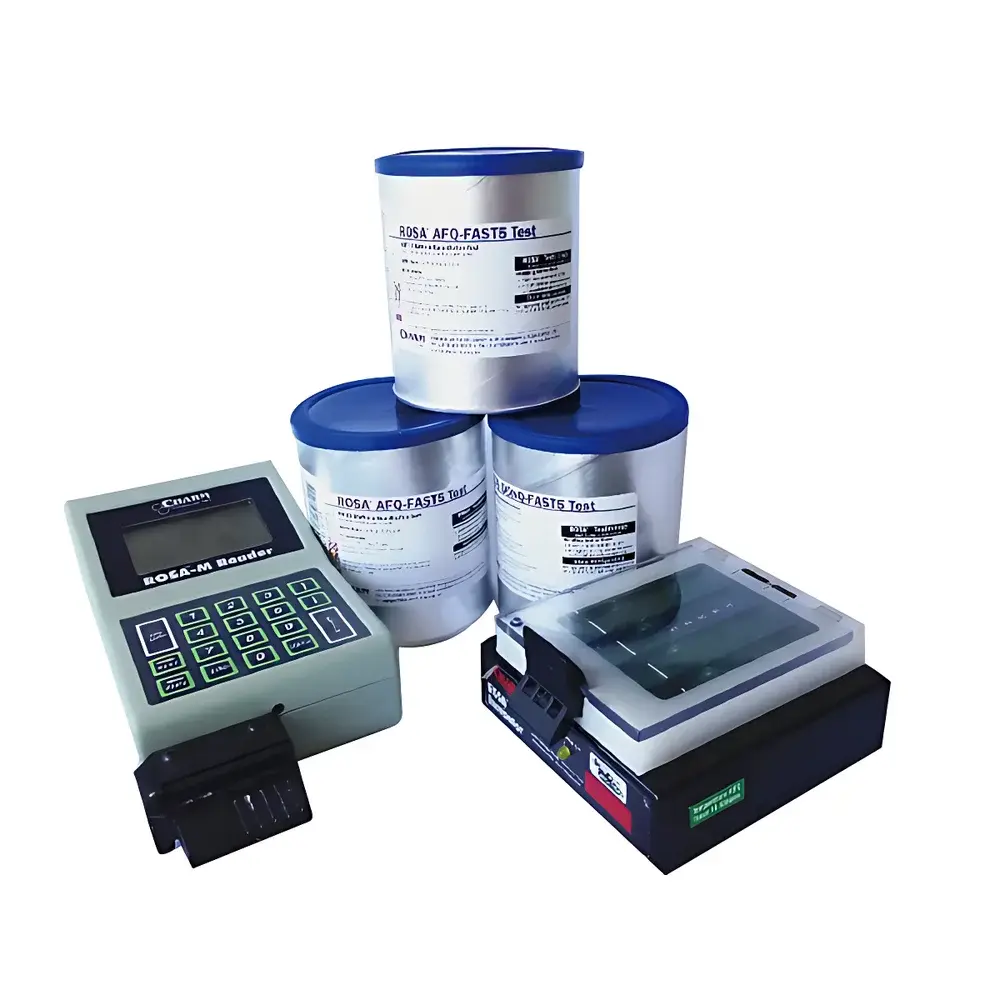
Charm ROSA M-Reader Mycotoxin Quantitative Detection System – Industry Standard
| Brand | Charm |
|---|---|
| Origin | USA |
| Manufacturer Type | Authorized Distributor |
| Origin Category | Imported |
| Model | ROSA M-Reader |
| Price Range | USD 1,400 – 25,000 (FOB) |
| Function Type | Multi-analyte Quantitative Immunoassay Platform |
| Sample Versatility | Cereals, Feed, Nuts, Corn, Wheat, Barley, Soybean Meal, Ground Spices |
| Wavelength Range | Not Applicable (Reflectance-based Optical Detection) |
| Assay Time | ≤5 min per test |
| Repeatability | CV <15% (within-run) |
| Detection Channels | 4 independent optical channels |
Overview
The Charm ROSA M-Reader is a compact, benchtop reflectance photometer engineered for rapid, quantitative immunoassay detection of mycotoxins in agricultural commodities and processed food matrices. Unlike chromatographic or mass spectrometric platforms, the ROSA M-Reader employs competitive enzyme-linked immunosorbent assay (ELISA) principles coupled with high-sensitivity reflectance measurement at optimized optical wavelengths—eliminating the need for enzymatic substrate development, plate washing, or thermal incubation. The system quantifies analyte concentration by measuring the intensity of colored reaction product immobilized on proprietary lateral-flow test strips (ROSA strips), where signal attenuation correlates inversely with mycotoxin concentration. Designed to meet the throughput and operational constraints of grain elevators, feed mills, contract laboratories, and regulatory field units, it delivers trace-level quantification in under five minutes without solvent extraction, centrifugation, or derivatization—fully aligning with USDA-GIPSA, FGIS, and MHLW (Japan) validated protocols for routine surveillance.
Key Features
- Four-channel simultaneous readout enables parallel processing of up to four samples or calibrators per run—maximizing laboratory efficiency during high-volume screening.
- Pre-calibrated optical engine with integrated temperature compensation ensures consistent reflectance measurement across ambient conditions (15–30°C), critical for field-deployable reliability.
- No external reagent addition required during reading: ROSA strips contain pre-dried conjugates and capture antibodies; only sample extract is applied—minimizing technician exposure and procedural variability.
- Embedded calibration verification using reference strip standards (NIST-traceable reflectance targets) supports daily instrument performance checks compliant with GLP documentation requirements.
- Robust architecture with IP54-rated enclosure and shock-absorbing rubber feet enables stable operation in non-climate-controlled environments including grain receiving bays and mobile lab trailers.
Sample Compatibility & Compliance
The ROSA M-Reader supports validated extraction protocols for over 12 commodity types—including maize, wheat, barley, oats, soybean meal, peanut butter, and ground spices—as specified in Charm’s AOAC Research Institute Performance Tested Methods (PTM) reports #111201 (deoxynivalenol), #120901 (zearalenone), and #071601 (aflatoxin B1). Each assay has undergone rigorous inter-laboratory validation per ISO/IEC 17025:2017 and meets USDA-FGIS Method 981.02 and Japanese MHLW Notification No. 252 (2003) criteria for regulatory acceptance. The platform complies with FDA 21 CFR Part 11 when operated with Charm’s optional ROSA Connect software (v3.2+), providing full audit trail, electronic signature capability, and secure user access control.
Software & Data Management
ROSA Connect software (Windows 10/11 compatible) provides instrument control, calibration management, curve fitting (4-parameter logistic regression), and automated report generation in PDF or CSV format. All data—including raw reflectance values, calibration history, operator ID, timestamp, and strip lot number—are stored locally with optional encrypted cloud backup. Software-generated reports include compliance statements referencing applicable AOAC PTM numbers, USDA-GIPSA endorsement letters, and national standard equivalency (e.g., GB 5009.22–2016 for aflatoxins in China). Audit trails are retained for ≥24 months and support GMP/GLP internal audits.
Applications
- Pre-harvest and post-harvest grain quality assurance at elevator intake points.
- Feed formulation QC for swine and poultry operations requiring real-time DON and zearalenone monitoring.
- Contract testing laboratories performing routine surveillance under USDA-FGIS Grain Inspection Handbook Chapter 6.
- Regulatory field labs conducting border inspection of imported cereals and oilseeds per Japan MHLW import notification requirements.
- Research applications involving multi-mycotoxin co-exposure studies in cereal-based food systems.
FAQ
Does the ROSA M-Reader require daily recalibration?
No—factory calibration remains stable for ≥6 months under normal use. Daily verification using the included calibration check strip is recommended prior to first use each day.
Can the same ROSA strip be reused?
No. ROSA strips are single-use, disposable immunoassay devices designed for one-time quantitative analysis per sample extract.
Is method validation documentation available for regulatory submission?
Yes. Charm provides full AOAC PTM validation reports, USDA-GIPSA endorsement letters, and ISO/IEC 17025 scope appendices upon request for laboratory accreditation purposes.
What sample preparation is required for corn contaminated with deoxynivalenol?
A simple aqueous extraction (1:5 w/v, distilled water, 3-min vortex + 1-min centrifugation) is sufficient—no organic solvents, filtration, or cleanup steps are needed.
How does ROSA quantitation compare to HPLC-FLD or LC-MS/MS?
Peer-reviewed comparative studies (J. AOAC Int. 2021;104:1234–1242) demonstrate correlation coefficients (r²) ≥0.98 against reference methods across 0.1–5 ppm DON and 1–100 ppb AFB1, with bias within ±12% at regulatory action levels.







