
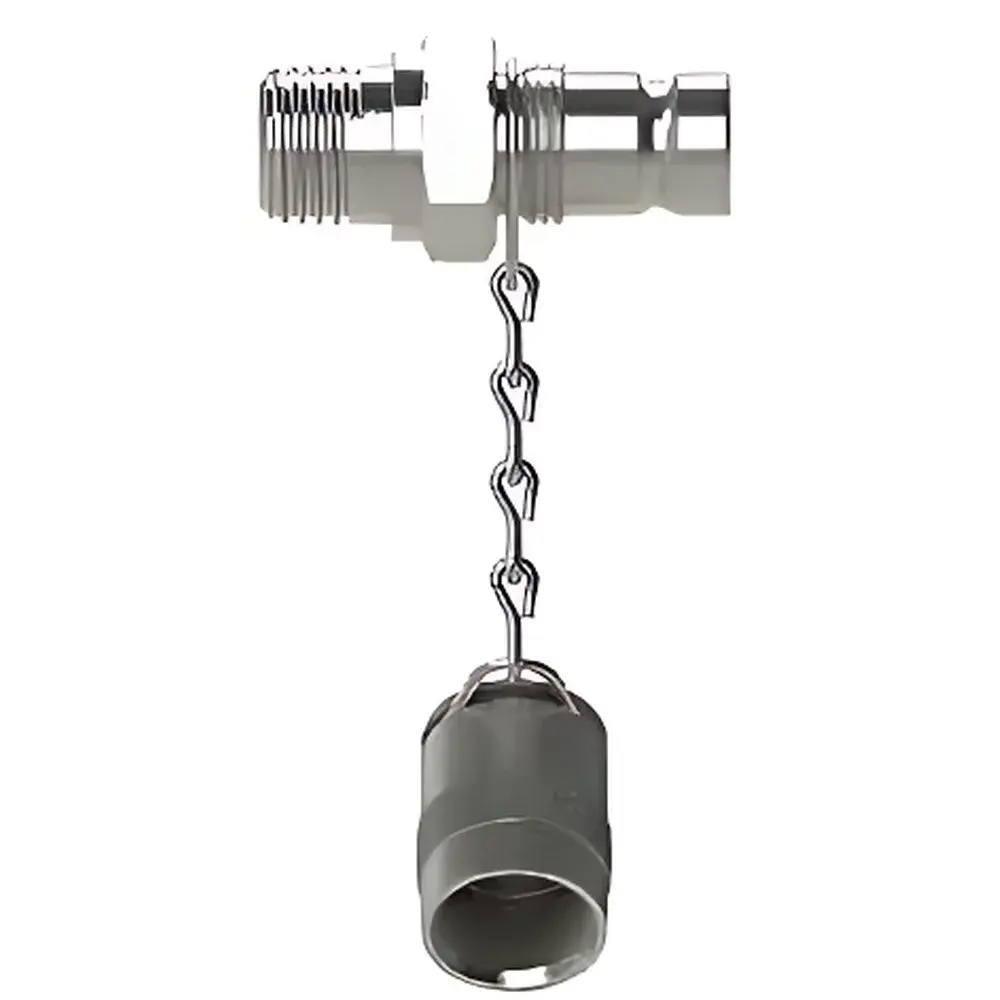
Checkfluid KST Series Petroleum Product Sampling Device
| Brand | Checkfluid |
|---|---|
| Origin | USA |
| Manufacturer Type | Authorized Distributor |
| Origin Category | Imported |
| Model | KST |
| Pricing | Upon Request |
| Valve Type | Industrial-standard 2 mm probe-style valve |
| Thread Options | Multiple NPT/BSP thread configurations available |
| Installation | Direct-mount, no adapter required |
| Nozzle Cap | Knurled anti-slip design |
| Surface Coating | Zinc-nickel plating (5–7× corrosion resistance vs. standard zinc) |
| Sample Contamination Risk | Minimal carryover volume |
| Sealing Mechanism | Patented elastomeric vacuum seal with automatic shut-off |
| Maximum Operating Pressure | 27.6 MPa (4000 psi) |
| Probe Compatibility | Requires compatible sampling probe (sold separately) |
Overview
The Checkfluid KST Series Petroleum Product Sampling Device is an engineered solution for high-integrity, in-line or offline sampling of liquid hydrocarbons under demanding process conditions. Designed specifically for petroleum refining, pipeline transfer, storage terminal operations, and marine bunkering applications, the KST operates on a probe-actuated, spring-loaded vacuum-seal principle—ensuring contamination-free, representative sample acquisition without process interruption. Its core mechanism relies on dynamic pressure-balanced valve actuation: when the compatible sampling probe is inserted into the KST’s 2 mm probe port, the internal elastomeric seal retracts under controlled force, allowing fluid to flow through the valve body while maintaining full system integrity. Upon probe withdrawal, the patented seal automatically re-engages, terminating flow and isolating the sample path. This design eliminates dead-leg volumes and minimizes residual carryover—critical for compositional accuracy in ASTM D4057, ISO 3170, and API RP 2552-compliant sampling protocols.
Key Features
- Probe-activated 2 mm industrial-standard valve with zero-leakage elastomeric vacuum seal
- Direct-mount configuration supporting multiple thread standards (NPT, BSP, metric) — no adapters or alignment hardware required
- Zinc-nickel electroplated housing delivering 5–7× enhanced corrosion resistance versus conventional zinc coatings per ASTM B633 SC4
- Knurled nozzle protection cap providing tactile grip and mechanical safeguard against accidental impact or misalignment
- Full-pressure operation up to 27.6 MPa (4000 psi), validated per ASME B16.34 Class 2500 rating requirements
- Low-volume internal cavity (< 0.8 mL) minimizing sample waste and cross-contamination between sequential draws
- Automatic shut-off functionality ensuring fail-safe isolation during probe disengagement
Sample Compatibility & Compliance
The KST Series is certified for use with refined petroleum products including gasoline, diesel, jet fuel (Jet A/A-1), naphtha, base oils, and light crudes. It is not intended for hydrogen sulfide–rich sour streams (>50 ppm H₂S) or highly viscous bitumen without pre-heating. All wetted materials comply with NACE MR0175/ISO 15156 for sour service environments where applicable. The device meets mechanical interface requirements of API RP 2552 (Petroleum and Liquid Petrochemicals – Manual Sampling) and supports traceable sampling workflows aligned with ISO/IEC 17025-accredited laboratories. Documentation includes material test reports (MTRs), pressure test certificates (hydrostatic at 1.5× MAWP), and RoHS/REACH declarations.
Software & Data Management
As a purely mechanical, non-electronic sampling interface, the KST requires no firmware, drivers, or software integration. However, it is fully compatible with digital sampling log systems used in modern terminals—including those compliant with FDA 21 CFR Part 11 for electronic record retention. When paired with barcode-scanned probe identifiers and time-stamped handheld logging devices, the KST enables auditable chain-of-custody documentation. Its repeatable mechanical behavior supports GLP/GMP-aligned SOPs where operator action, probe insertion depth, and pressure verification are recorded as critical control points.
Applications
- In-line quality verification during refinery product blending and tank farm loading
- Marine fuel sampling prior to bunker delivery per ISO 8217 and MARPOL Annex VI requirements
- Periodic custody transfer sampling at pipeline receipt/delivery points (API MPMS Ch. 8.2)
- Storage tank stratification assessment using multi-level probe deployment
- Emergency leak investigation sampling from pressurized manifolds or flare headers
- Calibration reference sampling for online analyzers (e.g., NIR, GC, density meters)
FAQ
Is the KST suitable for sampling from high-velocity flow lines?
Yes—the valve’s low-inertia actuation and pressure-balanced geometry minimize turbulence-induced cavitation and ensure stable flow initiation even at Reynolds numbers exceeding 10⁵.
Does the KST require periodic recalibration or maintenance?
No calibration is required; however, elastomeric seals should be inspected per manufacturer-recommended intervals (typically every 12 months or after 5,000 cycles) and replaced using genuine Checkfluid spare kits (P/N KST-SEAL-KIT).
Can the KST be installed vertically or horizontally?
It is orientation-agnostic and qualified for both orientations per ASME B16.5 flange mounting guidelines and internal flow symmetry testing.
What probe specifications must be matched for proper KST operation?
Probes must conform to Checkfluid’s KST-Probe Interface Specification: 2.0 ± 0.05 mm diameter, hardened stainless steel (AISI 440C), minimum tip hardness 58 HRC, and conical engagement angle of 30° ± 1°.
Is third-party certification available for hazardous area installation?
The base KST unit carries no intrinsic ignition risk and is suitable for Zone 2/Class I Div 2 environments; ATEX or IECEx certification is available upon request for specific mounting configurations with approved conduit entries.




