
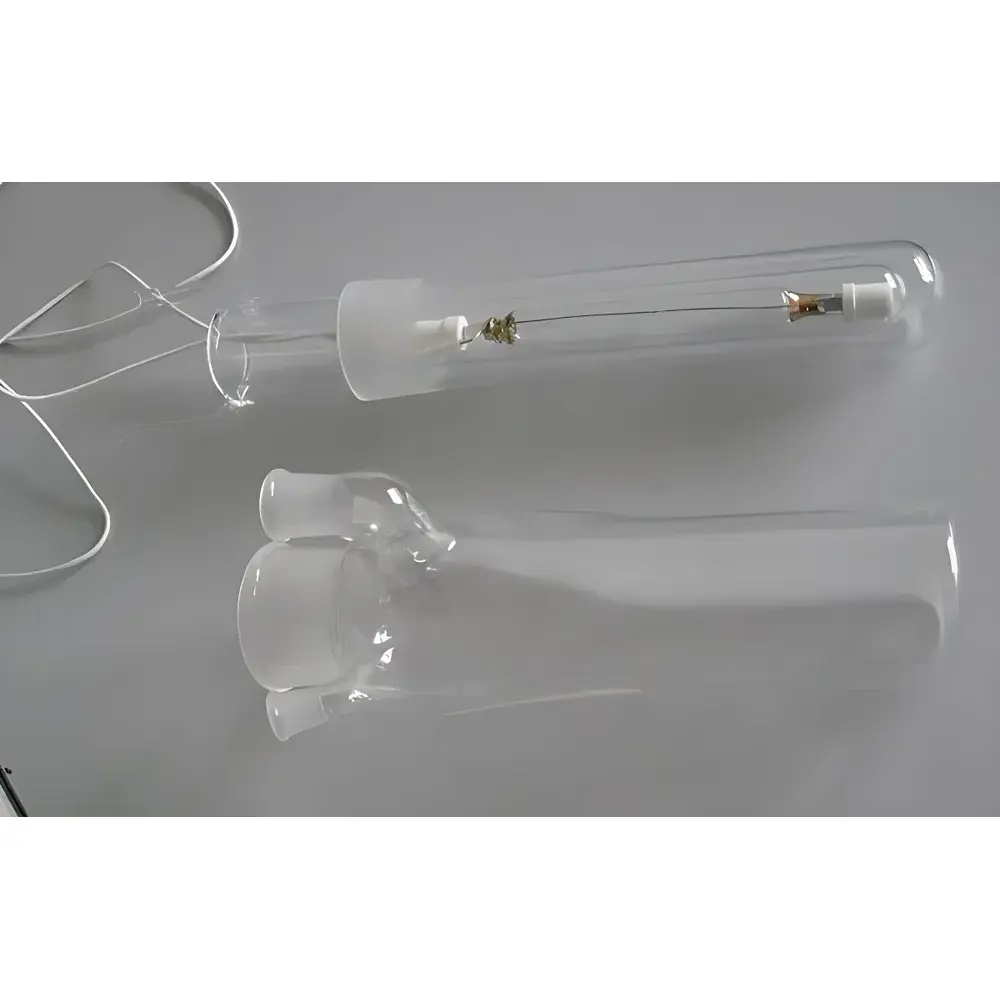
Chemical Reactor System CEQW-22 (Photochemical Reaction Setup)
| Brand | Zhongjiao Jinyuan |
|---|---|
| Origin | Beijing, China |
| Manufacturer Type | Direct Manufacturer |
| Country of Origin | China |
| Model | CEQW-22 |
| Pricing | Upon Request |
| Cold Finger | CEQW-22, 60/40 standard taper, effective length 220 mm, fused quartz |
| Reactor Vessel | CNR-25 or CNR-50, borosilicate glass (PYREX® equivalent), flat-bottom or round-bottom configuration, 250 mL or 500 mL capacity |
| Cooling | Water-jacketed cold finger for lamp thermal management and IR filtration |
| Housing | Light-tight reaction chamber with structural support for integrated photoreactor assembly |
Overview
The CEQW-22 Photochemical Reactor System is a laboratory-scale, modular photoreaction platform engineered for controlled light-driven chemical transformations—particularly photocatalytic degradation, photoisomerization, and photo-redox synthesis. It operates on the principle of incident photon delivery to catalytically active species (e.g., TiO₂, g-C₃N₄, or molecular photosensitizers) suspended or immobilized within a transparent reaction medium. The system integrates two core components: a water-cooled fused quartz cold finger (CEQW-22) and a high-purity borosilicate glass reactor vessel (CNR-25/CNR-50). The cold finger serves dual functions—thermal regulation of high-intensity UV/visible lamps (e.g., 300–1000 W Xe or Hg-Xe arc lamps) and spectral conditioning via infrared (IR) attenuation—thereby minimizing non-photochemical heating artifacts and ensuring photonic energy is delivered predominantly in the actinic range (typically 250–780 nm). The reactor body accommodates either flat-bottom or round-bottom configurations, enabling compatibility with magnetic stirring assemblies and facilitating homogeneous irradiation distribution under laminar or turbulent mixing conditions.
Key Features
- Fused quartz cold finger (CEQW-22) with 60/40 standard taper joint and 220 mm effective cooling length—optimized for high UV transmittance (>90% at 254 nm) and thermal shock resistance
- Borosilicate glass reactor vessels (CNR-25/CNR-50) conforming to ISO 3585 specifications; certified for thermal stability up to 500 °C and chemical resistance against dilute acids, alkalis, and organic solvents
- Modular design supporting interchangeable vessel geometries (flat-bottom for optimized stirrer coupling; round-bottom for uniform light path depth and reflux compatibility)
- Light-tight aluminum alloy housing with interlocked access door—meets IEC 61000-4-3 radiated immunity requirements and provides Class 1 optical containment per ANSI Z136.1 guidelines
- Integrated water inlet/outlet ports with quick-connect fittings (¼” NPT) compatible with standard laboratory chillers (10–25 °C setpoint recommended)
- Standardized ground-glass joints (ISO K 29/32 and K 35/40 interfaces) ensure vacuum-tight and pressure-stable assembly up to 0.5 bar gauge
Sample Compatibility & Compliance
The CEQW-22 system supports heterogeneous photocatalytic suspensions (e.g., nanoparticle dispersions), homogeneous photochemical solutions (e.g., Ru(bpy)₃²⁺ in acetonitrile/water), and gas–liquid phase reactions (e.g., CO₂ photoreduction under 1 atm N₂/CO₂ flow). Vessels are compatible with inert atmosphere purging (N₂, Ar) via septum-sealed side arms or Schlenk-line integration. All glass components comply with ASTM E438 Type I, Class A specifications for laboratory glassware. The system architecture permits validation under GLP environments: documentation packages include material traceability (quartz lot numbers, PYREX® batch certificates), dimensional inspection reports, and calibration records for temperature sensors (Pt100, ±0.15 °C accuracy). Optional accessories—including quartz viewports, gas dosing manifolds, and condenser modules—enable extension toward ISO 10677 (photocatalytic air purification testing) and ISO 22197-1 (NOₓ decomposition evaluation) protocols.
Software & Data Management
While the base CEQW-22 operates as a hardware-only platform, it is fully compatible with third-party process monitoring systems. Digital temperature logging (via PT100 probes embedded in cold finger jacket and reactor wall), irradiance mapping (using calibrated UV-A/UV-B/VIS radiometers positioned at sample plane), and real-time pH/conductivity tracking can be synchronized using LabVIEW™ or Python-based acquisition frameworks. Audit trails generated from such integrations meet FDA 21 CFR Part 11 requirements when deployed with electronic signature modules and role-based user access controls. Raw spectral irradiance data may be processed in accordance with CIE S 026/E:2019 for effective photon flux quantification (Einstein·m⁻²·s⁻¹) across defined wavelength bands.
Applications
- Photocatalytic degradation kinetics of organic pollutants (e.g., methylene blue, phenol, tetracycline) under simulated solar irradiation
- Quantum yield determination for semiconductor photocatalysts using actinometry (e.g., potassium ferrioxalate or Aberchrome 540)
- Photoelectrochemical cell precursor synthesis under controlled O₂-free conditions
- Visible-light-mediated C–C bond formation (e.g., [2+2] cycloadditions, α-alkylations) with stoichiometric or catalytic photosensitizers
- Accelerated photostability testing of pharmaceutical intermediates per ICH Q1B guidance
- Gas-phase photocatalytic oxidation of VOCs (formaldehyde, toluene) for indoor air quality research
FAQ
What lamp types are compatible with the CEQW-22 cold finger?
Standardized for 300–1000 W medium-pressure mercury, xenon, or metal-halide arc lamps with vertical orientation and integrated reflectors. Lamp housing must provide mechanical alignment to maintain <±0.5 mm axial deviation.
Can the system operate under vacuum or elevated pressure?
Yes—when assembled with vacuum-rated ground-glass joints and appropriate sealing grease, the CNR-series vessels support static vacuum down to 10⁻² mbar. Pressure operation is limited to 0.5 bar gauge without additional reinforcement.
Is the quartz cold finger resistant to ozone exposure?
Fused quartz exhibits negligible degradation under ambient ozone concentrations (10 ppm O₃ at elevated temperatures (>80 °C) may induce surface hydroxylation, reducing UV transmission over extended service life.
How is light intensity calibrated across the reactor volume?
Calibration requires spatial mapping using a cosine-corrected radiometer at multiple radial and axial positions; recommended grid resolution is 5 mm × 5 mm in horizontal plane and 10 mm vertical increments.
Does Zhongjiao Jinyuan provide IQ/OQ documentation templates?
Yes—validated installation and operational qualification protocols aligned with ISO/IEC 17025 and ASTM E2500-21 are available upon request for GMP-regulated laboratories.



