
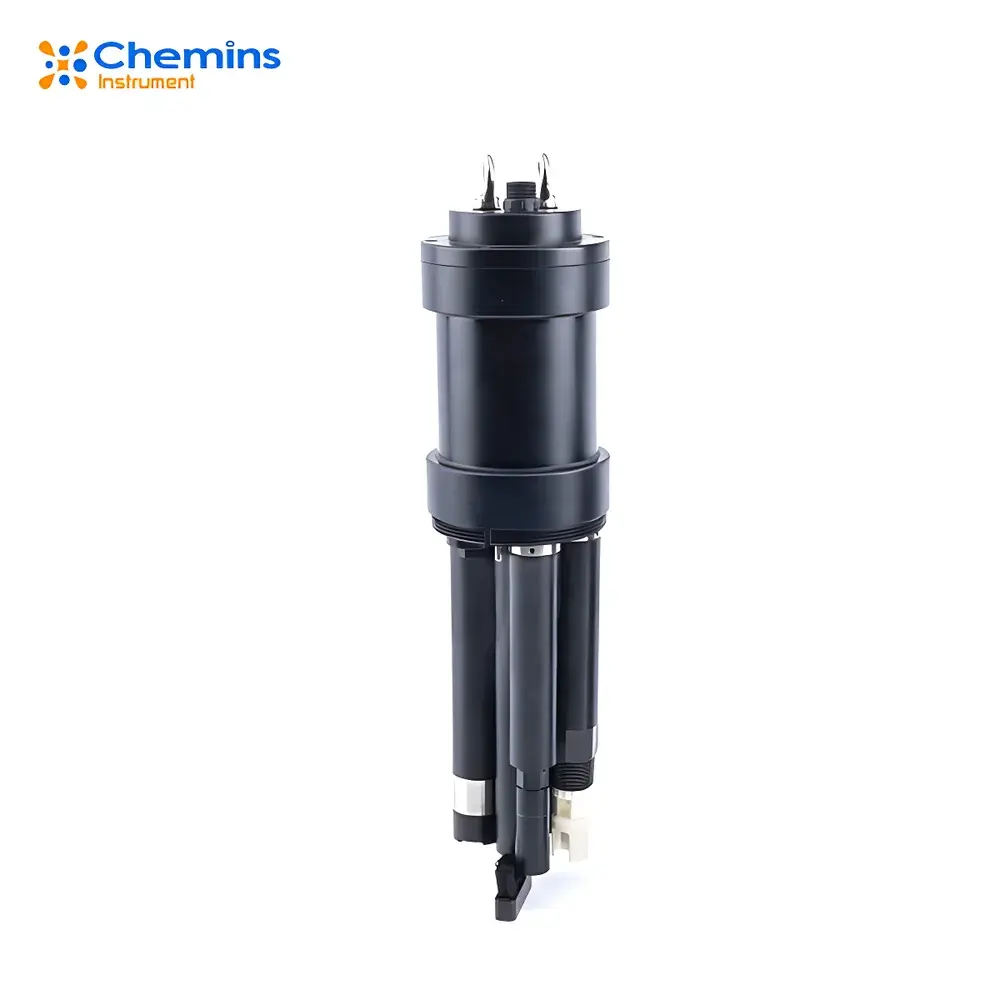
Chemins MPS-400 Online Multi-Parameter Self-Cleaning Water Quality Sensor
| Brand | Chemins |
|---|---|
| Model | MPS-400 |
| Origin | Zhejiang, China |
| Manufacturer | Chemins Instrument Technology Co., Ltd. |
| Sensor Interface | RS-485 (Modbus RTU) |
| Communication Protocol | Modbus RTU |
| Output | Digital (SDI-12 optional) |
| Max Simultaneous Parameters | 8 (including temperature) |
| Cleaning Mechanism | Motorized brush-based auto-clean system with programmable interval (1–1440 min) and rotation count (1–20 cycles) |
| Enclosure Rating | IP68 |
| Connector Type | Waterproof quick-disconnect M12 circular connector |
| Probe Protection | Perforated stainless-steel guard sleeve with ≥2 mm slot width |
| Compatible Sensor Modules | Dissolved Oxygen (optical or electrochemical), COD (UV-Vis absorption), Conductivity/Salinity, Turbidity (90° scattered light), Ammonia-N (ion-selective), pH (glass electrode or ISFET), ORP (Pt/AgCl reference) |
Overview
The Chemins MPS-400 is an industrial-grade, submersible multi-parameter water quality sensor platform engineered for continuous, unattended operation in challenging surface water, wastewater effluent, drinking water distribution, and aquaculture environments. Unlike conventional fixed-sensor arrays, the MPS-400 integrates a programmable mechanical self-cleaning subsystem directly into its probe housing—eliminating manual intervention while preserving measurement integrity over extended deployment cycles. Its core architecture follows the Couette flow principle for turbidity and optical absorption measurements, employs temperature-compensated potentiometric sensing for pH and ORP, utilizes conductivity cell geometry compliant with ASTM D1125 and ISO 7888, and applies phase-shift fluorescence quenching for dissolved oxygen quantification. The system operates on a digital bus architecture, minimizing analog signal degradation and enabling precise time-synchronized sampling across up to eight concurrent parameters—including temperature as a mandatory reference channel.
Key Features
- Integrated motor-driven brush cleaning system with user-configurable cleaning frequency (1 minute to 24 hours) and brush rotation count (1–20 revolutions), optimized to remove biofilm, silt, and algal adhesion without abrasion to optical windows or electrode surfaces.
- Modular sensor bay supporting hot-swappable digital sensor cartridges—each calibrated and serialized at factory level—enabling field-reconfigurable parameter sets without recalibration of the base unit.
- IP68-rated titanium-alloy housing with corrosion-resistant 316L stainless-steel guard sleeve; perforated design (2.0 mm slot width) ensures hydraulic continuity while blocking macro-particulates (>100 µm) and benthic organisms from contacting active sensing elements.
- Digital RS-485 interface compliant with Modbus RTU protocol (slave ID 1–247, baud rates 9600–115200); supports daisy-chaining up to 32 nodes on a single bus without repeaters.
- Embedded temperature compensation algorithms per sensor type, traceable to NIST-traceable reference standards; all calibration coefficients stored in non-volatile memory with write-protection.
- Low-power design (<1.2 W average consumption) suitable for solar-battery hybrid telemetry systems; operating temperature range: −10 °C to +50 °C.
Sample Compatibility & Compliance
The MPS-400 is validated for use in freshwater, brackish water, and secondary-treated wastewater streams with suspended solids ≤ 200 mg/L and chlorophyll-a concentrations ≤ 150 µg/L. It meets structural and electrical safety requirements per IEC 60529 (IP68), EMC compliance under IEC 61326-1 (industrial environment), and material compatibility with EN 14897 for potable water contact. Sensor-specific performance aligns with relevant regulatory test methods: pH and ORP modules satisfy US EPA Method 150.1 and ISO 10523; conductivity/salinity adheres to ISO 7888 and ASTM D1125; turbidity modules conform to ISO 7027-1 (nephelometric principle); DO sensors comply with ISO 5814 and ASTM D888. Data logging and configuration functions support audit-ready metadata tagging required under GLP and GMP frameworks.
Software & Data Management
The MPS-400 communicates natively with industry-standard SCADA platforms (e.g., Ignition, Siemens Desigo, Schneider EcoStruxure) via Modbus RTU. Chemins provides optional PC-based configuration software (MPS-Config v3.2) for sensor initialization, cleaning schedule programming, zero/span verification, and firmware updates—all logged with timestamped operator ID and change history. Raw sensor outputs are delivered as ASCII-encoded Modbus registers with IEEE 754 floating-point encoding for precision. Optional integration with cloud telemetry gateways enables MQTT/HTTPS transmission to AWS IoT Core or Azure IoT Hub, with TLS 1.2 encryption and configurable data retention policies. Audit trails include calibration events, cleaning actuation logs, communication timeouts, and sensor health diagnostics—fully compatible with FDA 21 CFR Part 11 requirements when deployed with electronic signature-enabled HMI layers.
Applications
- Real-time monitoring of intake and discharge points in municipal wastewater treatment plants (WWTPs), supporting compliance reporting under EU Urban Wastewater Treatment Directive (91/271/EEC) and US Clean Water Act NPDES permits.
- Early-warning detection of algal blooms and hypoxia events in reservoirs and lakes using synchronized DO, pH, turbidity, and temperature trends.
- Process control in recirculating aquaculture systems (RAS), where stable NH₄⁺/NH₃, DO, and pH readings inform feed scheduling and aeration modulation.
- Drinking water distribution network surveillance, particularly at critical junctions and storage tanks, to detect contamination anomalies through multi-parameter deviation analysis.
- Environmental impact assessment (EIA) campaigns requiring long-term, low-maintenance deployment in remote riverine or coastal zones with limited site access.
FAQ
Can the MPS-400 operate in seawater or high-salinity estuarine environments?
Yes—the conductivity, salinity, and pH modules are rated for 0–70 mS/cm conductivity and up to 45 ppt salinity; however, extended exposure above 35 ppt requires quarterly inspection of the guard sleeve and cleaning brush mechanism for crystalline salt accumulation.
Is third-party calibration certification available?
Chemins offers ISO/IEC 17025-accredited calibration services for individual sensor modules upon request; certificates include uncertainty budgets per ISO/IEC 17025:2017 Annex A.3.
How is sensor drift managed during multi-month deployments?
Each module incorporates dual-point automatic drift correction logic triggered by scheduled zero-span checks; raw sensor outputs retain full resolution (16-bit ADC) to support post-deployment reprocessing with updated calibration coefficients.
Does the system support alarm thresholds and relay outputs?
The MPS-400 itself does not include dry-contact relays; however, threshold-triggered alerts are transmitted via Modbus register flags and can be mapped to external PLCs or telemetry units with discrete I/O capability.
What is the expected service life of the cleaning brush assembly?
Under typical inland freshwater conditions (≤5 NTU, <10 mg/L TSS), the brush mechanism is rated for ≥15,000 cleaning cycles; replacement kits (brush + drive gear) are field-serviceable with standard Torx tools and require no recalibration.
Related Products







