
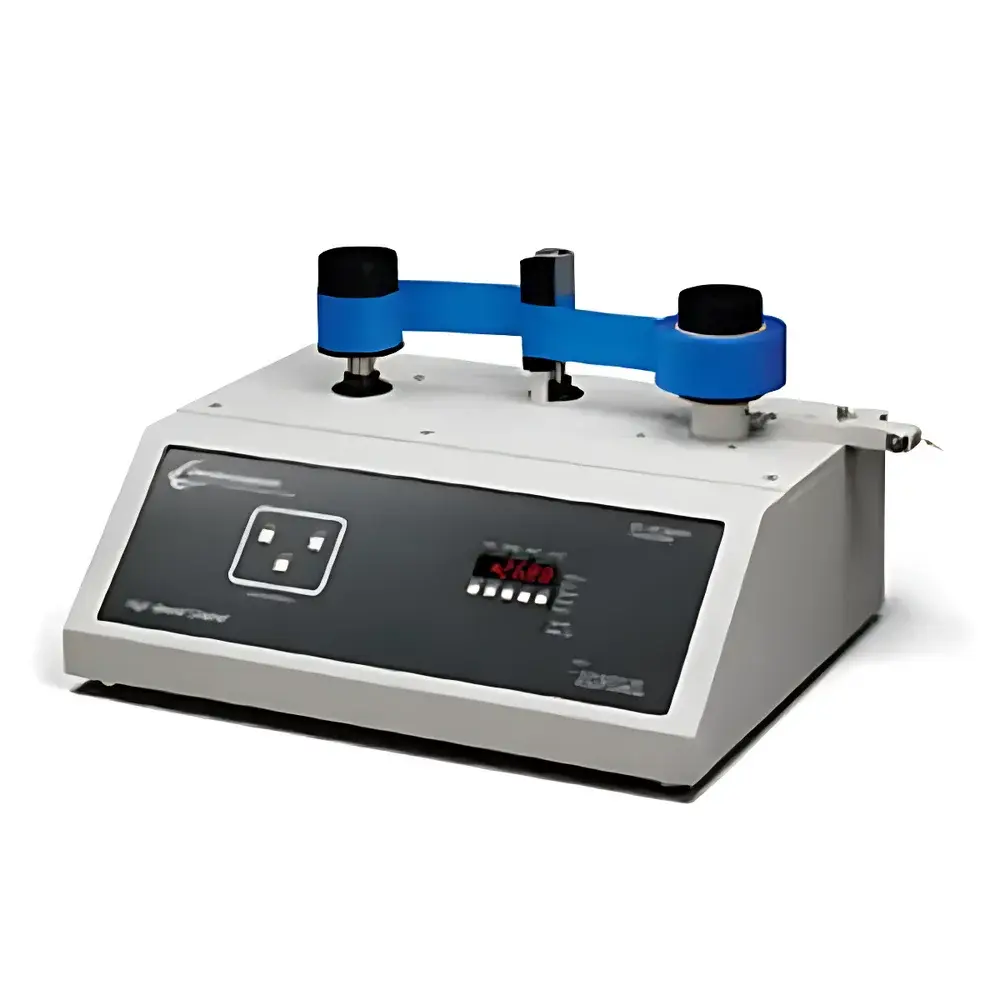
ChemInstruments HSU-1000 High-Speed Unwind Force Tester
| Origin | USA |
|---|---|
| Manufacturer Type | Authorized Distributor |
| Origin Category | Imported |
| Model | HSU-1000 |
| Quotation | Upon Request |
| Unwind Width | 3 in (75 mm) |
| Max Roll Diameter | 12 in (305 mm) |
| Speed Range | 10–400 ft/min (3–122 m/min) |
| Load Cell Capacity | 25 lbf (11.3 kgf / 111 N) |
| Load Cell Accuracy | ±0.1% of full scale |
| Temperature Operating Range | 0–70 °C |
| Data Acquisition Rate | 400 Hz |
| Storage Capacity | 20 independent test records |
| Display Units | g, kg, oz, lb, N |
| Dimensions (H×W×D) | 15×25×18 in (38×63×45.7 cm) |
| Weight | 59 lb (26.8 kg) |
Overview
The ChemInstruments HSU-1000 High-Speed Unwind Force Tester is an electromechanical precision instrument engineered for the quantitative measurement of unwind force—the tensile resistance encountered when unwinding pressure-sensitive adhesive tapes, labels, and laminates from a rotating roll under controlled linear velocity. It operates on the principle of dynamic load cell transduction coupled with closed-loop servo-controlled unwinding, ensuring consistent angular acceleration and stable belt-line velocity across the full operational range. Designed explicitly for compliance-driven quality assurance laboratories, the HSU-1000 replicates real-world high-speed converting conditions found in flexographic printing, label dispensing, and tape slitting operations. Its mechanical architecture adheres to the kinematic requirements of ASTM D1000 (Standard Test Method for Pressure-Sensitive Tape—Unwind Force), AFERA 4008 (Unwinding Behavior of Self-Adhesive Tapes), PSTC-8 (Peel Adhesion Release Force), and PSTC-13 (Roll Unwind Resistance), making it suitable for both routine QC testing and method validation under GLP and GMP frameworks.
Key Features
- High-fidelity load measurement via a calibrated 25 lbf (111 N) strain-gauge load cell with traceable NIST-certified accuracy of ±0.1% FS.
- Closed-loop digital speed control system maintains constant linear unwinding velocity from 10 to 400 ft/min (3–122 m/min), eliminating slip-induced torque variance.
- Integrated length encoder records cumulative unwind distance in selectable units (ft or m), synchronized with force-time acquisition at 400 Hz sampling rate.
- Modular mechanical frame accommodates rolls up to 12 in (305 mm) in diameter and 3 in (75 mm) in nominal web width—compatible with standard industrial core sizes (1″, 1.5″, 3″).
- Thermally stable aluminum chassis ensures dimensional integrity across 0–70 °C ambient operating conditions, minimizing thermal drift in sensor output.
- Front-panel LCD display shows real-time force waveform, plus statistical outputs: mean, max, min, and standard deviation per test cycle.
Sample Compatibility & Compliance
The HSU-1000 supports a broad spectrum of pressure-sensitive materials including acrylic, rubber-based, silicone, and hot-melt adhesive tapes; printed and die-cut labels; release liners; and thin polymer films. Its mechanical interface allows rapid changeover between core-mounted and mandrel-mounted configurations without tooling. All test protocols are fully aligned with internationally recognized standards: ASTM D1000 (unwind force at specified speed), AFERA 4008 (dynamic unwinding behavior under variable tension), PSTC-8 (release force during peel initiation), and PSTC-13 (steady-state unwind resistance). The system’s documented calibration procedures, audit-ready data logs, and configurable pass/fail thresholds support regulatory submissions compliant with ISO/IEC 17025, FDA 21 CFR Part 11 (when used with validated EZ-Lab software configuration), and EU Annex 11 requirements for electronic records.
Software & Data Management
The EZ-Lab software suite provides native Windows-based control, visualization, and reporting functionality. It captures raw 400-Hz force/time data streams, applies real-time filtering (moving average, low-pass), and computes ASTM-aligned metrics—including peak unwind force, average steady-state force, and coefficient of variation (CV%). Each test record includes metadata: operator ID, timestamp, environmental temperature, roll geometry, and test standard selected. Up to 20 complete test histories are retained onboard; exported datasets (.csv or .txt) preserve all acquisition parameters and comply with LIMS integration requirements. RS-232 serial communication enables bidirectional handshake with laboratory information management systems (LIMS) or enterprise QA databases. Optional software validation packages include IQ/OQ documentation, electronic signature workflows, and 21 CFR Part 11-compliant audit trails.
Applications
- Quality control of pressure-sensitive tape manufacturing—verifying consistency across production lots and validating adhesive formulation changes.
- Converter process optimization—correlating unwind force profiles with slitter knife settings, tension control algorithms, and rewind torque profiles.
- R&D evaluation of backing film stiffness, liner release characteristics, and adhesive rheology under dynamic shear.
- Supplier qualification testing—assessing incoming material conformance to contractual unwind specifications per PSTC or AFERA benchmarks.
- FDA-regulated medical device labeling validation—demonstrating consistent unwind performance across sterilization cycles and shelf-life storage conditions.
FAQ
Does the HSU-1000 meet ASTM D1000 and PSTC-13 requirements for regulatory submission?
Yes—the mechanical design, sensor resolution, speed control fidelity, and data logging architecture satisfy all apparatus and procedural clauses defined in ASTM D1000 Section 6 and PSTC-13 Section 4. Full compliance documentation is provided with each unit.
Can the system be integrated into an existing LIMS environment?
Yes—via RS-232 serial interface with configurable ASCII protocol; custom drivers and API wrappers are available upon request for major LIMS platforms (e.g., LabWare, STARLIMS, Thermo SampleManager).
Is temperature compensation applied to the load cell output?
No automatic compensation is applied in hardware; however, EZ-Lab software permits manual input of ambient temperature for post-acquisition correction using published thermal drift coefficients supplied in the calibration certificate.
What maintenance intervals are recommended for long-term accuracy?
Annual recalibration of the load cell and speed encoder is recommended. Mechanical inspection (belt tension, bearing play, core alignment) should occur every 6 months or after 500 operational hours—whichever comes first.
Can the HSU-1000 test non-standard widths or diameters?
The standard configuration supports up to 3 in (75 mm) width and 12 in (305 mm) diameter. Custom adapters for wider webs (up to 6 in) or larger rolls (up to 18 in) are available as optional accessories, subject to mechanical stability verification.



