
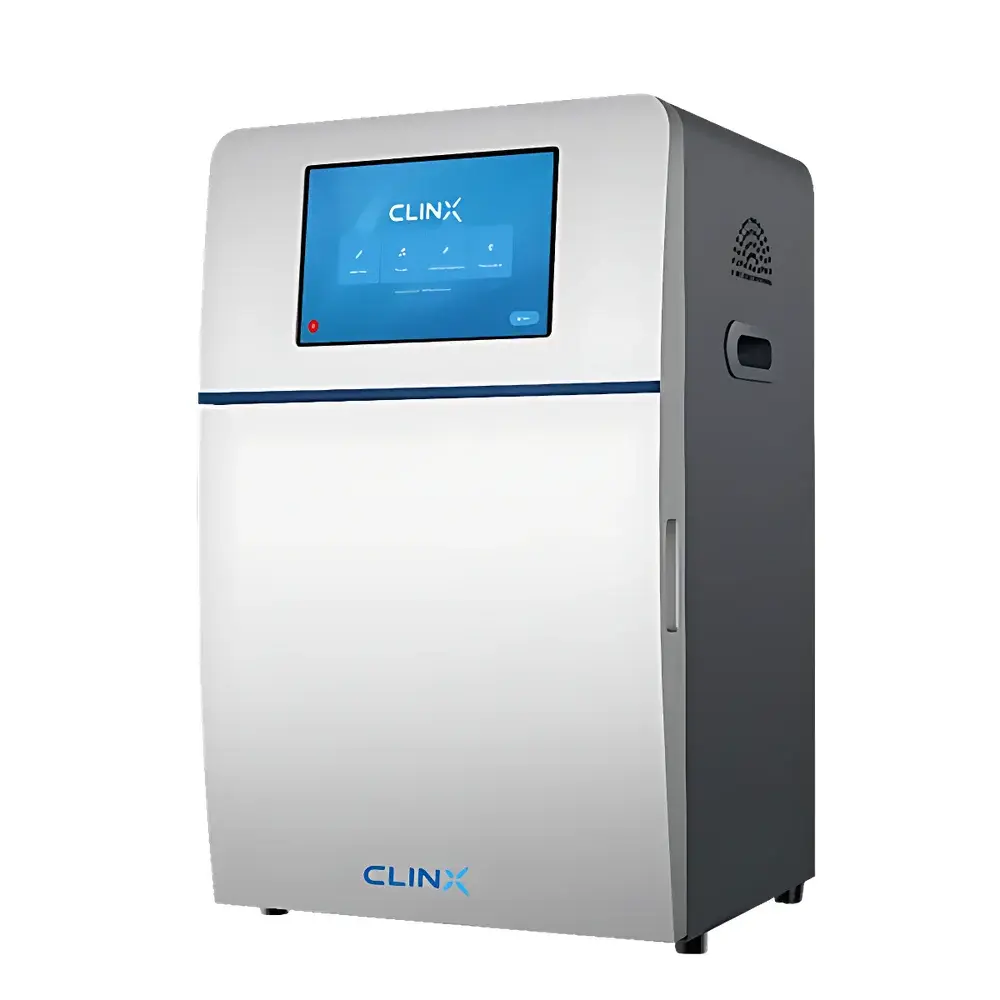
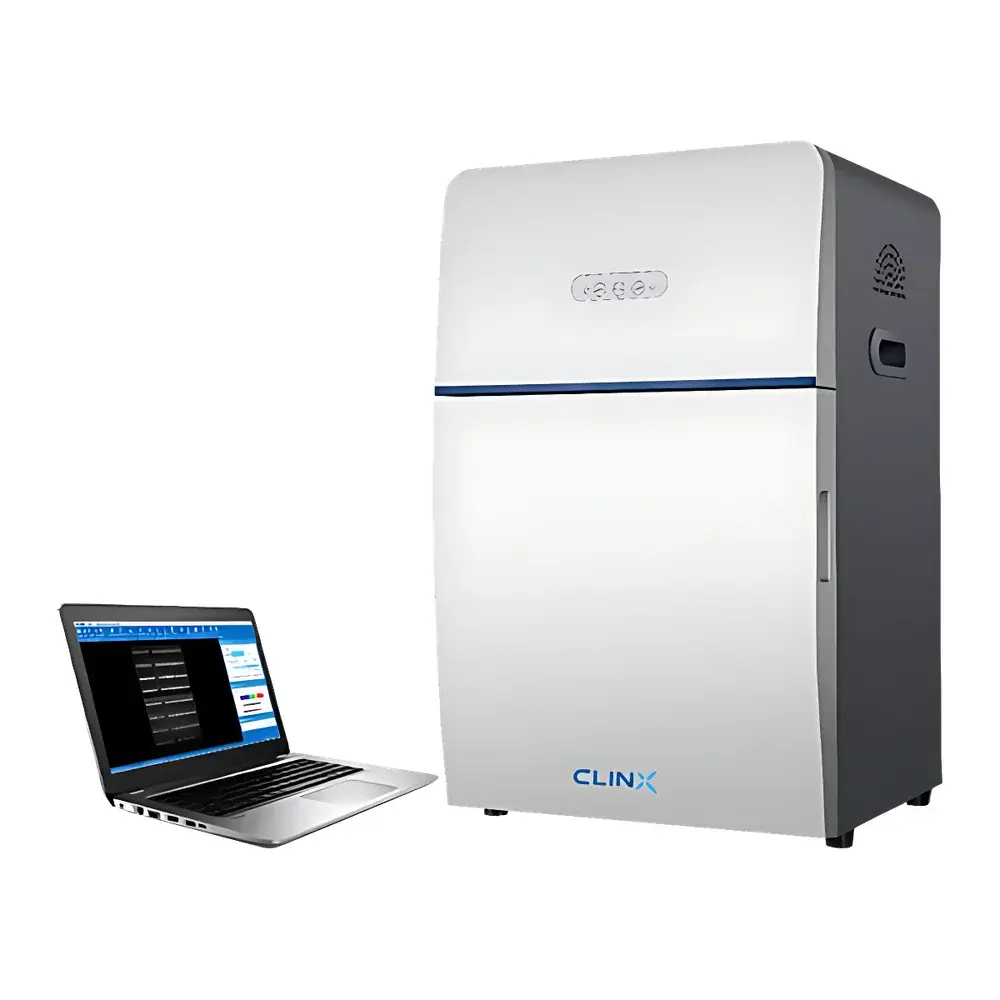
ChemiScope 6100 Multifunctional Chemiluminescence Imaging System
| Brand | CLINX |
|---|---|
| Origin | Shanghai, China |
| Model | ChemiScope 6100 |
| Instrument Type | Chemiluminescence Gel Imaging System |
| CCD Resolution | 6 MP |
| Sensor Cooling | −25 °C |
| Bit Depth | 16-bit (65,536 gray levels) |
| Pixel Binning Options | 1×1, 2×2, 3×3, 4×4 |
| Lens | F/0.95 motorized auto-focus lens |
| Transmission Illumination Area | 15 cm × 18 cm |
| Optional Transillumination Sources | UV LED (365 nm or 380 nm), Blue LED (470 nm), White LED |
| Optional Reflective Fluorescence Excitation | Monochromatic LEDs (365, 470, 530, 630, 660, 730 nm) |
| Optional Emission Filters | 460, 525, 585, 690, 715, 810 nm |
| Sample Stage | Dual-layer chemiluminescence stage with white LED reflectance illumination |
| Software | ChemiScope Image Acquisition & Analysis Suite |
| Data Interface | Dual USB 2.0 ports |
| Dimensions (W×D×H) | 435 mm × 395 mm × 700 mm |
Overview
The CLINX ChemiScope 6100 Multifunctional Chemiluminescence Imaging System is an integrated, high-sensitivity platform engineered for quantitative detection and analysis of chemiluminescent, fluorescent, and visible-light signals in life science applications. Based on cooled CCD imaging technology, the system employs a thermoelectrically regulated −25 °C sensor to suppress dark current noise and ensure stable, low-noise acquisition across extended exposure durations—critical for detecting weak ECL signals from low-abundance proteins in Western blot membranes. Its optical architecture combines a large-aperture F/0.95 motorized lens with programmable pixel binning (1×1 to 4×4), enabling dynamic optimization of signal-to-noise ratio (SNR) and spatial resolution without hardware reconfiguration. Designed for compliance-driven laboratories, the system supports audit-ready workflows through timestamped image metadata, operator traceability, and GLP/GMP-aligned software logging.
Key Features
- Cooled 6-megapixel CCD sensor operating at −25 °C, delivering true 16-bit dynamic range (65,536 gray levels) and sub-picogram-level protein detection sensitivity.
- F/0.95 motorized auto-focus lens with real-time focus validation—ensures consistent optical alignment across repeated acquisitions and minimizes user-induced variability.
- Intelligent multi-source illumination management: automatic recognition of installed transilluminator modules (UV, blue, white LED) and reflective fluorescence excitation sources; firmware-enforced safety interlocks prevent unintended UV exposure.
- Dual-layer sample stage optimized for chemiluminescence: upper layer accommodates blots and membranes; lower layer provides uniform white LED reflectance for visible-stain documentation (e.g., Coomassie, silver stain).
- Modular fluorescence capability: selectable monochromatic LED excitation sources (365–730 nm) paired with precision bandpass emission filters (460–810 nm), supporting multiplexed detection of FAM, Cy2/Cy3/Cy5, GFP, mCherry, and near-infrared probes.
- Embedded 10.1-inch industrial touchscreen interface with optional external PC connectivity—enabling seamless transition between standalone operation and network-integrated data management.
Sample Compatibility & Compliance
The ChemiScope 6100 supports a broad spectrum of molecular biology and proteomics workflows, including chemiluminescent detection of Western, Northern, and Southern blots using ECL, ECL Plus, or enhanced luminol-based substrates; fluorescent quantification of nucleic acids stained with SYBR Safe, GelRed, or ethidium bromide analogs; and visible-light imaging of SDS-PAGE gels stained with Coomassie Brilliant Blue or silver nitrate. Its LED-based illumination sources meet IEC 62471 photobiological safety standards for UV and blue light emissions. The ChemiScope software complies with ALCOA+ principles for data integrity and includes electronic signature support, audit trail generation, and export of raw images in lossless TIFF format—facilitating adherence to FDA 21 CFR Part 11, ISO/IEC 17025, and GLP regulatory requirements.
Software & Data Management
The ChemiScope Image Acquisition & Analysis Suite provides a unified environment for acquisition, quantification, and reporting. Predefined acquisition templates cover common assays (e.g., “ECL Standard”, “SYBR Green Nucleic Acid”, “Coomassie Protein Gel”), while custom protocols allow precise control over exposure time, binning mode, lens focus, and illumination source selection. Image analysis features include automated lane and band detection with manual correction tools; background subtraction via rolling-ball or morphological filtering; relative quantification based on integrated optical density (IOD); and molecular weight calibration using reference ladders. All operations are logged with user ID, timestamp, and parameter set. Results—including annotated images, band intensity tables, and calibration curves—can be exported directly to Excel or PDF reports containing embedded metadata, instrument configuration, and audit trail summaries.
Applications
- Western blot chemiluminescence imaging with quantitative densitometry for target protein expression profiling.
- Reporter gene assays using luciferase or GFP variants under promoter-specific regulation.
- Nucleic acid gel documentation and fragment sizing for PCR, restriction digest, and RNA integrity assessment.
- Protein gel imaging across staining modalities: Coomassie, silver, fluorescent dyes (e.g., Deep Purple), and label-free total protein normalization.
- Multiplex fluorescence imaging of antibody arrays, tissue sections, and microplate-based assays.
- SDS-PAGE and native PAGE documentation with side-by-side comparison of replicate gels under identical acquisition conditions.
FAQ
What is the maximum exposure time supported for chemiluminescent imaging?
The system supports exposures up to 60 minutes with continuous cooling and real-time noise compensation algorithms.
Can the ChemiScope 6100 perform simultaneous dual-wavelength fluorescence imaging?
No—it acquires single-channel images sequentially using motorized filter wheels; however, spectral unmixing is supported post-acquisition when multiple reference standards are included.
Is the software validated for use in regulated environments?
Yes—the ChemiScope Suite includes configurable user roles, electronic signatures, immutable audit trails, and 21 CFR Part 11-compliant export options for raw and processed data.
Does the system require a darkroom for chemiluminescence imaging?
No—its light-tight enclosure and internal black-body baffling eliminate ambient light interference, enabling full functionality in standard laboratory lighting.
How is calibration maintained across long-term usage?
The system includes built-in flat-field correction routines and optional NIST-traceable calibration standards for intensity and spatial uniformity verification.



