
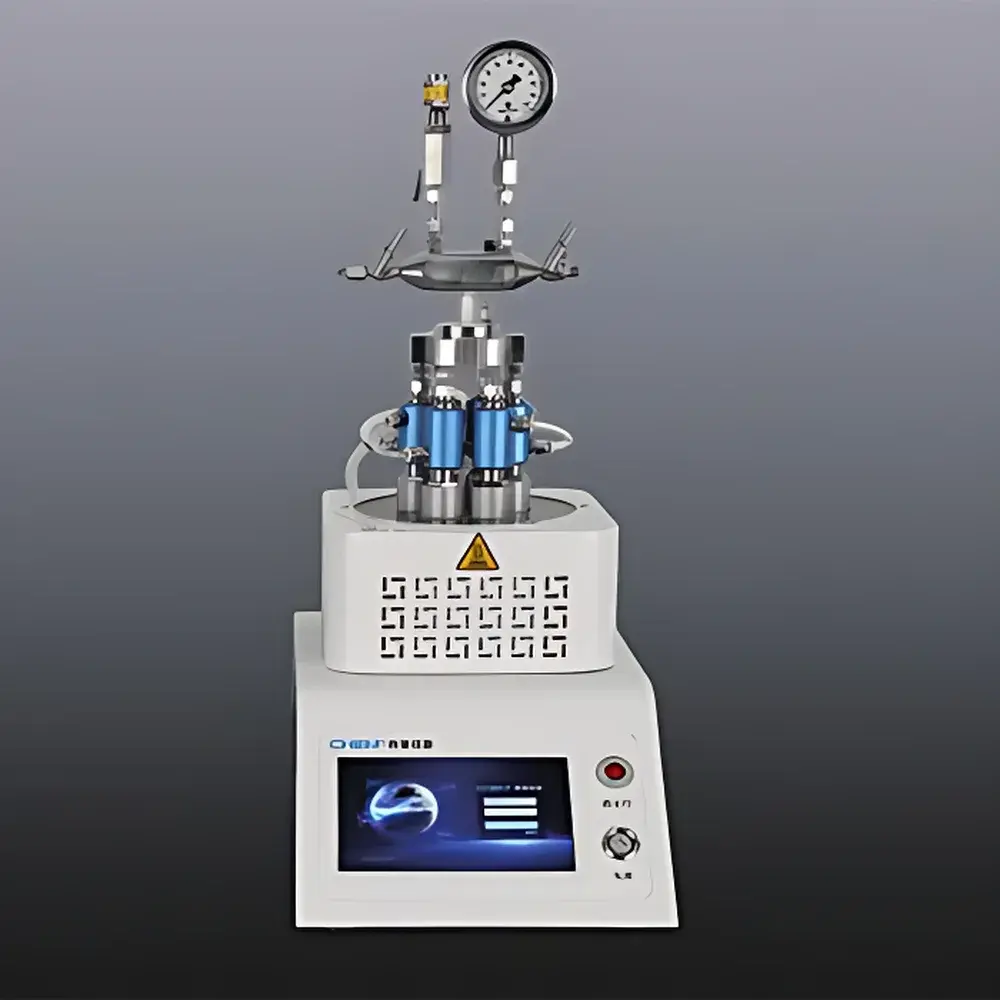
Chemn NS6-20D-SS1-P3-T2 Six-Station High-Pressure Parallel Reactor
| Brand | Chemn |
|---|---|
| Origin | Anhui, China |
| Model | NS6-20D-SS1-P3-T2 |
| Vessel Capacity | 10 mL & 20 mL per station |
| Design Pressure | 10 MPa (100 bar) |
| Design Temperature | 200 °C |
| Construction Material | 316L Stainless Steel & Hastelloy C-276 |
| Heating Method | Embedded Aluminum Sleeve Heater |
| Stirring Mechanism | Magnetic Stirring |
| Speed Range | 100–1200 rpm |
| Control Interface | 7-inch HD Touchscreen with PID Temperature Control & Stepless Speed Regulation |
| Pressure Monitoring | Yaskawa (USA) Pressure Gauge (optional pressure transmitter) |
| Safety Valves | Fitok (USA) Relief Valve & Rupture Disc |
| Gas Inlet/Outlet Valves | Swagelok (USA) Needle Valves |
| Power Supply | 200–240 V AC, 50–60 Hz |
| Controller Dimensions | 260 × 470 × 260 mm (L×D×H) |
Overview
The Chemn NS6-20D-SS1-P3-T2 is a six-station parallel high-pressure reactor system engineered for reproducible, scalable screening of heterogeneous catalytic reactions under controlled thermal, pressure, and mixing conditions. Based on Couette-type magnetic stirring within sealed, individually isolated reaction vessels, the system enables simultaneous execution of up to six independent experiments at pressures up to 10 MPa (100 bar) and temperatures up to 200 °C. Each vessel operates as a self-contained micro-reactor with dedicated pressure monitoring, temperature regulation, and agitation control—eliminating cross-contamination and enabling statistically robust comparative studies. The reactor architecture adheres to ASME BPVC Section VIII Div. 1 design principles for pressure containment, with full traceability of material certifications (316L SS and Hastelloy C-276), weld procedure specifications (WPS), and non-destructive testing (NDT) records available upon request.
Key Features
- Modular six-station configuration with fully independent pressure-rated vessels (10 mL and 20 mL options), each equipped with Swagelok needle valves for precise gas dosing and venting.
- Integrated embedded aluminum sleeve heating modules ensure uniform thermal distribution and rapid ramp rates (≤5 °C/min), validated by ASTM E2847 thermal mapping protocols.
- High-fidelity magnetic stirring system delivers stable rotational speeds from 100 to 1200 rpm with ≤±2 rpm repeatability across all stations—critical for kinetic consistency in gas–liquid–solid triphasic reactions.
- 7-inch capacitive touchscreen HMI running embedded Linux OS supports real-time display of temperature, pressure, speed, and elapsed time per station; data logging at user-defined intervals (1–60 s) to internal memory or external USB drive.
- Factory-calibrated Yaskawa pressure transducers (optional 4–20 mA output) and Fitok-certified safety components—including dual-stage overpressure protection (relief valve + rupture disc)—meet ISO 4126-1 and PED 2014/68/EU requirements.
- One-piece machined reactor body minimizes flange interfaces and eliminates gasket-dependent sealing points, reducing leak risk and simplifying cleaning between campaigns.
Sample Compatibility & Compliance
The NS6-20D-SS1-P3-T2 accommodates solid catalysts (e.g., Pd/C, PtO₂, Raney Ni), liquid reagents (including pyridine derivatives and benzyl-protected substrates), and gaseous reactants (H₂, CO, NH₃, syngas). All wetted parts comply with USP Class VI biocompatibility standards and are passivated per ASTM A967. System documentation includes full DQ/IQ/OQ validation templates aligned with ICH Q7 and FDA 21 CFR Part 11 for electronic record integrity—supporting GLP/GMP-regulated development workflows. Pressure vessel certification conforms to GB/T 150.1–2011 (China) and equivalent EN 13445-1:2021 clauses for unfired pressure equipment.
Software & Data Management
Data acquisition is handled via an onboard ARM Cortex-A9 controller with deterministic real-time scheduling. Logged parameters (temperature, pressure, RPM, timestamp) are exported in CSV format compatible with MATLAB, Python pandas, and JMP for multivariate kinetic analysis. Optional Chemn LabLink™ software provides remote monitoring via Ethernet/Wi-Fi, automated report generation (PDF/Excel), and audit-trail-enabled user access control (role-based permissions, electronic signatures). All firmware updates undergo SHA-256 checksum verification and retain full backward compatibility with legacy experiment files.
Applications
This reactor system is routinely deployed in academic and industrial R&D for: hydrogenation of N-heterocycles (e.g., pyridine ring saturation), deprotection of benzyl ethers and carbamates under mild H₂ pressure, Fischer–Tropsch screening, ammonia synthesis precursors, and asymmetric transfer hydrogenation optimization. Its parallel architecture reduces experimental throughput time by >80% versus sequential single-vessel testing—enabling efficient DoE (Design of Experiments) matrices for catalyst loading, H₂ partial pressure, temperature gradients, and residence time effects.
FAQ
What pressure rating does each reactor vessel support?
Each vessel is rated for a maximum design pressure of 10 MPa (100 bar) at 200 °C, verified by hydrostatic test at 1.5× design pressure.
Can the system be integrated into an existing laboratory automation framework?
Yes—RS485 Modbus RTU and optional Ethernet TCP/IP interfaces enable bidirectional communication with LIMS or SCADA platforms.
Is third-party calibration certification available?
NIST-traceable calibration certificates for temperature (PT100 sensors) and pressure (Yaskawa transducers) are provided at time of delivery, with annual recalibration services supported.
What maintenance is required for long-term reliability?
Routine inspection of O-rings (per ASTM D1418), torque verification of closure fasteners (per ISO 898-1), and annual verification of safety valve setpoints are recommended per manufacturer’s maintenance schedule.
Does the system meet explosion-proof requirements for hazardous area installation?
The base unit is rated for Zone 2/Class I Division 2 environments; ATEX/IECEx-certified variants with intrinsically safe signal conditioning are available upon request.



