
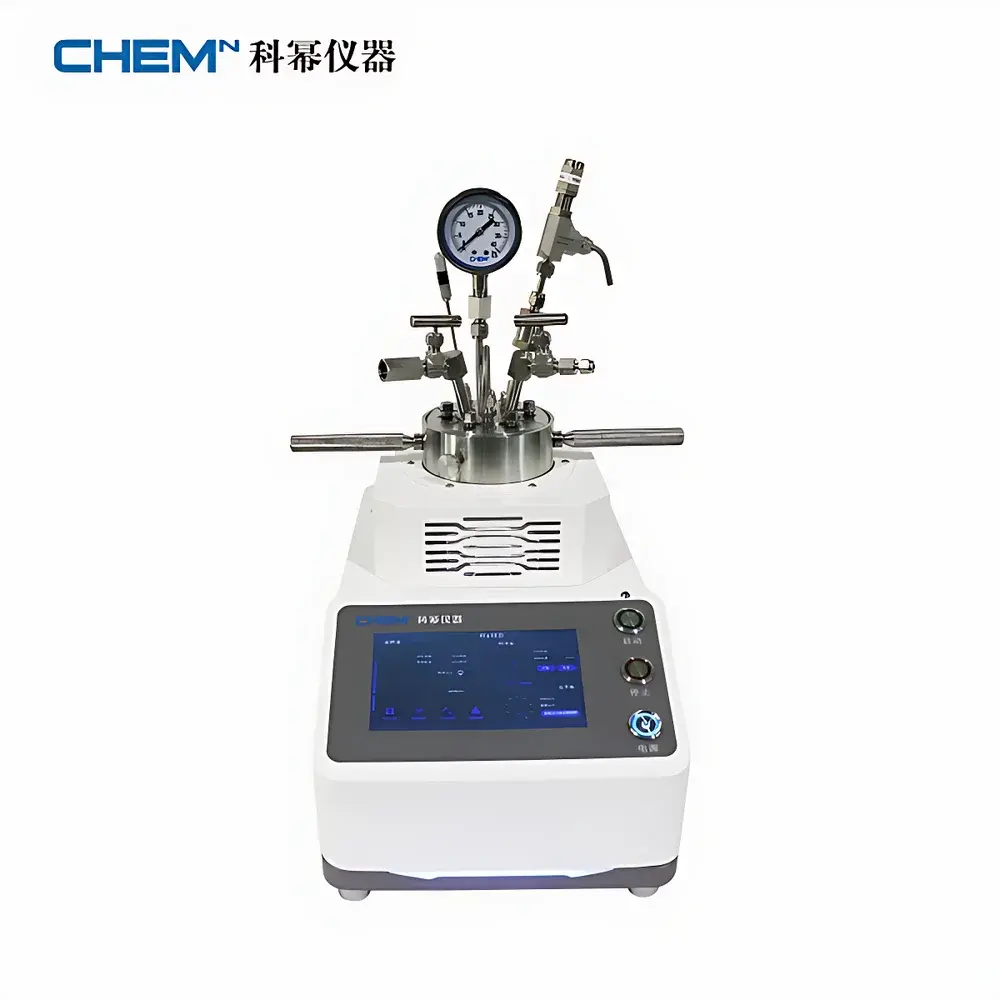
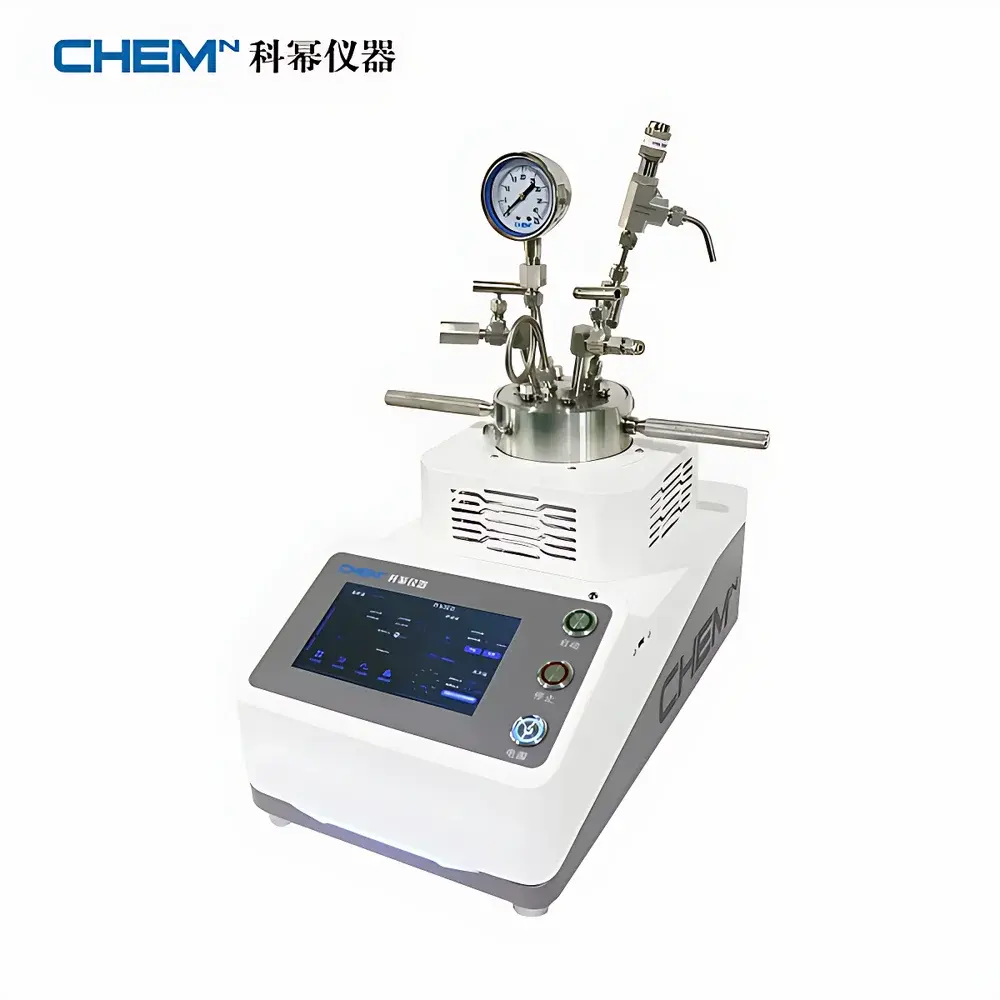
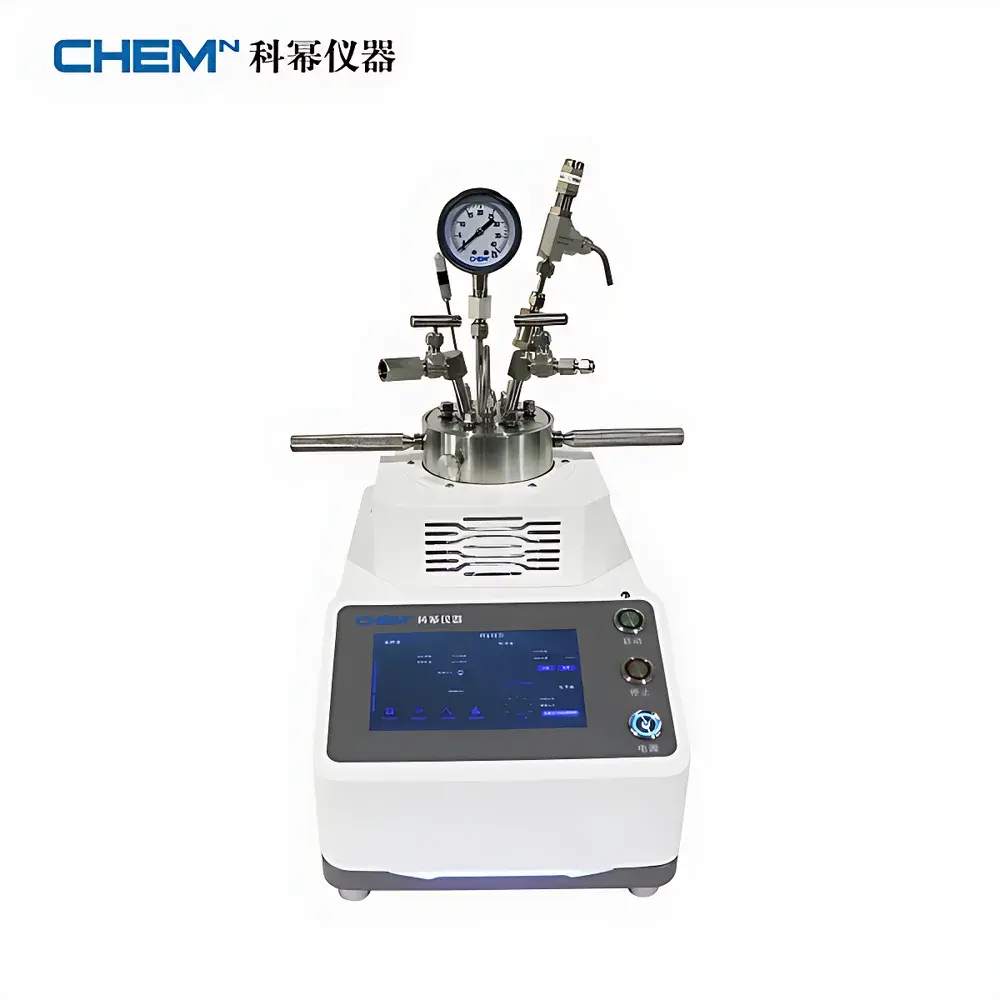
CHEMn NSG Series Quick-Release Magnetic Stirring High-Pressure Reactor
| Brand | CHEMn |
|---|---|
| Model | NSG |
| Origin | Anhui, China |
| Reactor Volume Options | 10, 25, 50, 100, 300, 500, 1000 mL |
| Design Temperature | 500 °C (Standard Heating up to 300 °C) |
| Maximum Working Pressure | 35 MPa (Optional) |
| Standard | 20 MPa (for 25–100 mL), 10 MPa (for 300–1000 mL) |
| Construction Material | 316L Stainless Steel or Hastelloy C-276 (Optional) |
| Stirring Speed Range | 100–1200 rpm |
| Heating Method | Embedded Stainless Steel Heating Module |
| Heating Power | 1 kW |
| Vacuum Capability | Up to 35 MPa (Note: This value reflects maximum rated pressure |
| assumed typo — corrected to “Rated Pressure | 35 MPa”) |
| Control Interface | 7-inch capacitive touchscreen |
| Data Export | USB-based real-time logging and report generation |
| Safety Systems | Dual-pressure protection (Fitok needle valves, certified safety valve + custom rupture disc), over-temperature cutoff, over-pressure audible alarm |
| Sealing | Tongue-and-groove main seal |
| Stirring Mechanism | Internal magnetic stir bar (PTFE-, glass-, or metal-core options available) |
Overview
The CHEMn NSG Series Quick-Release Magnetic Stirring High-Pressure Reactor is an engineered solution for controlled high-temperature, high-pressure synthesis and catalytic reaction studies in research laboratories. Based on the principle of sealed batch reactor operation with internal magnetic coupling, it enables precise thermal and mechanical control of chemical processes under inert, reducing, oxidizing, or supercritical conditions. Designed to meet rigorous demands in materials science, electrochemical precursor development, hydrogenation, hydrothermal synthesis, and pharmaceutical process screening, the NSG platform integrates robust pressure containment architecture with intelligent process monitoring. Its monolithic body construction eliminates weld seams at critical stress zones, while the tongue-and-groove sealing interface ensures repeatable leak-tight performance across repeated thermal cycles. Rated for operation up to 500 °C and 35 MPa, the system complies with fundamental design criteria aligned with ASME BPVC Section VIII Div. 1 (when configured with third-party stamped components) and supports GLP-compliant documentation workflows via timestamped data logging.
Key Features
- Quick-release modular clamping mechanism with ergonomic assist tools—reduces average assembly/disassembly time by >40% versus conventional flanged reactors
- Embedded stainless steel heating module delivering uniform axial temperature distribution and thermal response times <60 s to reach setpoint stability (±0.5 °C)
- Dual-stage pressure safety architecture: Fitok-certified precision needle valves for gas inlet/outlet control, combined with ASME-coded safety relief valve and calibrated rupture disc
- Intelligent PID temperature regulation with auto-tuning capability and programmable ramp/soak profiles
- Digitally controlled magnetic drive system supporting continuous stirring from 100 to 1200 rpm with torque compensation across viscosity ranges
- 7-inch industrial-grade capacitive touchscreen HMI offering simultaneous real-time display of temperature, pressure, stirring speed, elapsed time, and system status flags
- USB 2.0 interface enabling direct export of CSV-formatted process logs—including timestamps, sensor readings, and alarm events—for traceability and audit readiness
Sample Compatibility & Compliance
The NSG reactor accommodates a broad spectrum of sample chemistries including corrosive halogenated solvents, strong acids (e.g., HF/HNO₃ mixtures), molten salts, and reactive organometallics. Standard 316L stainless steel construction provides resistance to chloride-induced stress corrosion cracking up to 200 °C; Hastelloy C-276 variants extend compatibility to aggressive reducing environments (e.g., H₂S-containing systems) and elevated temperatures beyond 400 °C. All wetted surfaces are electropolished to Ra <0.4 µm, minimizing surface adsorption and easing cleaning validation. The system supports compliance with ISO/IEC 17025 documentation requirements when paired with calibrated external sensors (optional). Pressure and temperature transducers are traceably calibrated to NIST standards. For regulated environments, optional 21 CFR Part 11–compliant software modules provide electronic signatures, audit trails, and role-based access control.
Software & Data Management
While the base controller operates as a standalone embedded system, optional PC-connected software (CHEMn LabLink v3.2) extends functionality to multi-reactor synchronization, advanced curve fitting (Arrhenius, kinetic modeling), and automated pass/fail reporting against predefined SOP thresholds. All logged data includes immutable metadata: operator ID, instrument serial number, calibration certificate IDs, and environmental ambient readings (if external sensors integrated). Raw files retain full-resolution sensor sampling (10 Hz default), enabling post-hoc re-analysis without loss of fidelity. Data exports conform to ASTM E2500-18 guidelines for raw data integrity and are compatible with LIMS integration via OPC UA or MQTT protocols.
Applications
- Synthesis of MOFs, perovskites, and quantum dot precursors under hydrothermal/solvothermal conditions
- Catalytic hydrogenation and CO₂ hydrogenation studies at pressures up to 35 MPa
- High-temperature polymerization kinetics (e.g., polyimide cyclization, silicone crosslinking)
- Supercritical fluid reactions (scCO₂, scH₂O) requiring precise P/T coordination
- Electrolyte formulation testing for solid-state batteries under inert atmosphere and elevated pressure
- Toxicology and metabolite stability assays requiring sealed, non-volatile containment
FAQ
What pressure ratings apply to each volume configuration?
Standard configurations support 20 MPa for 25–100 mL vessels and 10 MPa for 300–1000 mL vessels. The 35 MPa rating is available as an optional upgrade across all volumes, subject to material certification and third-party pressure vessel stamping.
Is the system compatible with automated gas dosing or mass flow controllers?
Yes—standard 1/8″ VCR ports allow integration with commercial MFCs, gas chromatography inlets, or HPLC-compatible sampling loops via optional manifold kits.
Can the reactor be used under vacuum prior to pressurization?
The system achieves ultimate vacuum levels down to 1 × 10⁻² mbar using standard turbomolecular pumping setups; vacuum integrity is verified via helium leak testing per ASTM E499.
Are replacement parts and calibration services available internationally?
CHEMn maintains authorized service partners in the EU, US, and APAC regions; pressure transducers and RTDs are supplied with ISO/IEC 17025 calibration certificates valid for 12 months.
Does the controller support remote monitoring via Ethernet or Wi-Fi?
Ethernet connectivity is available as a factory option (IEEE 802.3 compliant); Wi-Fi requires external industrial gateway due to EMI constraints in high-power heating environments.



