
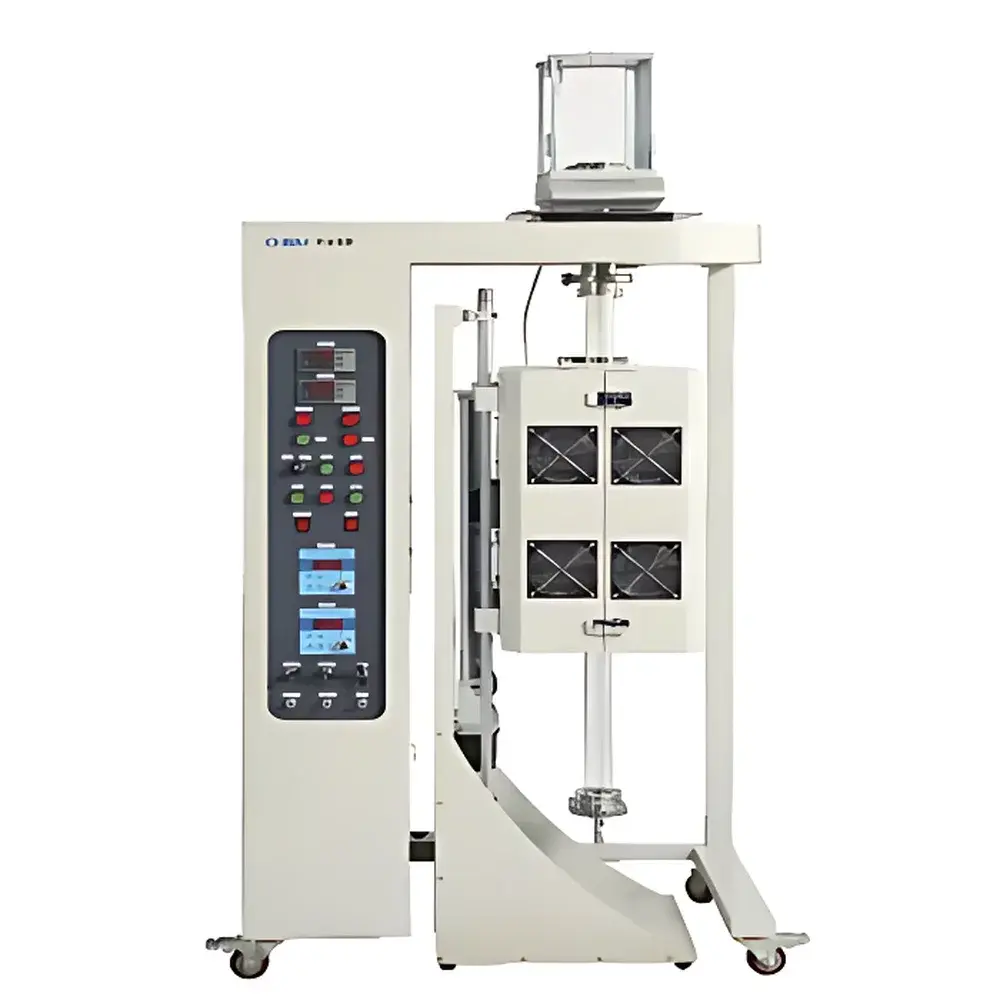
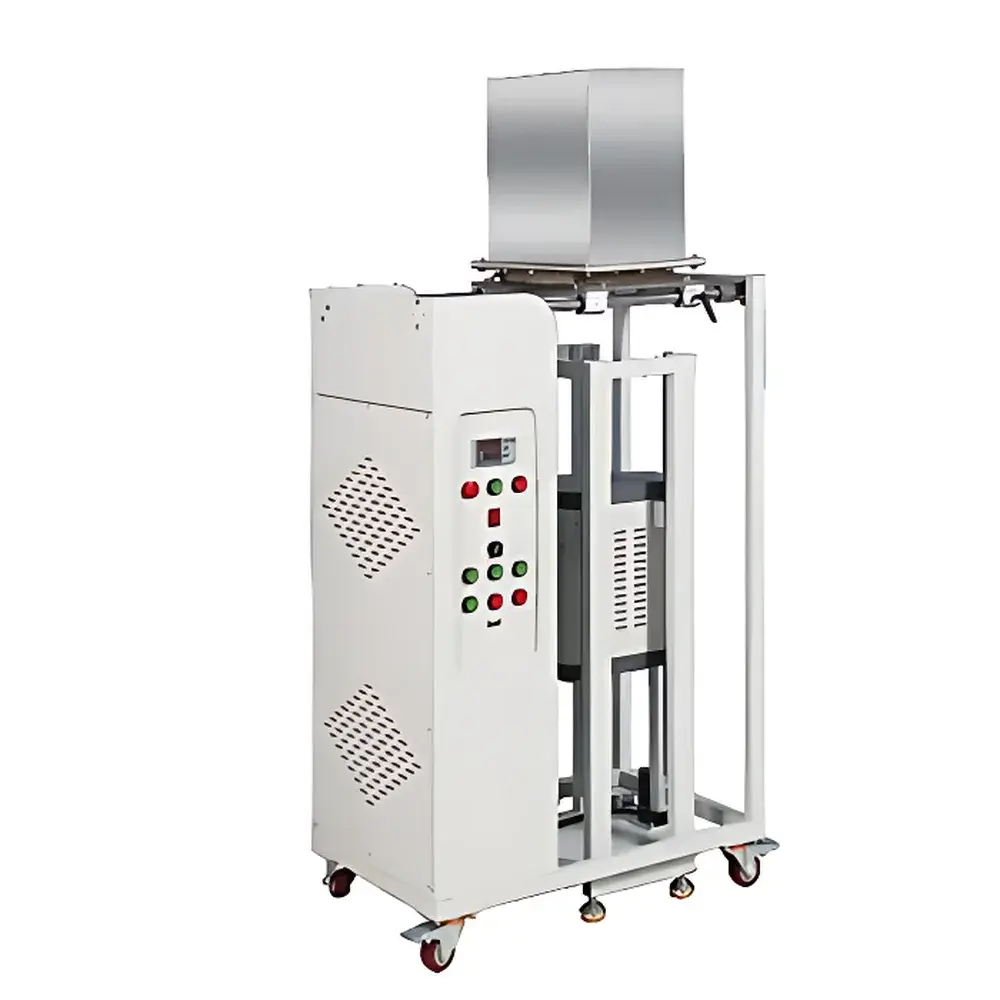
CHEMn TFD-1200-50-II-200-RZ Dual-Zone Vertical Thermogravimetric Analyzer (TGA) Furnace
| Brand | CHEMn |
|---|---|
| Origin | Anhui, China |
| Model | TFD-1200-50-II-200-RZ |
| Max Temperature | 1200 °C |
| Temperature Control Accuracy | ±1 °C |
| Max Power | 1.5 kW |
| Heating Rate (to Max Temp) | ≤10 °C/min |
| Heating Method | Resistance Wire Heating |
| Chamber Configuration | Dual Independent Temperature Zones (ΔT ≤ 200 °C) |
| Internal Dimensions | Customizable |
| Instrument Type | Vertical Lift-Type TGA Furnace |
| Core Function | High-Temperature Atmosphere-Controlled Mass Change Monitoring |
Overview
The CHEMn TFD-1200-50-II-200-RZ is a vertically oriented, dual-zone thermogravimetric analysis (TGA) furnace engineered for precise, atmosphere-controlled monitoring of mass change under controlled thermal profiles. Unlike conventional single-zone muffle furnaces, this system integrates two independently regulated heating zones—each capable of stable operation up to 1200 °C—with a maximum inter-zone temperature differential of 200 °C. This architecture enables simultaneous or sequential thermal conditioning of sample and reference zones, supporting advanced experimental protocols such as isothermal aging, stepwise thermal ramping with zone-specific dwell periods, and differential thermal stability assessment. The furnace core employs high-purity alumina (99.7% Al₂O₃) vacuum-formed insulation, ensuring exceptional radial and axial temperature uniformity (<±2 °C across usable sample height) and low thermal mass for reproducible heating kinetics. Designed explicitly for integration with analytical balances (not included), the system conforms to ISO 11358-1:2014 and ASTM E1131–22 standards for thermogravimetric measurement methodology.
Key Features
- Dual independent PID-controlled temperature zones with real-time digital setpoint adjustment and cross-zone thermal isolation
- High-stability resistance wire heating elements embedded in monolithic alumina insulation, minimizing thermal lag and drift
- Vertical lift mechanism enabling rapid, repeatable sample insertion/extraction without thermal disturbance to the balance chamber
- ±1 °C temperature control accuracy over full operating range (room temperature to 1200 °C), verified per IEC 60584-2 calibration traceability
- Maximum heating rate of ≤10 °C/min to 1200 °C, programmable in 0.1 °C increments for multi-step thermal protocols
- Gas-tight flange interface compatible with inert (N₂, Ar), oxidizing (air, O₂), or reducing (H₂/N₂ mix) atmospheres via standard 6 mm Swagelok ports
- Structural design optimized for compatibility with microgram-class analytical balances (e.g., METTLER TOLEDO XSR series, Sartorius Entris II)
Sample Compatibility & Compliance
The TFD-1200-50-II-200-RZ accommodates crucibles ranging from 50 µL ceramic (Al₂O₃, Pt, or AlN) to 10 mL quartz or graphite, supporting sample masses from 0.1 mg to 500 mg. Its vertical configuration minimizes convection-induced buoyancy artifacts and ensures consistent gas flow dynamics around the sample—critical for quantitative kinetic analysis. The furnace meets mechanical and electrical safety requirements per IEC 61010-1:2010 for laboratory equipment. When operated with validated balance systems and documented SOPs, data generated supports GLP-compliant reporting and is admissible in regulatory submissions requiring ASTM E1641 or ISO 11358 compliance. Optional quartz viewing window and integrated thermocouple ports (Type S or K) enable in situ validation of thermal gradients during method development.
Software & Data Management
The furnace operates via RS-485 or Ethernet (optional) communication with third-party TGA acquisition software (e.g., Netzsch Proteus®, TA Instruments TRIOS™, or custom LabVIEW-based platforms). It supports synchronized timestamped logging of temperature (dual-zone), furnace power draw, and external mass signal inputs at up to 10 Hz sampling rate. All control parameters—including ramp rates, dwell times, gas flow setpoints (when interfaced with mass flow controllers), and alarm thresholds—are stored with user-defined metadata and exportable in CSV or ASCII format. Audit trail functionality—including operator ID, parameter changes, and system error logs—is implementable through compliant software layers aligned with FDA 21 CFR Part 11 requirements when deployed in regulated QC environments.
Applications
- Thermal degradation kinetics of polymers (e.g., PET, PEEK, polyimides) under air vs. nitrogen atmospheres
- Oxidative stability assessment of catalysts and battery electrode materials (LiCoO₂, NMC, Si-anodes)
- Dehydration/hydration equilibria in pharmaceutical hydrates (e.g., monohydrate → anhydrous transitions)
- Carbon burn-off quantification in supported metal catalysts and spent FCC catalysts
- Thermal aging studies of composite matrices (epoxy, phenolic) with zone-differential exposure
- Volatiles content determination in coatings, adhesives, and elastomers per ISO 3679 and ASTM D2765
FAQ
What atmosphere options are supported, and how are gas flows controlled?
The furnace features dual 6 mm Swagelok inlet/outlet ports. Gas flow is managed externally using calibrated mass flow controllers; recommended flow rates range from 20–200 mL/min depending on crucible geometry and reaction kinetics.
Can the two zones operate at identical temperatures?
Yes—the zones can be synchronized to identical setpoints or configured with fixed offsets up to ±200 °C, enabling both uniform heating and controlled thermal gradients.
Is the internal chamber dimension truly customizable?
Standard configurations include 50 mm (ID) × 100 mm (height); custom diameters up to 120 mm and heights up to 300 mm are available upon engineering review and lead-time agreement.
Does the system include a balance or vacuum pump?
No—this is a furnace-only platform designed for integration with user-supplied analytical balances and auxiliary gas/vacuum systems.
How is temperature uniformity validated across the dual zones?
Uniformity is certified using a 5-point thermocouple mapping procedure (per ASTM E220) performed at 600 °C, 900 °C, and 1200 °C, with results supplied in the factory calibration report.



