
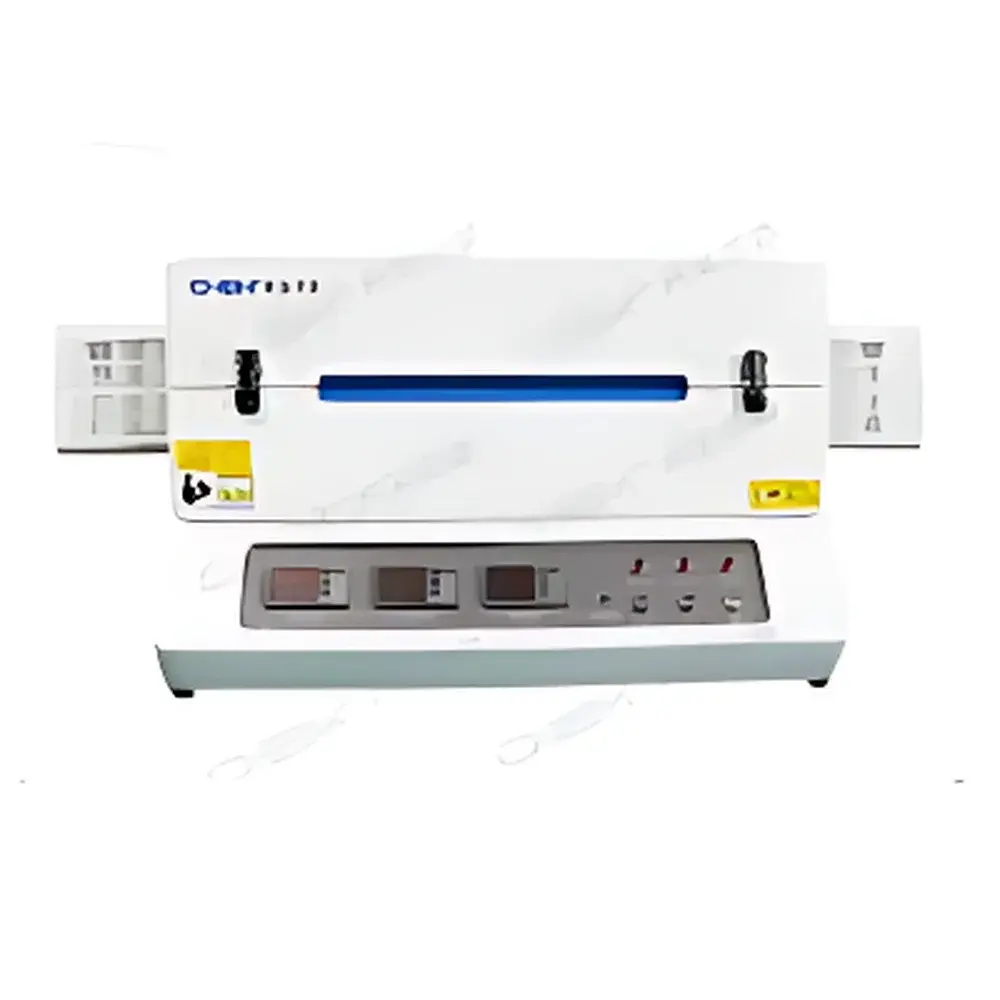
CHEMn TFH-1200-50-III-200 Triple-Zone Laboratory Tube Furnace
| Brand | CHEMn |
|---|---|
| Origin | Anhui, China |
| Model | TFH-1200-50-III-200 |
| Maximum Temperature | 1200 °C (short-term) |
| Rated Operating Temperature | 1100 °C |
| Temperature Control Accuracy | ±1 °C |
| Heating Zones | 3 independent zones (each 200 mm) |
| Uniform Temperature Zone Length | 400 mm |
| Tube Dimensions | Φ50 mm (OD) × 1000 mm (L) |
| Chamber Internal Dimensions | 1350 × 420 × 520 mm |
| Max. Power Consumption | 6 kW |
| Ramp Rate to Max Temp | ≤10 °C/min |
| Heating Element | HRE resistance wire (Shougang, Beijing) |
| Insulation Material | High-purity alumina microcrystalline fiber, vacuum-formed |
| Cooling System | Dual-layer forced-air cooling |
| Surface Temperature | ≤60 °C |
| Control System | Yudian AI-3756P 7-inch color touchscreen controller with 30-segment programmable ramp-soak profiles |
| Temperature Sensor | K-type thermocouple |
| Atmosphere Compatibility | Vacuum and inert/reducing/reactive gas environments (via quartz tube + stainless steel flanges) |
| Data Interface | USB port for real-time data logging and export |
Overview
The CHEMn TFH-1200-50-III-200 is a precision-engineered triple-zone laboratory tube furnace designed for controlled thermal processing under vacuum or regulated gas atmospheres. It operates on resistive heating principles, utilizing high-emissivity HRE alloy resistance wire wound parallel to a fused quartz process tube—ensuring axial thermal symmetry and minimizing radial temperature gradients. The furnace integrates three independently controllable heating zones (each 200 mm long), enabling precise axial temperature profiling across a 400 mm uniform zone—critical for solid-state synthesis, crystal growth, annealing, and CVD precursor decomposition where thermal gradient control directly influences phase formation kinetics and microstructural evolution. Its vacuum-compatible architecture—featuring a Φ50 mm OD × 1000 mm L quartz tube sealed with SS304 flanges—supports pressure ranges from 10⁻³ mbar to ambient, with optional mass flow controllers and gas purging manifolds available for reactive atmosphere applications.
Key Features
- Triple independent heating zones (3 × 200 mm) with individual PID control loops, supporting programmable axial thermal gradients for multi-step thermal treatments.
- High-stability temperature regulation: ±1 °C accuracy over the full operating range (room temperature to 1100 °C continuous, 1200 °C short-term), verified per ASTM E220 calibration protocols.
- Advanced insulation system: vacuum-formed high-purity alumina microcrystalline fiber (≥99.8% Al₂O₃) providing low thermal conductivity (50% energy reduction versus traditional ceramic fiber modules.
- Dual-layer forced-air cooling jacket maintains external surface temperature ≤60 °C during continuous operation at 1100 °C—meeting IEC 61000-3-2 safety requirements for lab equipment surface temperature limits.
- Yudian AI-3756P 7-inch capacitive touchscreen controller with 30-segment ramp-soak programming, real-time curve display, and password-protected parameter locking for GLP-compliant operation.
- Quick-release flange assembly with Viton O-rings and torque-limited clamping enables repeatable vacuum sealing (leak rate <5×10⁻⁸ mbar·L/s) and rapid sample loading without tooling.
- USB 2.0 interface supports time-stamped CSV export of setpoint, actual temperature, and power output—compatible with LabVIEW™ and MATLAB® for automated data ingestion and audit trail generation.
Sample Compatibility & Compliance
The TFH-1200-50-III-200 accommodates standard Φ50 mm OD quartz tubes (custom diameters up to Φ100 mm available), compatible with crucibles made of alumina, silicon carbide, graphite, or quartz. Its design conforms to ISO/IEC 17025:2017 requirements for thermal equipment used in accredited testing laboratories. The furnace meets CE marking directives (2014/35/EU Low Voltage Directive and 2014/30/EU EMC Directive), and its control firmware supports audit-trail-enabled operation per FDA 21 CFR Part 11 when integrated with validated third-party data acquisition software. Vacuum integrity complies with ISO 2859-1 sampling plans for leak testing verification.
Software & Data Management
The embedded AI-3756P controller stores up to 10 user-defined programs with full event logging (start/stop timestamps, segment transitions, alarm triggers). USB data export includes millisecond-resolution temperature traces synchronized with program steps. For networked labs, optional RS485 Modbus RTU interface enables integration into SCADA systems or centralized monitoring platforms. All exported data files include embedded metadata (model number, firmware version, operator ID, calibration date) to satisfy traceability requirements under ISO/IEC 17025 Clause 7.7.
Applications
- Controlled-atmosphere sintering of oxide ceramics (e.g., LiCoO₂, BaTiO₃) with zone-specific dwell profiles to suppress interdiffusion.
- Thermal annealing of 2D materials (graphene, MoS₂) under Ar/H₂ mixtures, leveraging the 400 mm uniform zone for wafer-scale homogeneity.
- Pyrolysis studies of polymer-derived ceramics, where sequential zone heating enables staged devolatilization and ceramic yield optimization.
- Calibration reference furnaces for thermocouple verification per ASTM E230/E230M Annex A2.
- Pre-treatment of catalyst supports (γ-Al₂O₃, SiO₂) under reducing atmospheres prior to metal loading.
FAQ
What vacuum level can the furnace achieve with the standard quartz tube and flanges?
With a new Viton O-ring and proper flange torque (25–30 N·m), the system achieves ≤5×10⁻³ mbar using a single-stage rotary vane pump; ≤1×10⁻⁵ mbar with optional two-stage diffusion pumping.
Is the furnace suitable for hydrogen atmosphere operation?
Yes—when equipped with H₂-rated stainless steel flanges, leak-tested valves, and appropriate ventilation monitoring per NFPA 55 guidelines. Quartz tube compatibility is confirmed up to 5% H₂ in Ar at 1000 °C.
Can the three zones be operated at different setpoints simultaneously?
Yes—the controller permits fully independent ramp rates, soak times, and target temperatures for each zone, with cross-zone thermal coupling minimized by optimized zone spacing and insulation segmentation.
What is the recommended recalibration interval for the K-type thermocouples?
Per ISO/IEC 17025, annual verification against a NIST-traceable reference thermometer is advised; drift should not exceed ±1.5 °C at 1000 °C between calibrations.
Does the furnace support remote monitoring via Ethernet or Wi-Fi?
The base model includes USB and RS485 interfaces only; Ethernet/Wi-Fi connectivity requires an external protocol converter (e.g., Moxa NPort) configured in Modbus TCP mode.



