
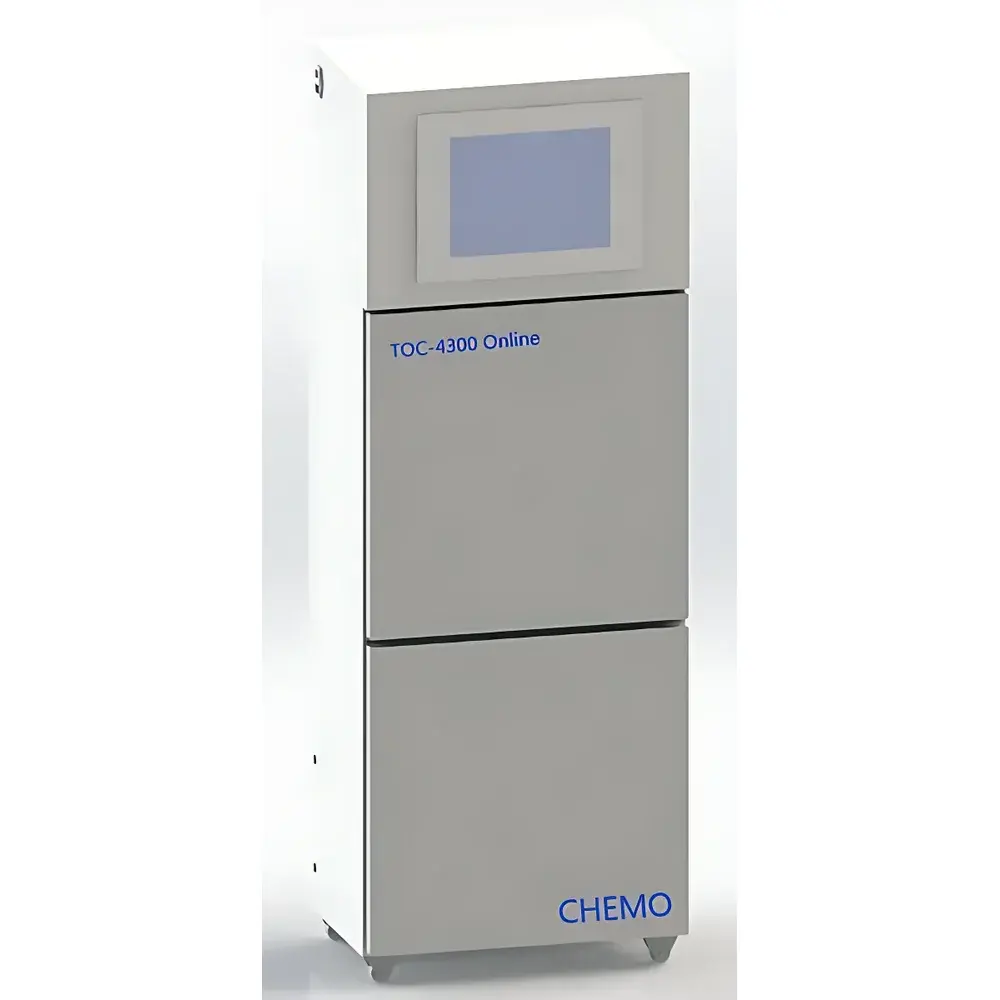
Chemo TOC-4300Online Total Organic Carbon Analyzer
| Brand | Chemo |
|---|---|
| Origin | Hubei, China |
| Manufacturer Type | Authorized Distributor |
| Product Category | Domestic |
| Model | TOC-4300Online |
| Instrument Type | Online TOC Analyzer |
| Detection Principle | Non-Dispersive Infrared Absorption (NDIR) |
| Oxidation Method | UV/Persulfate Oxidation |
| Measurement Range | 0–100 mg/L |
| Accuracy | ±5% |
| Resolution | 1 ppb |
| Detection Limit | 5 ppb |
| Repeatability | ≤3% |
Overview
The Chemo TOC-4300Online Total Organic Carbon Analyzer is an industrial-grade online water quality monitoring system engineered for continuous, real-time quantification of total organic carbon in ultrapure and process water streams. It operates on the well-established UV/persulfate oxidation–NDIR detection principle: organic carbon compounds are fully mineralized to CO2 under synergistic ultraviolet irradiation and acidic persulfate catalysis; simultaneously, inorganic carbon (IC) is acidified and purged as CO2; the resulting CO2 is carried by high-purity nitrogen gas through a dual-stage electronic condenser and hydrophobic membrane dryer before entering a temperature-stabilized, gold-coated NDIR optical cell. The absorbance at 4.26 µm is measured with high signal-to-noise ratio, enabling trace-level TOC determination with metrological rigor suitable for regulated environments.
Key Features
- Four simultaneous measurement modes—Total Carbon (TC), Total Inorganic Carbon (TIC), Total Organic Carbon (TOC = TC − TIC), and Non-Purgeable Organic Carbon (NPOC)—executed within a single reaction chamber, eliminating cross-contamination and calibration drift between modes.
- Optimized NDIR detection architecture featuring a highly reflective gold-plated gas cell, collimated infrared source, and thermoelectrically cooled pyroelectric detector—delivering stable baseline performance and sub-ppb sensitivity across extended operational cycles.
- Dual-path electronic condensation combined with selective membrane dehydration ensures consistent removal of water vapor without CO2 loss, maintaining stoichiometric integrity of the carbon signal.
- Real-time graphical display of TOC response curves, oxidation efficiency profiles, and system diagnostics—accessible via integrated Windows-based HMI with touch-enabled interface and multi-user permission levels.
- Comprehensive self-monitoring of critical process parameters: reactor temperature (±0.1 °C), carrier gas pressure (±0.5 kPa), flow rate (±1 mL/min), and oxidation chamber status—all logged with timestamps for audit readiness.
- User-configurable calibration curves—including multi-point linear, quadratic, or custom polynomial fits—enabling accurate quantification across heterogeneous sample matrices without hardware modification.
- Fully automated unattended operation with scheduled cleaning, blank verification, and system validation—designed for 7×24 deployment in clean utilities and critical water loops.
- Low-maintenance design: no consumable catalysts, minimal reagent usage (only low-concentration persulfate and phosphoric acid), and service intervals exceeding 6 months under typical operating conditions.
Sample Compatibility & Compliance
The TOC-4300Online is validated for direct analysis of low-conductivity water matrices including drinking water, municipal surface water, potable water distribution systems, purified water (PW), water for injection (WFI), and nuclear/thermal power plant secondary coolant loops. Its design conforms to key regulatory expectations for continuous TOC monitoring: it supports 21 CFR Part 11-compliant data integrity when paired with validated software configurations; meets ISO 8466-1 requirements for calibration traceability; and aligns with USP <643>, EP 2.2.44, and ASTM D5905 guidelines for TOC methodology. All wetted materials (e.g., PFA, quartz, 316L SS) comply with extractables/leachables limits for pharmaceutical-grade applications.
Software & Data Management
The embedded Windows 10 IoT Enterprise platform hosts Chemo TOC Control Suite v3.2—a GxP-ready application supporting role-based access control, electronic signatures, and full audit trail logging (including method changes, calibration events, and alarm acknowledgments). Raw sensor outputs, processed TOC values, QC check results, and system health metrics are timestamped and stored locally (≥12 months) with optional encrypted export to SQL databases or cloud platforms via OPC UA or Modbus TCP. Native RS-485 (Modbus RTU) and Ethernet (RJ45, Modbus TCP/IP) interfaces enable seamless integration with SCADA, DCS, or PLC systems for centralized alarm management and batch record linkage.
Applications
- Continuous monitoring of feedwater and condensate in thermal and nuclear power generation facilities per IAEA NS-G-1.7 and EPRI guidelines.
- Real-time TOC surveillance in pharmaceutical water systems—supporting FDA CGMP compliance for PW/WFI distribution loops and point-of-use validation.
- Early leak detection in semiconductor fab ultrapure water (UPW) networks via trend analysis of baseline TOC excursions.
- Regulatory reporting for municipal drinking water utilities under EPA Method 415.3 and EU Directive 98/83/EC Annex I parameters.
- Process optimization in chemical manufacturing plants—tracking organic carryover in cooling tower blowdown and closed-loop heat exchanger circuits.
FAQ
What oxidation methods does the TOC-4300Online support?
It employs UV/persulfate oxidation—validated for >95% recovery of refractory organics including humic acids, acetates, and low-MW alcohols—without requiring high-temperature combustion or noble-metal catalysts.
Can the instrument measure TOC in high-salinity or high-TDS water?
While optimized for low-conductivity matrices (<5 µS/cm), optional dilution modules and matrix-matched calibration protocols extend applicability to waters up to 1000 µS/cm; consult technical documentation for salinity correction factors.
How is data integrity ensured for regulated environments?
The system supports ALCOA+ principles: all measurements include embedded digital signatures, immutable audit trails, and configurable retention policies—fully compatible with FDA 21 CFR Part 11 and EU Annex 11 requirements when deployed with validated software configuration.
What maintenance is required during long-term unattended operation?
Routine tasks include quarterly replacement of reagent bottles, biannual inspection of gas filters and membrane dryers, and annual verification of NDIR zero/span stability—no optical alignment or detector recalibration is needed under normal use.
Is remote diagnostics and firmware updates supported?
Yes—via secure HTTPS web interface or VPN-connected VNC session; firmware updates follow IEC 62443-3-3 security controls and require dual-authorized approval before installation.







