
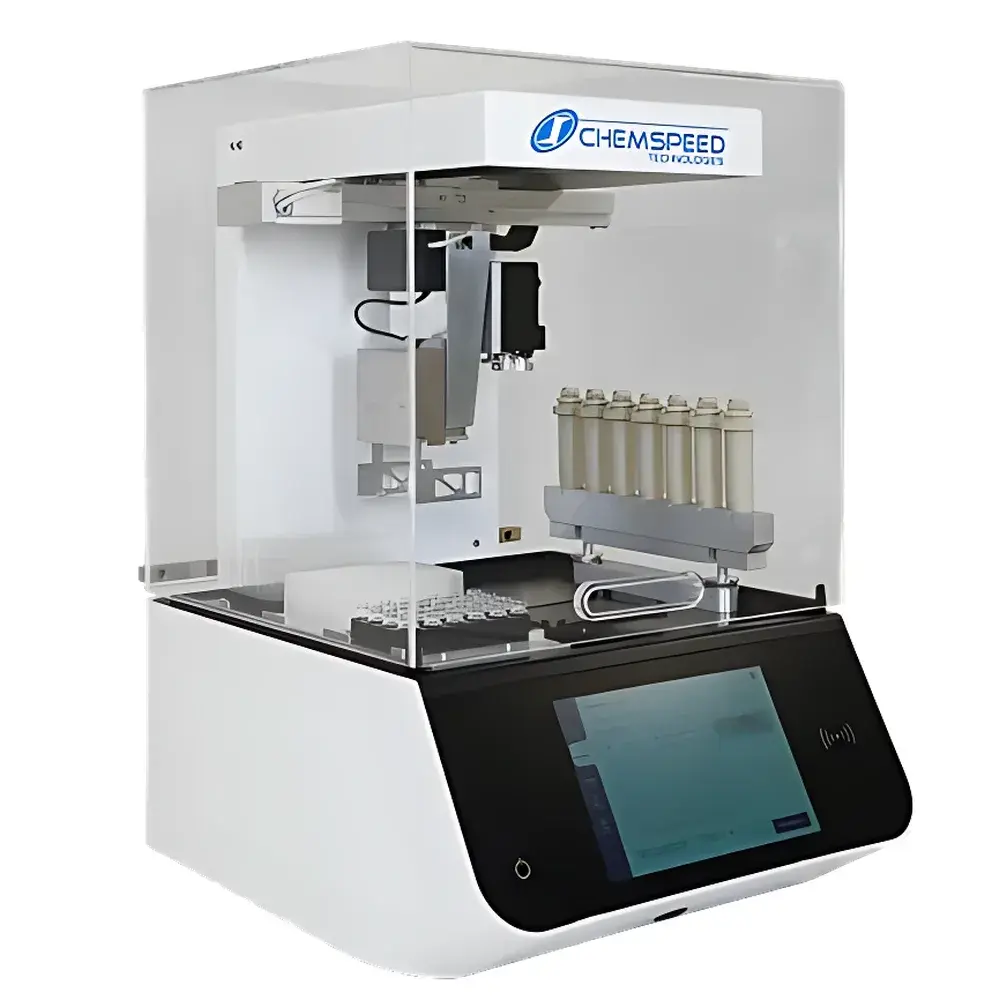
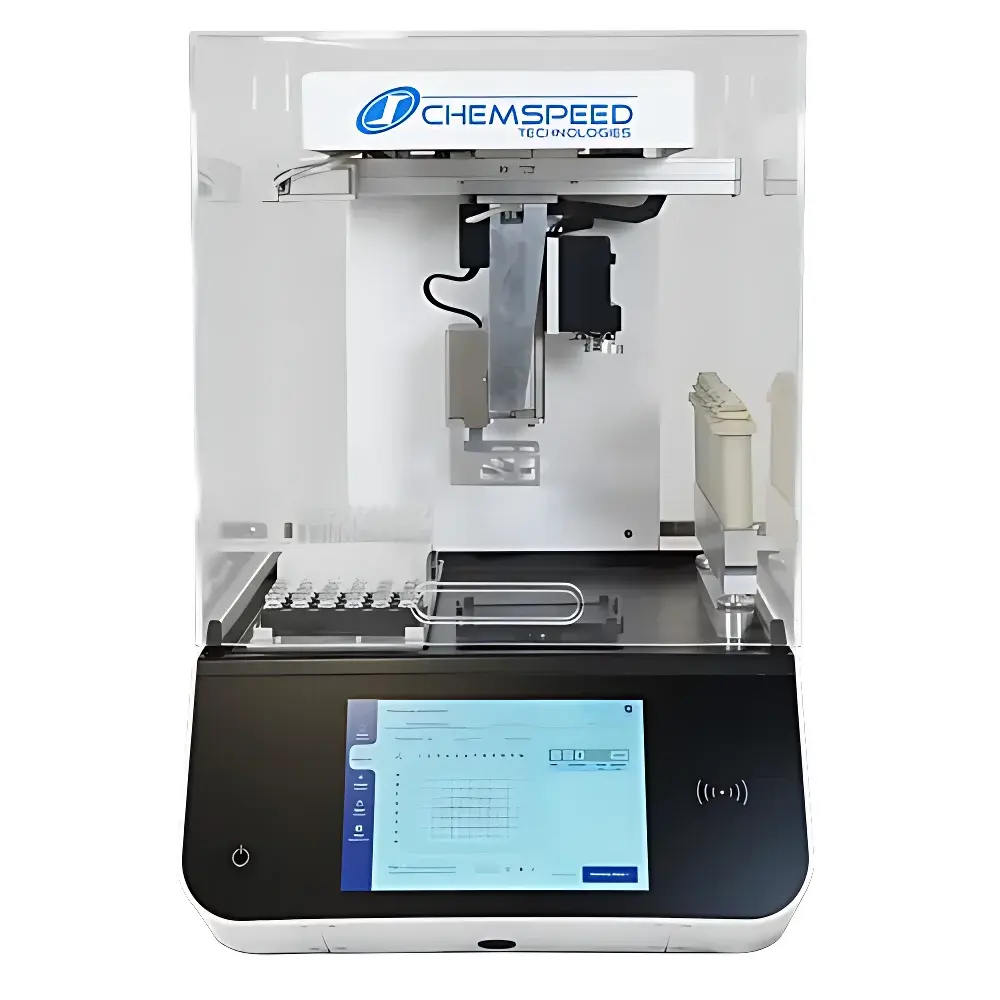
Chemspeed CRYSTAL POWDERDOSE Automated Gravimetric Solid Dosing Workstation
| Brand | CHEMSPEED |
|---|---|
| Origin | Switzerland |
| Model | CRYSTAL POWDERDOSE |
| Weighing Resolution | 10 µg |
| Weighing Range | 1 mg – 20 g |
| Sample Vial Capacity | 7 × 30 mL storage vessels |
| Footprint | 45 cm × 54 cm × 92 cm |
| Dosing Modes | Single-to-Single, Multi-to-Single, Multi-to-Multi |
Overview
The Chemspeed CRYSTAL POWDERDOSE is an automated gravimetric solid dosing workstation engineered for high-precision, repeatable handling of dry powders and granular solids in research, development, and quality control laboratories. Unlike volumetric dispensers, it employs real-time mass-based feedback control—integrating a high-resolution analytical balance (10 µg resolution) with a synchronized robotic arm and intelligent sample management architecture. This closed-loop gravimetric principle ensures dosing accuracy independent of powder density, flowability, or electrostatic behavior—critical for formulation screening, crystallization studies, catalyst loading, and API dose uniformity testing. Designed as a compact benchtop system, the CRYSTAL POWDERDOSE operates within controlled laboratory environments and supports seamless integration into regulated workflows requiring audit trails, electronic signatures, and data integrity per FDA 21 CFR Part 11 and ISO/IEC 17025 guidelines.
Key Features
- Gravimetric dosing with real-time mass feedback: Achieves ±0.01 mg accuracy across the full 1 mg–20 g range, validated per USP & ASTM E899 standards for analytical balance performance.
- Modular sample handling architecture: Seven 30 mL RFID-tagged sample reservoirs enable unattended sequential or parallel processing of diverse solid materials—including hygroscopic, cohesive, or low-density powders.
- Flexible container compatibility: Direct dosing to standard microtiter plates (96-/384-well), vials (1.5–50 mL), scintillation vials, and custom reaction vessels via programmable XYZ positioning and adaptive tip alignment.
- Compact footprint (45 × 54 × 92 cm): Optimized for space-constrained labs while maintaining full functionality—no external ventilation, compressed air, or chilled water required.
- Touchscreen-driven workflow orchestration: Intuitive interface for method creation, DoE parameter mapping (e.g., gradient incremental dosing), and real-time deviation alerts during execution.
- Robust mechanical design: Stainless-steel dosing head, anti-static components, and sealed balance enclosure minimize cross-contamination and environmental interference.
Sample Compatibility & Compliance
The CRYSTAL POWDERDOSE accommodates a broad spectrum of solid-phase materials—crystalline APIs, metal oxides, polymer pellets, excipients, catalysts, and nanomaterials—without requiring solvent slurry preparation. Its gravimetric core eliminates reliance on calibration curves or bulk density assumptions. For regulatory compliance, the system supports full ALCOA+ data integrity principles: all weight values, timestamps, operator IDs, method versions, and environmental logs (temperature/humidity if externally monitored) are immutably recorded. ArkSuite enforces role-based access control, electronic signatures, and 21 CFR Part 11-compliant audit trails—making it suitable for GxP environments including GLP, GMP, and ISO 13485-certified labs.
Software & Data Management
ArkSuite serves as the unified software backbone—combining method development, inventory tracking, run scheduling, and electronic lab notebook (ELN) integration. It supports offline method preparation and batch queueing; once initiated, runs execute autonomously with live progress visualization and automatic failure recovery (e.g., vessel refill prompts). All raw weighing data, intermediate calculations, and final dosing reports export in CSV, PDF, or SDMX formats. Remote monitoring is enabled via secure HTTPS web interface or mobile-responsive dashboard—allowing lab managers to verify status, review historical runs, and trigger diagnostics without physical access. Data backups follow NIST SP 800-88 revision 1 retention protocols.
Applications
- High-throughput formulation screening: Precise multi-component blending for solubility enhancement or polymorph stability assessment.
- Catalyst library preparation: Accurate sub-milligram dosing of heterogeneous catalysts into parallel reactors.
- Reference standard preparation: Certified mass-based dilution series for HPLC/GC calibration.
- DoE-driven crystallization studies: Automated gradient addition of anti-solvents or seeding agents with trace-level reproducibility.
- QC release testing: Uniformity of dosage units (USP ) and content uniformity (USP ) verification for solid oral dosage forms.
- Materials science R&D: Controlled stoichiometric mixing of battery cathode precursors or MOF synthesis reagents.
FAQ
What types of powders can be handled without pre-conditioning?
Hygroscopic, free-flowing, cohesive, and low-density powders—including APIs, salts, and nanoscale fillers—are routinely processed without drying or glidant addition, thanks to adaptive vibration-assisted dispensing and real-time mass feedback.
Is calibration traceable to national standards?
Yes—internal calibration routines reference certified weights traceable to PTB (Germany) and NIST (USA); full calibration reports comply with ISO/IEC 17025 requirements.
Can the system integrate with existing LIMS or ELN platforms?
Via RESTful API and configurable CSV/XML export templates, enabling bidirectional synchronization with major LIMS (e.g., LabWare, Thermo Fisher SampleManager) and ELN systems (e.g., Benchling, Dotmatics).
How is cross-contamination prevented between samples?
Automated cleaning cycles (vacuum purge + ultrasonic tip wash option), disposable dosing tips, and RFID-verified vessel swaps ensure material segregation; cleaning logs are embedded in audit trails.
What maintenance is required for long-term operational reliability?
Scheduled quarterly verification of balance linearity, robotic repeatability, and RFID reader sensitivity—documented in ArkSuite’s preventive maintenance scheduler with auto-generated service tickets.
Related Products



