
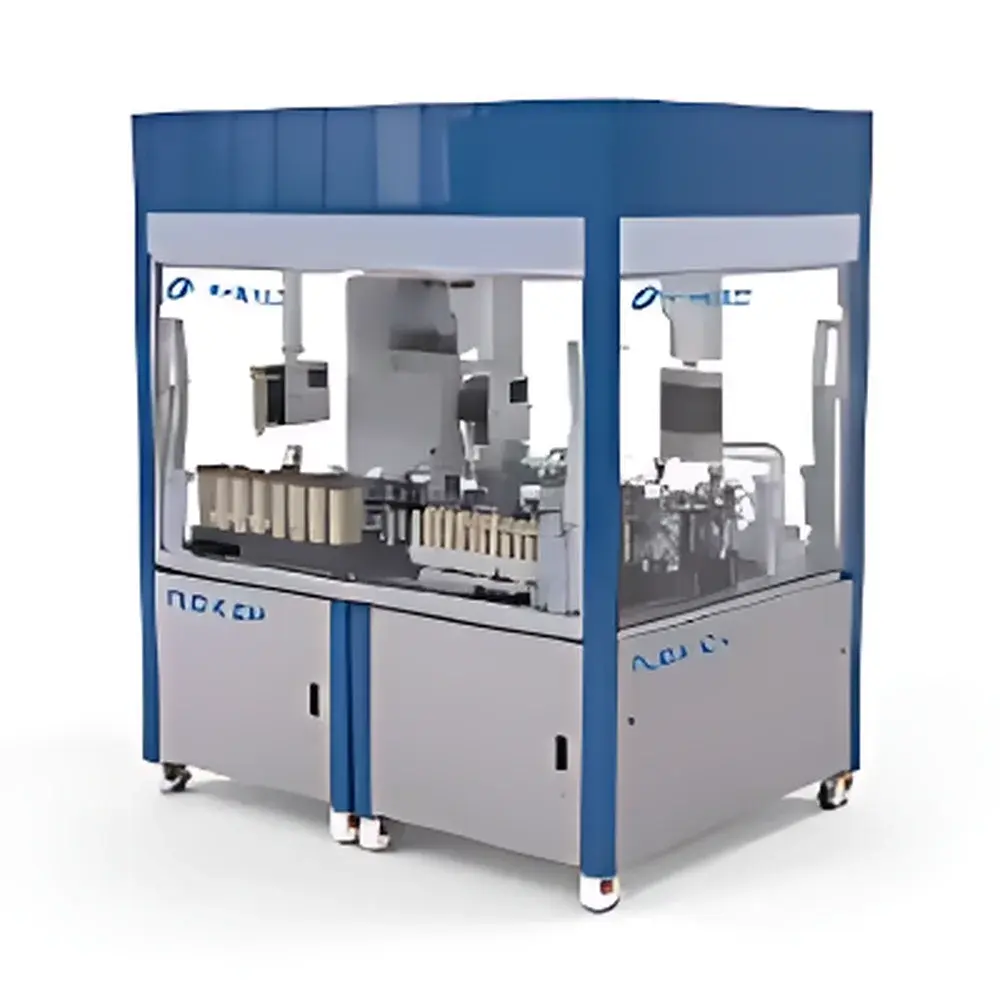
CHEMSPEED FLEX EP High-Throughput Mobile Phase Preparation Workstation
| Brand | CHEMSPEED |
|---|---|
| Origin | Switzerland |
| Model | FLEX EP |
| Batch Capacity | 15 × 2 L (with optional 0.5 L and 1 L volumetric flasks) |
| Volumetric Accuracy | Automated final volume adjustment to flask neck |
| Solid Dispensing Accuracy | ±0.1 mg |
| Liquid Dispensing Accuracy | ±0.4 mL |
| pH Control Range | 1.0–13.0 |
| Regulatory Compliance | Fully compliant with GMP and FDA 21 CFR Part 11 requirements |
| Integration | Native LIMS connectivity via ASTM E1578-compliant interface |
Overview
The CHEMSPEED FLEX EP High-Throughput Mobile Phase Preparation Workstation is an engineered solution for the automated, traceable, and auditable preparation of chromatographic mobile phases in regulated analytical laboratories. Built upon a modular robotic platform, it implements gravimetric solid dispensing, precision liquid metering, and closed-loop pH adjustment within a single integrated workflow. Unlike manual or semi-automated methods, the FLEX EP executes mobile phase formulation using a validated sequence of operations—including reagent identification, mass-based solid dosing, solvent addition, homogenization, pH titration, and final volumetric adjustment—each step digitally recorded with full electronic audit trail. Its architecture supports both reversed-phase and ion-pairing HPLC/UHPLC method development, stability-indicating assay validation, and routine QC batch preparation under cGMP environments.
Key Features
- Gravimetric solid dispensing with high-resolution microbalances (±0.1 mg repeatability), enabling accurate preparation of buffer salts, ion-pair reagents, and additives.
- Positive-displacement liquid handling system delivering ±0.4 mL accuracy across 0.5 L, 1 L, and 2 L volumetric flasks—calibrated per ISO/IEC 17025-accredited procedures.
- Integrated pH metrology module featuring automatic electrode calibration (two-point, NIST-traceable buffers), real-time titrant delivery, and dynamic endpoint detection for precise acid/base adjustment within pH 1.0–13.0.
- Automated volumetric finishing: optical meniscus detection aligns final solvent addition to the etched neck mark of Class A volumetric glassware, eliminating parallax error and operator dependency.
- Modular tool changer supporting interchangeable solid dosing heads, liquid probes, pH electrodes, and magnetic stirrers—enabling unattended multi-step protocols without manual intervention.
- Embedded process control logic ensures sequential execution only upon successful verification of intermediate conditions (e.g., stable pH reading, temperature equilibration, mass tolerance met).
Sample Compatibility & Compliance
The FLEX EP accommodates standard laboratory-grade volumetric flasks (DIN EN ISO 1042) in capacities of 0.5 L, 1 L, and 2 L. It handles aqueous buffers, organic-aqueous mixtures (e.g., acetonitrile/water, methanol/water), and low-volatility solvents (e.g., THF, DMF) with inert fluid path materials (PFA, PEEK, sapphire). All user interactions, parameter entries, and instrument events are captured in a secure relational database with immutable timestamps, electronic signatures, and role-based access control—fully satisfying FDA 21 CFR Part 11 Subpart B requirements for electronic records and signatures. System validation documentation (IQ/OQ/PQ protocols), risk assessments (per ICH Q9), and change control logs are provided as part of the delivery package, facilitating GLP and GMP audits.
Software & Data Management
Controlled by CHEMSPEED’s SWING software suite, the FLEX EP operates under a 21 CFR Part 11-compliant environment with built-in audit trail, electronic signature enforcement, and data integrity safeguards (ALCOA+ principles). Method templates are stored as version-controlled XML files; each run generates a complete digital batch record including raw sensor data (mass vs. time, pH vs. titrant volume), metadata (operator ID, timestamp, environmental conditions), and deviation flags. Data export adheres to ASTM E1578 (Standard Guide for Laboratory Information Management Systems) and supports direct integration into enterprise LIMS platforms via HTTPS-based RESTful API or OPC UA protocol. Raw data archives are encrypted at rest and retained in accordance with internal SOPs and regulatory retention policies (e.g., FDA guidance on data retention for pharmaceutical testing).
Applications
- Routine preparation of HPLC/UHPLC mobile phases for pharmacopeial assays (USP , EP 2.2.46).
- Stability-indicating method development requiring systematic variation of pH, ionic strength, and organic modifier concentration.
- QC release testing workflows where mobile phase composition directly impacts system suitability (e.g., resolution, tailing factor, retention time reproducibility).
- Method transfer between R&D and manufacturing labs, ensuring identical mobile phase preparation conditions across sites.
- Support for DOE (Design of Experiments) studies involving >50 mobile phase variants, with full traceability from formulation parameters to chromatographic output.
FAQ
Does the FLEX EP support non-aqueous mobile phases such as pure acetonitrile or THF?
Yes—the liquid handling system is chemically resistant to common HPLC solvents, and all wetted parts are constructed from PFA, PEEK, and sapphire to ensure long-term compatibility and minimal extractables.
Can the system be qualified for use in a GMP manufacturing environment?
Yes—CHEMSPEED provides full qualification documentation (IQ/OQ/PQ), vendor risk assessments, and 21 CFR Part 11 compliance reports suitable for submission during regulatory inspections.
Is remote monitoring and intervention possible during a run?
Yes—SWING software supports secure remote desktop access and real-time dashboard viewing via TLS-encrypted web interface, with configurable email/SNMP alerts for critical events.
How is calibration traceability maintained for mass and pH measurements?
All balances are calibrated using NIST-traceable weights annually, and pH electrodes are calibrated against certified buffer standards before each batch; calibration records are automatically embedded in the electronic batch record.
What happens if a volumetric flask breaks during operation?
The workstation includes integrated glass break detection via acoustic sensors and pressure feedback; the system halts immediately, logs the event, and initiates safety protocols to isolate fluid paths and prevent cross-contamination.



