
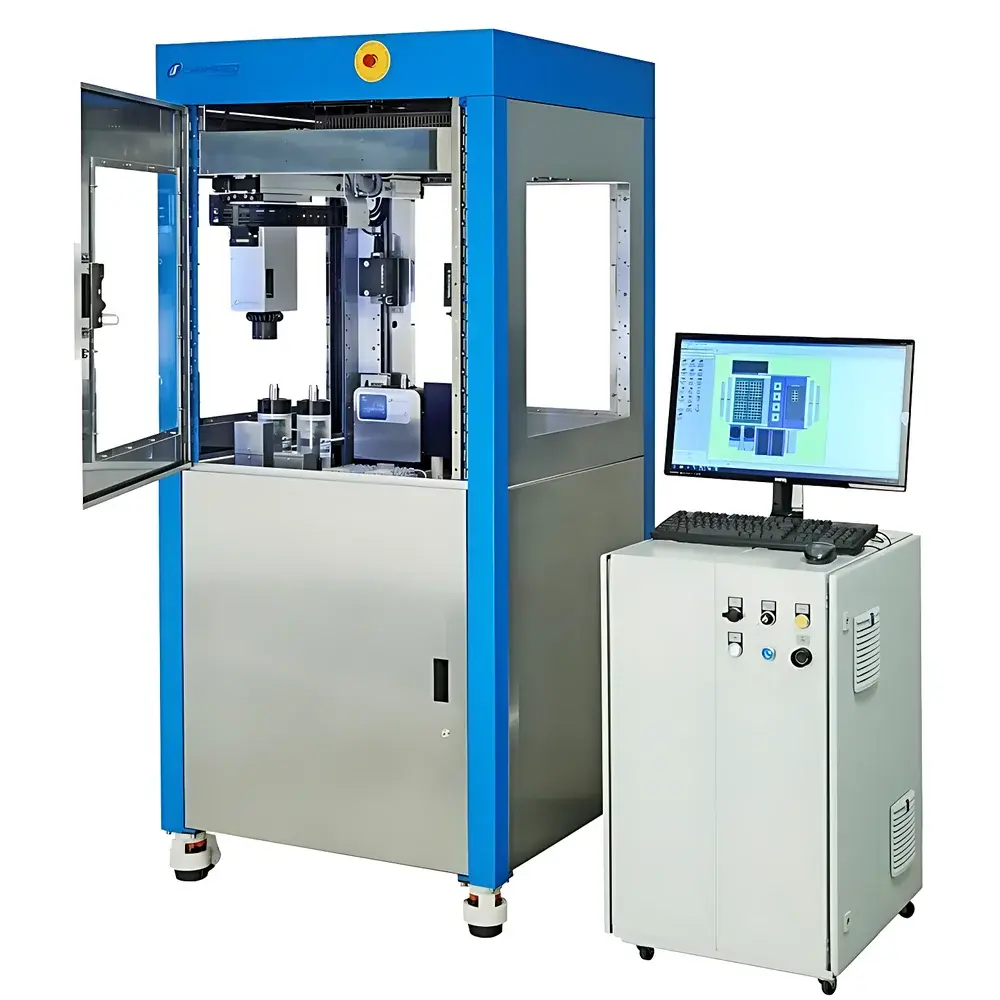
Chemspeed FLEX ISYNTH High-Throughput Automated Synthesis Workstation
| Brand | CHEMSPEED |
|---|---|
| Origin | Switzerland |
| Model | FLEX ISYNTH |
| Temperature Range | –20 °C to +150 °C |
| Reaction Volume Capacity | microscale to milliliter scale |
| Parallel Reaction Capacity | up to 96 reactions per run |
| Footprint | 90 cm × 90 cm |
Overview
The Chemspeed FLEX ISYNTH is a fully automated, modular high-throughput synthesis workstation engineered for precision, reproducibility, and operational flexibility in modern synthetic chemistry laboratories. Built upon Chemspeed’s proprietary robotic platform architecture, the FLEX ISYNTH integrates reaction setup, execution, workup, and inline analysis into a single closed-loop system—enabling both solid-phase and solution-phase library synthesis under programmable environmental control. Its core operation relies on gravimetric solid dispensing (via the patented SWILE powder handling module) and multi-channel liquid handling (using Chemspeed’s 4-tip positive-displacement pipetting system), ensuring stoichiometric accuracy across heterogeneous reagent classes. The system operates under inert atmosphere capability (optional integration with glovebox or nitrogen purge), supports reflux, heating, cooling, shaking, and vacuum-assisted filtration—all within standardized reaction vessels arranged in 48- or 96-position arrays. Designed for scalability and method transfer, the FLEX ISYNTH serves as a central node in digital lab infrastructure, compliant with FAIR data principles and compatible with LIMS and ELN integrations.
Key Features
- Modular robotic platform with configurable station layout: users select and combine modules for weighing, liquid dispensing, reaction control, filtration, evaporation, and sampling without hardware reconfiguration.
- SWILE solid dispensing technology: enables gravimetric, one-to-one dosing of powders—including air-sensitive, hygroscopic, or low-melting-point compounds—with resolution down to 10 µg and repeatability <±1% RSD.
- 4-channel positive-displacement pipetting system: delivers liquids from 1 µL to 5 mL with CV <0.8% at volumes ≥10 µL; compatible with DMSO, THF, chlorinated solvents, and aqueous buffers.
- Temperature-controlled reaction block: Peltier-based heating/cooling with real-time PID regulation; uniform thermal distribution across all positions; programmable ramp rates and dwell times.
- Integrated mechanical agitation: orbital shaking (100–1200 rpm) and vortex mixing options ensure homogeneity during heterogeneous catalysis or suspension-based reactions.
- Compact footprint (90 cm × 90 cm): optimized for benchtop deployment in fume hoods or controlled-environment labs without requiring dedicated floor space or external utilities.
Sample Compatibility & Compliance
The FLEX ISYNTH accommodates a broad spectrum of chemistries—from air- and moisture-sensitive organometallic transformations (e.g., Grignard, Suzuki-Miyaura, Negishi couplings) to thermally demanding Diels–Alder cycloadditions and transfer hydrogenations. Vessel formats include 0.5–5 mL glass vials with septa-compatible caps, screw-top reactors with integrated condensers, and filter plates for solid-phase scavenging. All wetted materials are chemically resistant (e.g., PTFE, sapphire, borosilicate glass, Hastelloy C-276), validated for compatibility with strong bases (e.g., n-BuLi), Lewis acids (e.g., AlCl₃), and oxidants (e.g., mCPBA). The system supports GLP/GMP-aligned workflows through audit-trail-enabled software logging, electronic signatures (21 CFR Part 11 compliant when deployed with validated AUTOSUITE configuration), and traceable metadata capture for each reaction step—including mass logs, temperature profiles, and actuator timestamps.
Software & Data Management
AUTOSUITE is a workflow-driven, Windows-based control environment that abstracts complex robotic sequencing into intuitive drag-and-drop protocol building. Users define synthesis methods using hierarchical steps (e.g., “dispense solid A”, “add solvent B”, “heat to 80 °C for 2 h”, “filter supernatant”), with conditional logic (IF/THEN branching), error-handling routines, and real-time status dashboards. All raw instrument data—including gravimetric records, temperature curves, and motor current traces—are stored in structured SQLite databases with SHA-256 checksum integrity verification. Export formats include CSV, PDF reports (with embedded spectra if coupled to UV-Vis or FTIR), and AnIML-compliant XML for cross-platform interoperability. Remote monitoring via HTTPS-enabled web interface allows secure access for QC review or cross-site collaboration.
Applications
- C–C and C–N cross-coupling optimization: rapid screening of ligands, bases, and catalyst loadings across 96 conditions in under 8 hours.
- Organometallic library generation: automated preparation of Grignard, organolithium, and zincate reagents followed by quenching and derivatization.
- Medicinal chemistry hit-to-lead campaigns: parallel synthesis of analog series with variable substitution patterns on heterocyclic scaffolds.
- Materials science precursor development: controlled synthesis of metal–organic frameworks (MOFs) and coordination polymers via solvothermal or mechanochemical protocols.
- Process chemistry route scouting: comparative evaluation of solvent systems, stoichiometries, and heating profiles prior to kilolab scale-up.
FAQ
What types of reactions can be automated on the FLEX ISYNTH?
The system supports a wide range of thermal, catalytic, and stoichiometric reactions—including transition-metal-catalyzed couplings, nucleophilic substitutions, cyclizations, reductions, and acid/base-mediated condensations—provided reagents are compatible with the material-wetted components and temperature range.
Is inert-atmosphere synthesis supported?
Yes; optional integration with nitrogen-purged enclosures or direct glovebox coupling enables Schlenk-line-level handling of oxygen- and moisture-sensitive reagents.
Can the FLEX ISYNTH interface with analytical instruments?
It supports automated sample transfer to HPLC autosamplers, GC vial racks, and microplate readers via standardized gripper tooling and TTL/RS232 triggers; API-level integration with Thermo Fisher, Agilent, and Waters platforms is available under custom deployment.
How is calibration and maintenance managed?
Gravimetric and volumetric calibrations are performed using NIST-traceable standards; scheduled diagnostics (e.g., pipette tip ejection force, motor torque profiling) are logged automatically and flagged for service if thresholds are exceeded.
What safety features are built into the system?
Hardware interlocks prevent door opening during pressurized or heated operations; thermal runaway detection halts heating if local sensor deviation exceeds ±5 °C from setpoint; solvent leak sensors trigger immediate shutdown and ventilation activation.



