
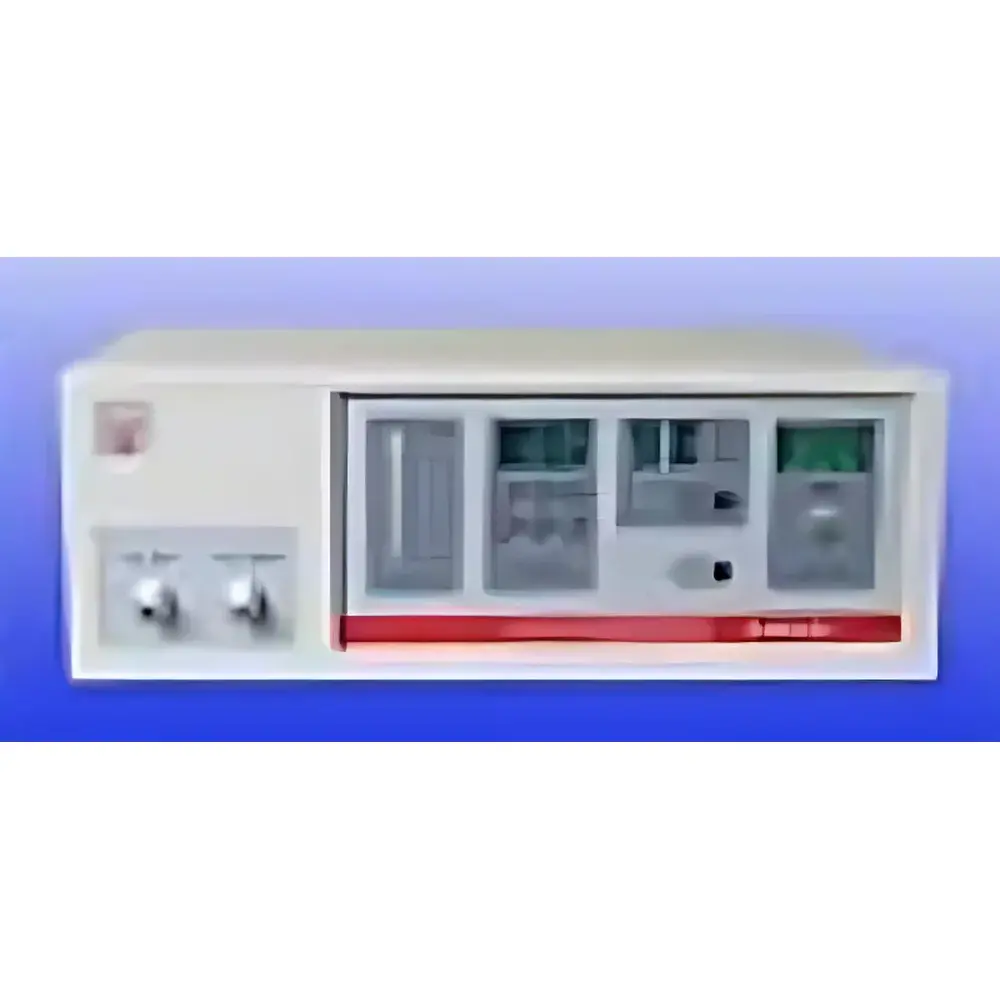
Chengdu Instrument Factory DHX Series Animal Ventilator
| Origin | Sichuan, China |
|---|---|
| Manufacturer Type | Distributor |
| Origin Category | Domestic (China) |
| Model | DHX |
| Pricing | Upon Request |
| Tidal Volume Range | 1–50 mL / 1–150 mL / 1–300 mL / 1–500 mL (selectable) |
| Respiratory Rate | 1–199 breaths/min |
| I | E Ratio Options: 1:1, 1:2, 1:3, 2:1 |
| Power Supply | 220 V ±10%, 50 Hz |
| Dimensions (W×H×D) | 400 × 140 × 280 mm |
Overview
The Chengdu Instrument Factory DHX Series Animal Ventilator is a microprocessor-controlled, volume-cycled, positive-pressure ventilator designed for acute and chronic in vivo physiological studies in laboratory animals. Engineered for precision and operational reliability, the DHX delivers consistent tidal volumes across a broad range of species—from small rodents (e.g., rats, guinea pigs, hamsters) to larger mammals (e.g., rabbits, cats, dogs, and non-human primates). Its core operating principle relies on stepper motor-driven piston displacement, enabling accurate volumetric delivery without dependence on external high-pressure gas sources. Air is drawn from ambient environment, filtered, and delivered at user-defined flow profiles to maintain alveolar ventilation and support gas exchange during anesthesia-induced apnea, thoracotomy, or neuromuscular blockade. The device complies with fundamental electrical safety requirements for Class I medical-grade laboratory equipment per GB 9706.1 (equivalent to IEC 60601-1), and its control architecture supports stable operation under standard vivarium power conditions.
Key Features
- Stepper motor–driven piston mechanism ensures high reproducibility and linearity in tidal volume delivery, with resolution down to 1 mL and real-time digital display of set and nominal tidal volume.
- Four selectable tidal volume ranges (1–50 mL, 1–150 mL, 1–300 mL, 1–500 mL) accommodate diverse animal models and experimental protocols without hardware modification.
- Adjustable respiratory rate from 1 to 199 breaths per minute, supporting both bradypneic and tachypneic ventilation strategies in pharmacological or pathological models.
- Preset inspiratory-to-expiratory (I:E) ratios—including symmetric (1:1) and asymmetric configurations (1:2, 1:3, 2:1)—enable simulation of physiological or pathophysiological breathing patterns.
- On-the-fly parameter adjustment: All settings—including rate, tidal volume, and I:E ratio—can be modified during active ventilation via front-panel controls; changes take immediate effect without interrupting airflow.
- Non-volatile memory retains the last-used configuration after power interruption, minimizing setup time between experiments and ensuring protocol continuity.
- Compact footprint (400 × 140 × 280 mm) and ambient-air operation eliminate need for compressed gas infrastructure, enhancing flexibility in multi-station surgical setups or mobile research platforms.
Sample Compatibility & Compliance
The DHX ventilator is validated for use with intubated or tracheostomized subjects across common preclinical models. Its modular airflow path accommodates standard small-animal endotracheal tubes (ID 0.8–4.0 mm) and features low-dead-space design to minimize rebreathing and CO2 accumulation. While not certified as a human medical device, the system adheres to GLP-aligned documentation practices for instrument qualification (IQ/OQ), including traceable calibration logs and user-accessible maintenance records. It supports integration into ISO/IEC 17025–accredited laboratories where equipment validation follows SOPs aligned with NIH OLAW and AAALAC International standards for humane animal use.
Software & Data Management
The DHX operates via embedded firmware with no external PC dependency; however, optional RS-232 or TTL-level serial interface enables connection to third-party data acquisition systems (e.g., ADInstruments LabChart, iWorx, or custom MATLAB/Python scripts) for synchronized recording of ventilation parameters alongside physiological signals (ECG, BP, SpO2, EMG). Timestamped event markers—such as “ventilation start,” “parameter change,” and “pause”—are output in ASCII format for post-hoc alignment. Audit trails are maintained locally for all parameter modifications, satisfying basic traceability requirements under institutional animal care and use committee (IACUC) review frameworks.
Applications
- Support of mechanical ventilation during surgical procedures involving thoracic or neurological interventions.
- Standardization of respiratory parameters in pharmacokinetic/pharmacodynamic (PK/PD) studies assessing drug effects on respiratory drive or airway resistance.
- Modeling of acute lung injury (ALI), ARDS, or obstructive pulmonary disease through controlled I:E manipulation and tidal volume titration.
- Neurophysiological studies requiring precise coupling of respiratory phase with neural recording (e.g., respiratory modulation of cortical oscillations).
- Teaching laboratories for demonstration of respiratory mechanics, compliance, and work of breathing concepts using live animal preparations.
FAQ
Does the DHX require an external compressed air supply?
No—the DHX draws and filters ambient air internally using a quiet, oil-free diaphragm pump; no external gas cylinders or wall outlets are needed.
Can tidal volume be calibrated independently for each range setting?
Yes—each of the four volume ranges includes dedicated calibration offsets stored in non-volatile memory, allowing independent verification and adjustment per range per institution’s metrology protocol.
Is the device compatible with negative pressure (iron lung–style) ventilation modes?
No—the DHX is exclusively a positive-pressure, volume-controlled ventilator; it does not support pressure-control, pressure-support, or negative-pressure operation.
What maintenance is required for long-term reliability?
Routine maintenance includes quarterly inspection of the air inlet filter, annual verification of tidal volume accuracy using a calibrated dry gas meter, and biannual lubrication of the stepper motor coupling per manufacturer’s technical bulletin.
How is alarm functionality implemented?
The DHX provides visual status indicators (LEDs) for power, ventilation active, and error states (e.g., occlusion, motor stall); however, it does not include audible alarms or automated shutdown—users must monitor operation visually or integrate external monitoring via serial output.




