
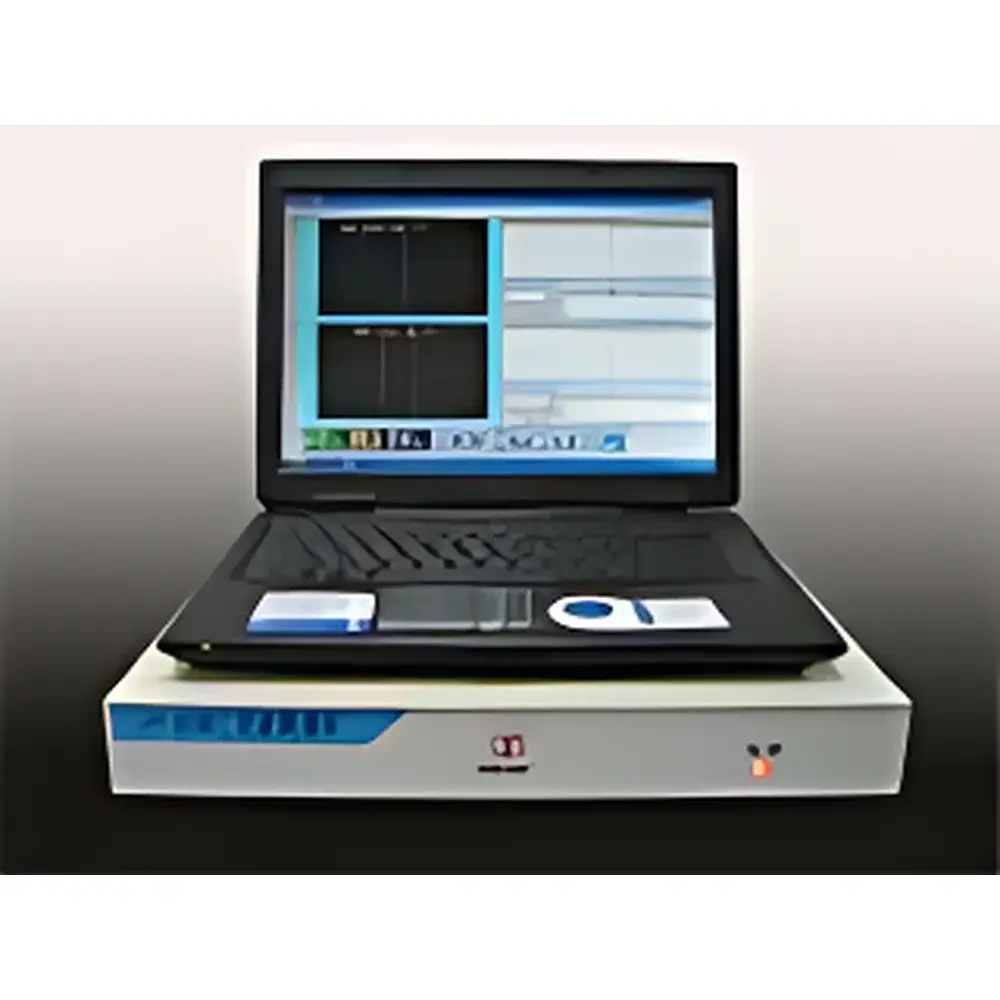
Chengdu Instrument Factory JP-2E Potentiostatic Stripping Voltammetry Analyzer
| Origin | Sichuan, China |
|---|---|
| Manufacturer Type | Authorized Distributor |
| Origin Category | Domestic (China) |
| Model | JP-2E |
| Pricing | Upon Request |
| Polarographic Sensitivity | <5×10⁻⁸ mol/L (Cd²⁺, Linear Sweep Voltammetry) |
| Polarographic Peak Resolution | <32 mV |
| Anti-Interference Capability (Pre-reduced Species) | >20,000:1 |
| Repeatability Error | <0.4% |
| Current Range | 15 nA–400 µA F.S., 23 programmable decades |
| Polarization Potential Range | ±4000 mV, minimum step: 2 mV |
| Scan Rate | 50–1600 mV/s |
| Scan Amplitude | 50–1600 mV |
| Scan Period | 2–22 s |
| Power Supply | AC 220 V ±10%, 50 Hz |
| Weight | 15 kg |
| Interface | USB 2.0 for PC connectivity |
| Software Modes | Linear Sweep Voltammetry, Stripping Voltammetry (Anodic/Cathodic), Cyclic Voltammetry (Anodic/Cathodic), First/Second Derivative Voltammetry |
| Quantitative Methods | Calibration Curve (Linear & Quadratic Regression), Standard Addition, Standard Comparison |
| Electrode Compatibility | Glassy Carbon Electrode (GCE) interface with full Dropping Mercury Electrode (DME) functional equivalence |
| Data Export | Native CSV/Excel-compatible output, curve annotation, overlay, and statistical post-processing |
Overview
The Chengdu Instrument Factory JP-2E Potentiostatic Stripping Voltammetry Analyzer is a benchtop electrochemical instrumentation platform engineered for high-precision trace metal quantification and redox behavior characterization in aqueous and semi-aqueous matrices. Based on classical polarographic principles—specifically controlled-potential electrolysis coupled with differential pulse and linear sweep detection—the JP-2E implements potentiostatic stripping voltammetry (PSV), anodic/cathodic stripping voltammetry (ASV/CSV), and cyclic voltammetry (CV) to resolve multi-element systems with sub-nanomolar sensitivity. Its design emphasizes reproducibility in regulated analytical workflows, particularly where sequential or simultaneous determination of co-existing analytes (e.g., Pb/Zn, W/Mo, Sn, aniline, or food-grade dyes) is required under standardized sample preparation protocols. The instrument operates under constant potential control during the pre-concentration (electrodeposition) phase, followed by a precisely timed, voltage-scanned dissolution step—enabling quantitative peak current integration and half-wave potential identification per IUPAC-recommended conventions.
Key Features
- 23-decade programmable current range (15 nA–400 µA F.S.) with auto-ranging and real-time baseline correction for capacitive and residual faradaic currents
- ±4000 mV polarization window with 2 mV resolution, supporting both anodic and cathodic stripping protocols without hardware reconfiguration
- Scan rate tunability from 50 to 1600 mV/s and amplitude adjustment from 50 to 1600 mV—enabling method optimization per electrode kinetics and diffusion layer constraints
- Dual-channel oscillographic display mode (software-enabled) for concurrent visualization of two independent voltammograms—ideal for comparative kinetic studies or internal standard referencing
- Integrated GCE-specific electrode interface with mechanical and electrical compatibility for rotating disk electrodes (RDE) and mercury-film electrodes, while retaining full functional equivalence to classical dropping mercury electrode (DME) operation
- Onboard parameter storage for up to five user-defined methods plus universal templates; all settings—including enrichment time, cleaning duration, and scan direction—are retained across power cycles
- Real-time curve rendering with multi-color trace assignment, automatic peak detection (wave height, Ep/2, Ep), and embedded quantitative regression engine
Sample Compatibility & Compliance
The JP-2E is routinely deployed in environmental monitoring (soil extract analysis for Mo, Sn), food safety (detection of heavy metals in milk, food additives, and colorants), clinical screening (trace element profiling in biological fluids), and agricultural chemistry (leaf-tissue molybdenum quantification). It supports ASTM D3559 (lead in water), ISO 8466-2 (calibration models for instrumental analysis), and USP / (elemental impurities in pharmaceuticals) when paired with validated sample digestion and matrix-matched calibration procedures. While not inherently 21 CFR Part 11 compliant, its software architecture permits audit-trail logging, electronic signature integration, and secure data archiving when deployed within GLP/GMP-aligned laboratory information management systems (LIMS).
Software & Data Management
The JP-2E is operated exclusively via Windows-based control software featuring three primary quantitative modules: (1) Standard Curve Analysis (linear and quadratic regression with R², slope, intercept, and confidence intervals); (2) Standard Addition Method (multi-point incremental spiking with extrapolated zero-intercept calculation); and (3) Standard Comparison (single-point ratio-based quantification). All acquired voltammograms are stored in vendor-neutral .csv format, fully compatible with Microsoft Excel, OriginLab, and Python-based electrochemical data processing libraries (e.g., PyEC). Curve overlays, derivative transformation (1st/2nd order), baseline subtraction, and noise filtering are performed in real time. Raw data files include metadata timestamps, instrument configuration logs, and electrode status flags—ensuring traceability for regulatory review.
Applications
- Simultaneous quantification of Pb and Zn in drinking water extracts using dual-step ASV with mercury-film electrodes
- Speciation analysis of molybdenum in plant tissue digests via cathodic stripping voltammetry at pH 4.5 acetate buffer
- Stability assessment of food-grade aniline derivatives through cyclic voltammetric reversibility indexing (ΔEp, ipa/ipc)
- Quality control of edible pigment batches (e.g., Tartrazine, Sunset Yellow) via adsorptive stripping voltammetry on activated carbon-modified GCE
- Teaching laboratories: hands-on instruction in diffusion-controlled electrode kinetics, Nernstian behavior, and ligand-complex stability constants using Cu(II)/EDTA titration curves
FAQ
Does the JP-2E support compliance with FDA 21 CFR Part 11?
The base software does not include built-in electronic signatures or audit-trail generation; however, it exports timestamped, immutable data files that can be ingested into validated LIMS platforms meeting Part 11 requirements.
Can the instrument perform stripping analysis with solid-state electrodes only?
Yes—its GCE interface supports carbon paste, bismuth-film, and gold nanoparticle-modified electrodes; mercury-based electrodes remain optional for legacy method alignment.
Is the 23-current-range capability manually selectable or fully automated?
Ranges are selected automatically based on signal-to-noise optimization during each scan cycle, though manual override is available for method development.
What is the maximum allowable sample volume for deposition in ASV mode?
No fixed upper limit—the deposition time (programmable 0–1800 s) and stirring rate govern mass transport; typical volumes range from 10–50 mL depending on analyte concentration and electrode surface area.
How is electrode cleaning handled between runs?
The software includes configurable electrochemical cleaning protocols (e.g., +1.2 V hold for 30 s in blank electrolyte) and optional mechanical polishing routines synchronized with sequence automation.






