
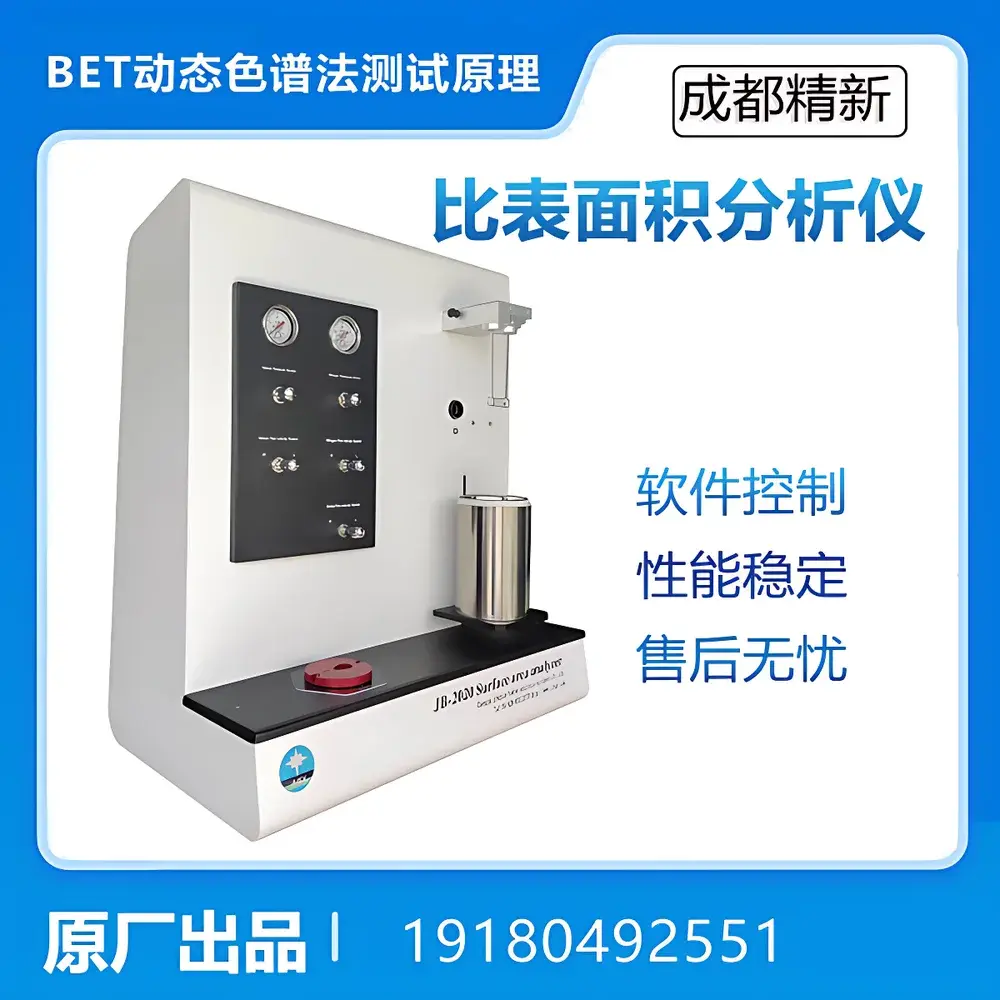
Chengdu Jingxin JB-2020 Dynamic Nitrogen Adsorption Specific Surface Area Analyzer
| Brand | Chengdu Jingxin (CDJX) |
|---|---|
| Origin | Sichuan, China |
| Manufacturer Type | Direct Manufacturer |
| Country of Origin | China |
| Model | JB-2020 |
| Instrument Category | Specific Surface Area Analyzer |
| Operating Principle | Dynamic (Flow) Nitrogen Adsorption at Cryogenic Temperature |
| Number of Analysis Stations | 1 |
| Measurement Range | 0.0005 m²/g to unlimited upper bound |
| Pressure Control Range | 1–5 kPa (gauge) |
| Theoretical Basis | Dynamic nitrogen adsorption coupled with thermal desorption detection and calibrated gas chromatographic response |
| Calibration Standards | GBW(E)130275 certified reference material (CRM), compliant with GB/T 19587–2017 |
| Sample Tube Material | High-temperature-resistant borosilicate glass (GG-type), U-shaped configuration |
| Repeatability | ≤ ±3% RSD |
| Accuracy | ≤ ±3% (vs. certified CRM) |
| Carrier Gas | Ultra-high-purity helium (≥99.999%) |
| Adsorbate Gas | Liquid-nitrogen-cooled high-purity nitrogen (≥99.999%) |
| Test Duration per Sample | ~3 minutes |
| Software Platform | Windows 10 / Windows 7 compatible |
| Dimensions | 700 mm × 360 mm × 710 mm (W × D × H) |
| Net Weight | ~30 kg |
| Power Supply | AC 220 V ±22 V, 50 Hz ±0.5 Hz |
| Ambient Requirements | 5–35 °C, RH <85% non-condensing |
| Detection System | Low-temperature, high-sensitivity thermal conductivity detector (TCD) |
Overview
The Chengdu Jingxin JB-2020 Dynamic Nitrogen Adsorption Specific Surface Area Analyzer is engineered for rapid, reliable quantification of specific surface area (SSA) of solid particulate materials using the dynamic (flow) method of low-temperature nitrogen adsorption. Unlike static volumetric analyzers that rely on equilibrium pressure measurements in closed systems, the JB-2020 implements a continuous-flow principle: helium serves as an inert carrier gas while nitrogen—pre-cooled by immersion in liquid nitrogen—is introduced as the adsorptive phase. As the sample tube transitions between cryogenic adsorption and ambient-temperature desorption stages, the transient TCD signal generated during nitrogen desorption is compared against calibrated responses from known standard gas volumes. This differential response enables direct calculation of monolayer nitrogen uptake and subsequent SSA derivation via single-point or multi-point BET analysis. Designed in strict accordance with GB/T 19587–2017 (equivalent to ISO 9277:2010 and ASTM D3037), the instrument delivers traceable, reproducible results suitable for QC/QA laboratories operating under GLP-compliant workflows.
Key Features
- Single-station architecture optimized for high-throughput routine analysis—average test time of approximately 3 minutes per sample without compromising metrological integrity.
- Dual-gas dynamic flow system utilizing ultra-high-purity helium (≥99.999%) as carrier and nitrogen (≥99.999%) as adsorbate, minimizing baseline drift and cross-contamination risk.
- U-shaped, GG-grade borosilicate glass sample tube rated for repeated thermal cycling between –196 °C and ambient conditions; resistant to alkali and acid exposure typical in catalyst or battery material testing.
- Low-noise, cryogenically stabilized thermal conductivity detector (TCD) with extended operational lifetime and immunity to compositional shifts in carrier/adsorbate mixtures.
- Integrated high-precision gas dosing module ensuring repeatable delivery of calibration gas volumes traceable to national standard GBW(E)130275.
- No external vacuum pump required—pressure regulation achieved via precision back-pressure control within the 1–5 kPa (gauge) operational range.
Sample Compatibility & Compliance
The JB-2020 supports a broad spectrum of powdered, granular, and porous solids including but not limited to lithium-ion battery cathode/anode materials (e.g., LiCoO₂, Li₄Ti₅O₁₂, graphite), pharmaceutical excipients and APIs, heterogeneous catalysts (e.g., Pt/C, Ni/Al₂O₃), zeolites, activated carbons, cement clinkers, ceramic precursors, and metal-organic frameworks (MOFs). Its measurement range extends from ultra-low surface areas (0.0005 m²/g) — critical for dense ceramics or sintered metals — to unbounded upper limits typical of highly microporous carbons. All calibrations are performed using GBW(E)130275, a NIST-traceable silica-based reference material certified under China’s National Institute of Metrology (NIM) framework. The analyzer meets functional equivalency to ISO 9277:2010 and ASTM D3037–17 for dynamic nitrogen adsorption methods and supports audit-ready documentation for ISO/IEC 17025-accredited labs.
Software & Data Management
The proprietary Windows-native software (compatible with Windows 7 and Windows 10, 64-bit) provides full control over method setup, real-time signal visualization, peak integration, BET linear regression, and report generation. Each test record includes timestamped raw TCD response curves, calibration verification logs, environmental condition metadata (ambient temperature/humidity), and operator ID fields. Export formats include CSV, PDF, and XML for LIMS integration. Audit trail functionality records all parameter modifications, result edits, and user logins—supporting compliance with FDA 21 CFR Part 11 requirements when deployed with appropriate IT governance controls. Data storage supports hierarchical folder structures, keyword-based search, side-by-side comparative analysis across batches, and customizable report templates meeting internal SOP or regulatory submission standards.
Applications
This analyzer is routinely deployed in R&D and production environments for quality control of high-value functional powders where surface area directly correlates with performance: catalytic activity in petrochemical refining; ion exchange capacity in water treatment resins; dissolution kinetics in oral solid dosage forms; electrode-electrolyte interfacial contact in energy storage devices; and sintering behavior prediction in advanced ceramics manufacturing. Its sensitivity at sub-0.001 m²/g enables discrimination between densified vs. partially sintered alumina batches, while its speed facilitates incoming raw material screening in high-volume battery material supply chains. The absence of complex vacuum infrastructure lowers total cost of ownership and expands deployment flexibility into satellite labs or cleanroom-adjacent spaces.
FAQ
What standards does the JB-2020 comply with?
It conforms to GB/T 19587–2017, which is technically aligned with ISO 9277:2010 and ASTM D3037–17 for dynamic nitrogen adsorption methodology.
Is liquid nitrogen consumption high during operation?
No—each test requires only brief immersion (~60 seconds) of the U-tube in liquid nitrogen; average LN₂ usage is ≤150 mL per 10-sample batch.
Can the instrument perform pore size distribution analysis?
No—the JB-2020 is dedicated to specific surface area determination via dynamic nitrogen adsorption; it does not support isotherm acquisition or BJH/KJS pore modeling.
Does the system require external vacuum pumping?
No—pressure control is achieved entirely through regulated back-pressure valves; no vacuum pump, oil traps, or roughing lines are needed.
How is data integrity ensured during long-term deployment?
All calibration events, gas cylinder lot numbers, environmental readings, and operator actions are embedded in the digital audit trail; raw signal files are stored with SHA-256 checksums for tamper detection.



