
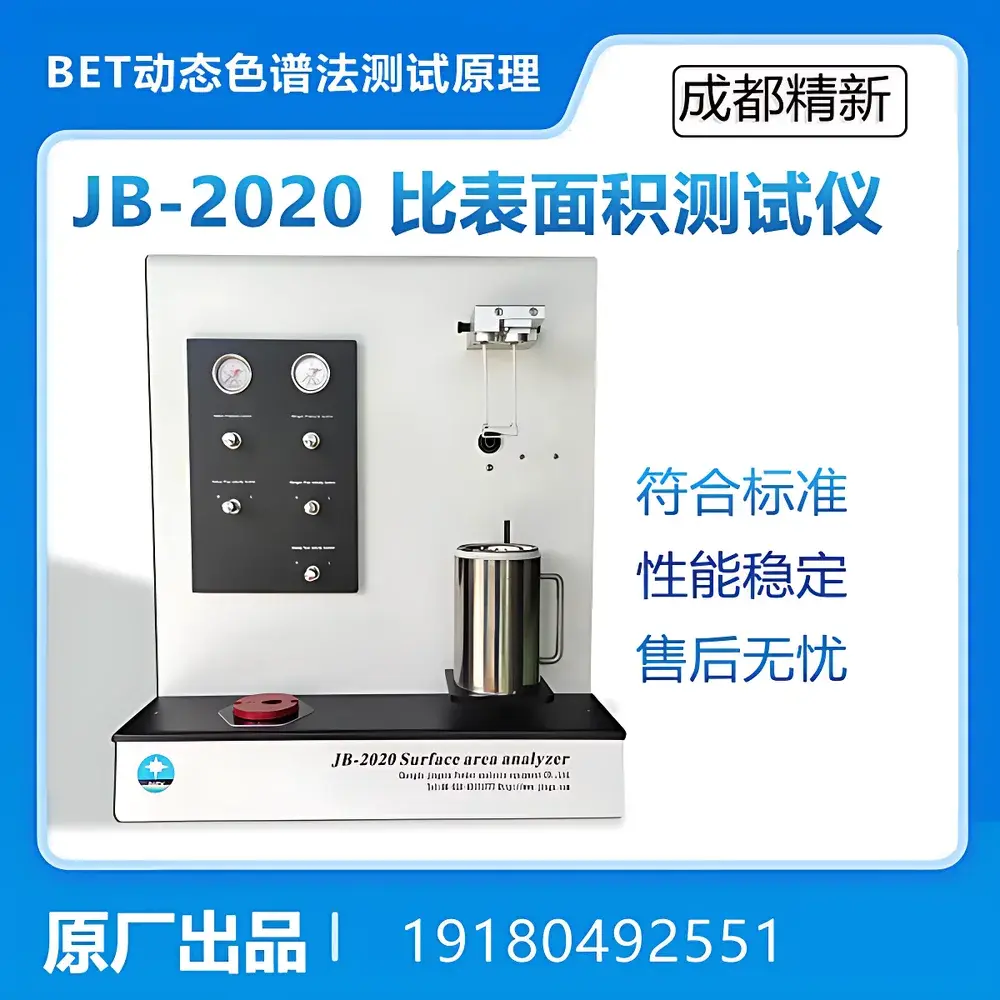
Chengdu Jingxin JB-2020 Single-Station Specific Surface Area Analyzer (Dynamic Flow Method)
| Brand | Chengdu Jingxin (CDJX) |
|---|---|
| Origin | Sichuan, China |
| Manufacturer Type | Direct Manufacturer |
| Origin Category | Domestic |
| Model | JB-2020 |
| Instrument Type | Specific Surface Area Analyzer |
| Measurement Principle | Dynamic Flow Method (Low-Temperature Nitrogen Adsorption) |
| Number of Analysis Stations | 1 |
| Measurement Range | 0.0005 m²/g to unlimited |
| Pressure Range | 1–5 kPa (gauge) |
| Test Theory | Dynamic nitrogen adsorption at 77 K using helium carrier gas and pulsed nitrogen dosing, based on chromatographic response integration |
| Calibration Standard | GBW(E)130275 certified reference material (CRM) per GB/T 19587–2017 |
| Repeatability Error | ≤ ±3% |
| Accuracy Error | ≤ ±3% |
| Sample Tube Material | High-temperature-resistant borosilicate glass (GG-type U-tube) |
| Carrier Gas | Ultra-high-purity helium (≥99.999%) |
| Adsorbate Gas | Ultra-high-purity nitrogen (≥99.999%) |
| Software Compatibility | Windows 7 / Windows 10 (32/64-bit) |
| Dimensions | 700 mm × 360 mm × 710 mm (W×D×H) |
| Weight | ~30 kg |
| Power Supply | AC 220 V ±22 V, 50 Hz ±0.5 Hz |
| Operating Environment | 5–35 °C, RH <85% non-condensing |
| Analysis Time per Sample | ~3 minutes (single-point or multi-point BET) |
Overview
The Chengdu Jingxin JB-2020 Single-Station Specific Surface Area Analyzer is an entry-level, high-reliability instrument engineered for routine specific surface area quantification of solid powders and porous materials using the dynamic flow (carrier gas) method at liquid nitrogen temperature (77 K). It operates on the fundamental principle of transient nitrogen adsorption/desorption kinetics: a precisely metered mixture of helium (carrier) and nitrogen (adsorbate) flows over a cooled sample; nitrogen is selectively adsorbed onto active surface sites, while helium remains inert. Upon removal from the cryogenic bath, desorbed nitrogen generates a characteristic thermal conductivity detector (TCD) response peak. By comparing the integrated peak area against a calibrated standard gas pulse—traceable to GBW(E)130275—the instrument calculates surface area via single-point or multipoint BET theory in accordance with GB/T 19587–2017, which aligns methodologically with ISO 9277 and ASTM D3037.
Key Features
- Single-station architecture optimized for laboratories requiring cost-effective, high-throughput surface area screening without sacrificing metrological traceability.
- Proprietary high-precision gas dosing module ensures stable, repeatable delivery of helium/nitrogen mixtures across variable flow rates and pressure ranges (1–5 kPa gauge), minimizing baseline drift and improving signal-to-noise ratio.
- Low-temperature TCD sensor with extended operational lifetime—designed for continuous exposure to cryogenic gas streams and insensitive to compositional shifts between carrier and adsorbate gases.
- U-shaped borosilicate glass sample tube (GG-grade) rated for thermal cycling between ambient and 77 K, enabling rapid sample loading, cooling, and regeneration without mechanical stress or contamination risk.
- Integrated calibration workflow compliant with national reference material protocols; supports both single-point (1 P/P₀) and full multipoint BET analysis (3–5 relative pressure points) for validation of monolayer formation and linearity.
Sample Compatibility & Compliance
The JB-2020 accommodates a broad spectrum of powdered solids—including battery cathode materials (e.g., LiCoO₂, LiMn₂O₄, Li₄Ti₅O₁₂), pharmaceutical excipients, heterogeneous catalysts, activated carbons, cement clinkers, ceramic precursors, and metal hydroxides—without requiring vacuum degassing pretreatment. Its dynamic method eliminates the need for ultra-high vacuum systems, reducing infrastructure dependency and maintenance overhead. All measurements adhere to GB/T 19587–2017, ensuring data comparability with international standards such as ISO 9277 (BET surface area by gas adsorption) and ASTM D3037 (standard test method for specific surface area of carbon black). While not designed for full GLP/GMP audit trails, raw signal data, calibration logs, and result metadata are timestamped and exportable for internal quality documentation.
Software & Data Management
The native Windows-compatible application provides full control over gas flow sequencing, temperature synchronization, peak integration parameters, and BET linear regression diagnostics. Results are stored in structured .csv and .xls formats with embedded metadata (sample ID, operator, date/time, calibration status, gas purity flags). The software supports side-by-side comparative analysis across batches, trend plotting over time, and customizable report generation—including printable PDF outputs with instrument ID, firmware version, and CRM lot numbers. No cloud connectivity or remote access functionality is included; all data reside locally, preserving confidentiality and simplifying IT compliance in regulated environments.
Applications
This analyzer serves quality control labs in advanced materials manufacturing where rapid, reproducible surface area verification is critical but capital investment must remain constrained. Typical use cases include incoming raw material inspection of lithium-ion battery cathodes, batch release testing of pharmaceutical micronized APIs, catalyst activity correlation studies, and R&D screening of novel porous ceramics. Its sensitivity down to 0.0005 m²/g makes it especially suitable for dense, low-surface-area oxides and metals—where gravimetric or volumetric errors dominate in static volumetric instruments. The 3-minute average cycle time enables >150 samples per 8-hour shift, supporting lean production workflows.
FAQ
What nitrogen adsorption theory does the JB-2020 implement?
It applies the Brunauer–Emmett–Teller (BET) multilayer adsorption model, validated through linear regression of the BET plot (P/P₀ vs. P/[V(1−P/P₀)]) derived from dynamic response curves.
Is vacuum degassing required before analysis?
No—this instrument uses a carrier-gas flow method and does not require high-vacuum pretreatment; ambient-air desorption is sufficient for most industrial powders.
Can the system perform pore size distribution analysis?
No—this is a dedicated specific surface area analyzer; it lacks the pressure stepping resolution and adsorption isotherm modeling capability required for BJH or DFT pore size evaluation.
What is the traceability basis for calibration?
Calibration is performed using GBW(E)130275 certified reference material, a national standard for specific surface area traceability in China, with documented uncertainty and certificate of analysis.
Does the software support 21 CFR Part 11 compliance?
No—electronic signatures, audit trails, and user role-based access controls are not implemented; the system is intended for non-GxP environments or as a supplementary QC tool under broader quality management oversight.



