
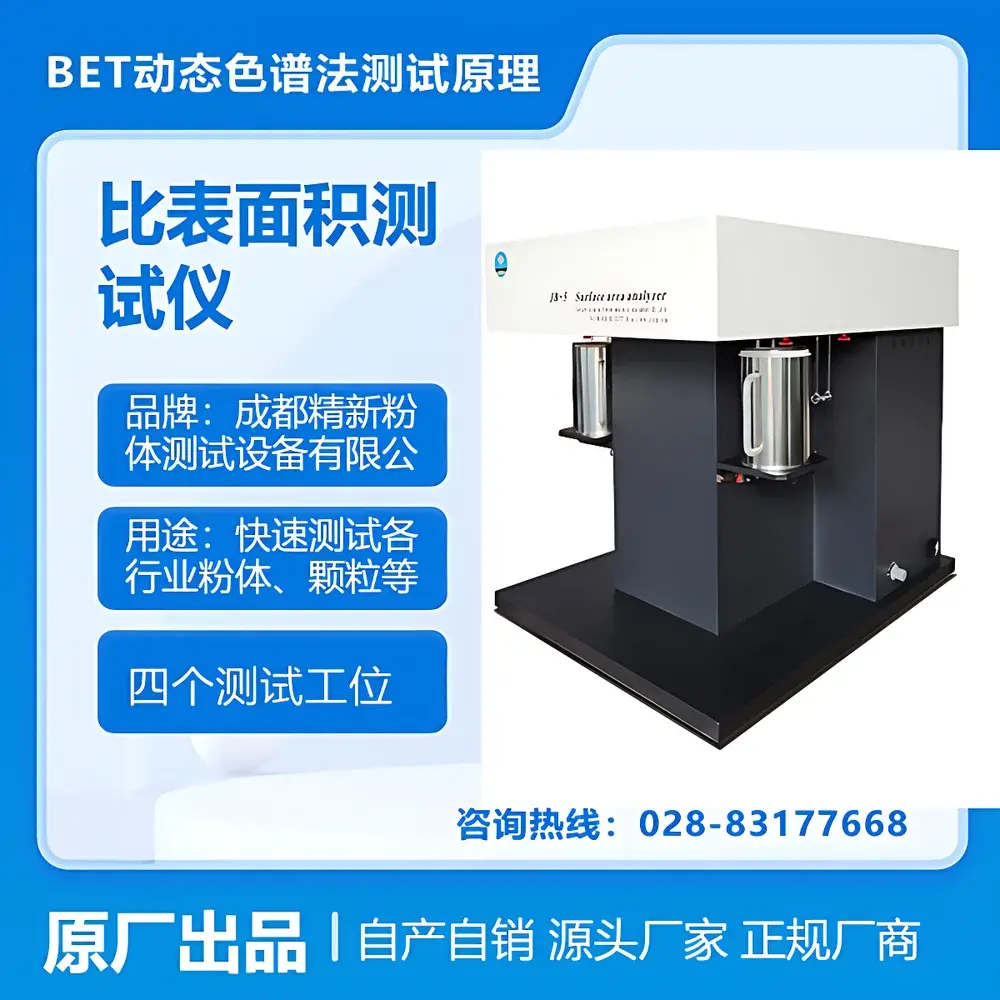
Chengdu Jingxin JB-5 Multi-Station Specific Surface Area Analyzer – Dynamic Chromatographic Method
| Brand | Chengdu Jingxin (CDJX) |
|---|---|
| Origin | Sichuan, China |
| Manufacturer Type | Direct Manufacturer |
| Regional Category | Domestic Instrument |
| Model | JB-5 |
| Instrument Type | Specific Surface Area Analyzer |
| Measurement Principle | Dynamic Flow Method (Gas Chromatography-Based) |
| Measurement Range | 0.0005 m²/g to unlimited |
| Theoretical Basis | BET Theory via Low-Temperature Nitrogen Adsorption (Dynamic Chromatographic Mode) |
| Repeatability | >99% |
Overview
The Chengdu Jingxin JB-5 Multi-Station Specific Surface Area Analyzer is an engineered solution for rapid, high-throughput determination of specific surface area (SSA) of solid powders and granular materials using the dynamic flow (carrier gas chromatographic) method. Unlike static volumetric or gravimetric adsorption systems, the JB-5 employs a continuous-flow configuration where a precisely controlled mixture of helium (carrier gas) and nitrogen (adsorptive gas) passes over a heated and degassed sample in a U-shaped quartz tube. Adsorption-induced concentration shifts in the effluent stream are detected by a low-temperature, high-stability thermal conductivity detector (TCD), enabling real-time quantification of nitrogen uptake. This approach aligns with ISO 9277:2010 and GB/T 19587–2017, both of which recognize dynamic chromatographic BET analysis as a valid and standardized technique for routine SSA assessment—particularly advantageous for samples with low to moderate surface areas (<10 m²/g) or limited adsorption capacity, where equilibrium-based methods may suffer from prolonged equilibration times or signal-to-noise limitations.
Key Features
- Four independent analytical stations operating sequentially—enabling unattended batch testing of up to four samples without manual intervention between runs.
- Optimized gas delivery architecture featuring high-precision mass flow controllers and dual-stage pressure regulation, ensuring stable, pulse-free carrier gas flow critical for chromatographic resolution and quantitative reproducibility.
- Low-drift thermal conductivity detector with extended operational lifetime, insensitive to gas composition changes and compatible with both He/N₂ and alternative carrier/adsorptive gas pairs (e.g., Ar/Kr for specialized applications).
- Large-capacity 500 mL Dewar flask with vacuum-insulated borosilicate glass inner vessel, providing ≥4 hours of stable liquid nitrogen hold time under standard ambient conditions—minimizing refills during extended test sequences.
- U-shaped sample tubes fabricated from high-purity GG-grade quartz, resistant to thermal shock and chemical degradation across typical pretreatment temperatures (up to 300 °C under vacuum or inert purge).
- Integrated pre-treatment module supporting programmable heating, vacuum evacuation, and inert gas purging—all synchronized with analysis sequence via embedded control logic.
Sample Compatibility & Compliance
The JB-5 accommodates a broad spectrum of industrially relevant solids, including battery cathode materials (e.g., LiCoO₂, NMC, Li₄Ti₅O₁₂), catalyst supports (γ-Al₂O₃, SiO₂, activated carbon), pharmaceutical excipients, cement clinkers, ceramic precursors, and metal oxides. Sample mass requirements range from 0.05 g to 1.5 g depending on expected SSA and density. All measurements comply with the procedural rigor defined in ISO 9277:2010 (Determination of specific surface area of solids by gas adsorption using the BET method) and GB/T 19587–2017 (Gas adsorption BET method for determining specific surface area of solid substances). The instrument architecture supports GLP-aligned operation through audit-trail-enabled software logging, user-access controls, and timestamped raw data archiving—facilitating regulatory review under FDA 21 CFR Part 11 when implemented with appropriate IT governance protocols.
Software & Data Management
The JB-5 is operated via Windows-native application software (compatible with Windows XP, 7, and 10) that provides full automation of measurement sequences, real-time chromatogram visualization, peak integration, and automatic BET linear regression fitting. Calibration routines include certified reference material (CRM) validation using standard silica gel or graphite, with traceable uncertainty reporting per ISO/IEC 17025 guidelines. All results—including raw TCD voltage traces, integrated peak areas, monolayer capacity (nm), and calculated SSA—are stored in structured binary + CSV dual-format files. Export options support direct printing, comparative overlay plots, and integration into LIMS environments via ODBC-compliant database connectors. No cloud dependency or third-party licensing is required; all processing occurs locally on the host PC.
Applications
This analyzer serves quality control laboratories in advanced materials manufacturing where throughput and robustness outweigh ultra-high-resolution pore characterization needs. Typical use cases include: incoming inspection of lithium-ion battery electrode powders; SSA trending during catalyst synthesis scale-up; batch release testing of pharmaceutical APIs and excipients; specification verification of construction-grade cement and pozzolanic additives; and R&D screening of novel MOFs or mesoporous silicas where relative surface area changes—not absolute micropore distribution—are the primary metrics. Its sub-7-minute per-sample cycle time makes it especially suited for production environments requiring >50 tests/day.
FAQ
What gases are required for operation?
High-purity helium (≥99.999%) as carrier gas and high-purity nitrogen (≥99.999%) as adsorptive gas. Optional compatibility with argon or krypton exists for specialized low-surface-area or microporous analyses.
Is vacuum pretreatment integrated into the system?
Yes—the JB-5 includes a built-in vacuum pump interface and programmable heating stage, allowing automated degassing at user-defined temperature, pressure, and dwell time prior to analysis.
Can the instrument perform multi-point BET analysis?
No—it implements single-point BET estimation only, optimized for speed and repeatability in routine QA/QC settings per GB/T 19587–2017 Annex B.
What is the minimum detectable surface area?
The validated lower limit is 0.0005 m²/g, achievable with appropriate sample mass selection and signal averaging over multiple injection cycles.
Does the software support electronic signatures or audit trails?
Basic audit logging (user, timestamp, parameter set, result) is enabled; full 21 CFR Part 11 compliance requires supplemental IT infrastructure and procedural controls beyond the instrument’s native capabilities.



