
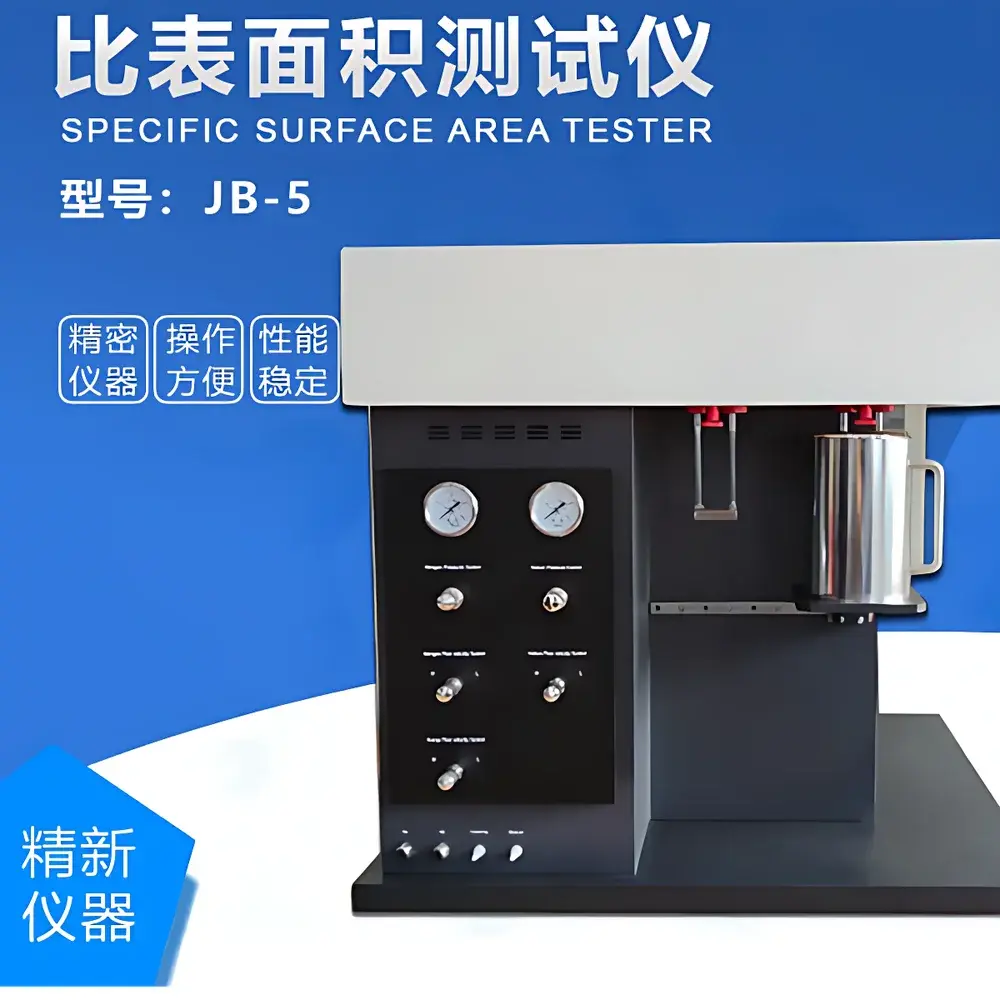
Chengdu Jingxin JB-5 Quad-Station Dynamic BET Specific Surface Area Analyzer
| Brand | Chengdu Jingxin (CDJX) |
|---|---|
| Origin | Sichuan, China |
| Manufacturer Type | Direct Manufacturer |
| Country of Origin | China |
| Model | JB-5 Series |
| Instrument Type | Specific Surface Area Analyzer |
| Measurement Principle | Dynamic Flow Method (Low-Temperature Nitrogen Adsorption with Helium Carrier Gas) |
| Number of Analysis Stations | 4 |
| Measurement Range | 0.0005 m²/g to unlimited |
| Calibration Standard | ISO 9277 & GB/T 19587–2004 |
| Accuracy | ≤ ±1% (verified using certified reference materials) |
| Sample Tube Material | High-Temperature-Resistant GG Glass U-Tube |
| Carrier Gas | Ultra-High-Purity Helium (≥99.999%) |
| Adsorbate Gas | Ultra-High-Purity Nitrogen (≥99.999%) |
| Test Modes | Single-Point, Multi-Point BET, Comparative Analysis |
| Cycle Time per Sample | 5–7 minutes |
| Software Platform | Windows XP/7/10 Compatible |
| Dimensions (L×W×H) | 700 × 300 × 600 mm |
| Power Supply | AC 220 V ±22 V, 50 Hz ±0.5 Hz |
Overview
The Chengdu Jingxin JB-5 Quad-Station Dynamic BET Specific Surface Area Analyzer is an engineered solution for high-throughput, precision-specific surface area characterization of solid particulates and powders. It operates on the dynamic flow (or continuous-flow) principle of low-temperature nitrogen adsorption, compliant with ISO 9277:2010 and GB/T 19587–2004 standards. Unlike static volumetric or gravimetric methods, this system employs a gas chromatographic configuration: ultra-high-purity helium serves as the inert carrier gas, while nitrogen functions as the adsorptive probe gas. As the sample is cooled to liquid nitrogen temperature (77 K), nitrogen molecules reversibly adsorb onto its surface in monolayer formation; the resulting concentration differential across the column is detected by a high-sensitivity thermal conductivity detector (TCD). The instrument calculates specific surface area via the Brunauer–Emmett–Teller (BET) theory, supporting both single-point and multi-point isotherm acquisition. Its quad-station architecture enables parallel analysis of four independent samples without cross-contamination or manual intervention—ideal for QC laboratories in battery materials, pharmaceuticals, catalysts, and advanced ceramics manufacturing.
Key Features
- Four independent analysis stations with fully synchronized operation—no sequential bottlenecks or idle time between runs.
- Thermal conductivity detector optimized for low-temperature gas-phase detection; stable baseline performance across varying gas compositions and extended operational lifetime under cryogenic conditions.
- Precision mass-flow control system with dual-stage pressure regulation ensures consistent helium carrier flow and precise nitrogen dosing—critical for reproducible BET slope determination.
- 500 mL large-bore Dewar flask with vacuum-insulated borosilicate glass inner liner delivers >4-hour cryogenic hold time, minimizing refills and maintaining thermal stability throughout multi-sample sequences.
- U-shaped sample tubes fabricated from GG-grade borosilicate glass—resistant to thermal shock, chemically inert, and dimensionally stable during repeated heating/cooling cycles up to 300 °C.
- Integrated pre-treatment module supports programmable degassing protocols (temperature ramp, dwell time, vacuum level) prior to analysis—ensuring removal of physisorbed moisture and contaminants per ASTM D3663 or USP .
Sample Compatibility & Compliance
The JB-5 accommodates standard powder specimens ranging from submicron nanoparticles (e.g., LiCoO₂ cathode materials) to coarse granules (e.g., cement clinker or ceramic precursors), with no upper limit on measurable surface area. It is validated for use with non-porous and mesoporous solids (2–50 nm pore range), though micropore analysis requires complementary t-plot or DFT modeling outside the base firmware. All measurement workflows adhere to ISO 9277:2010 (calculation of specific surface area by the BET method) and GB/T 19587–2004 (determination of specific surface area of solids by nitrogen adsorption). While not natively 21 CFR Part 11 compliant, audit trails, user access logs, and electronic signature support can be enabled through optional software modules aligned with GLP/GMP documentation requirements.
Software & Data Management
The proprietary Windows-native acquisition and analysis suite provides real-time chromatogram visualization, automatic peak integration, BET linear regression diagnostics (including C-constant validation and R² reporting), and comparative overlay of multiple isotherms. Raw data files (.csv and .jbx binary format) retain full metadata—including instrument ID, operator login, calibration timestamp, and environmental conditions (ambient T/P). Export options include PDF reports with embedded uncertainty estimates, Excel-compatible tables, and image-ready plots suitable for regulatory submissions. Batch processing mode allows queued execution of heterogeneous sample sets with customizable pass/fail thresholds based on relative standard deviation (RSD) limits.
Applications
This analyzer is routinely deployed in industrial R&D and quality control environments where throughput and traceability are critical: lithium-ion battery cathode/anode material qualification (e.g., graphite, NMC, LFP); pharmaceutical excipient surface uniformity assessment; catalyst support characterization (e.g., alumina, silica, zeolites); adsorbent capacity verification (activated carbon, MOFs); and raw material consistency monitoring in cement, pigment, and fine ceramic production. Its rapid cycle time (<7 min/sample) and robustness under continuous operation make it particularly suited for daily batch release testing in regulated manufacturing settings.
FAQ
What gases are required for operation, and what purity levels are recommended?
Helium (≥99.999% purity) as carrier gas and nitrogen (≥99.999% purity) as adsorbate are mandatory. Lower purities introduce baseline drift and compromise monolayer coverage assumptions.
Can the JB-5 perform pore size distribution analysis?
No—the JB-5 is dedicated to specific surface area quantification via dynamic BET. Pore size distribution requires isotherm scanning over broader relative pressure ranges (P/P₀ = 0.01–0.99), which is outside its hardware design scope.
Is sample degassing integrated into the instrument?
Yes—a programmable vacuum-heating module is built-in, supporting temperature-controlled degassing up to 300 °C and vacuum levels ≤10⁻² Pa.
How is calibration performed, and how often is it required?
Calibration uses certified reference materials (e.g., NIST SRM 1990a silica gel) and must be repeated before each analytical campaign or after any hardware maintenance affecting flow or detection sensitivity.
Does the system support remote monitoring or networked data export?
Local network sharing of result folders is supported; however, cloud-based telemetry or SCADA integration requires third-party middleware deployment.



