
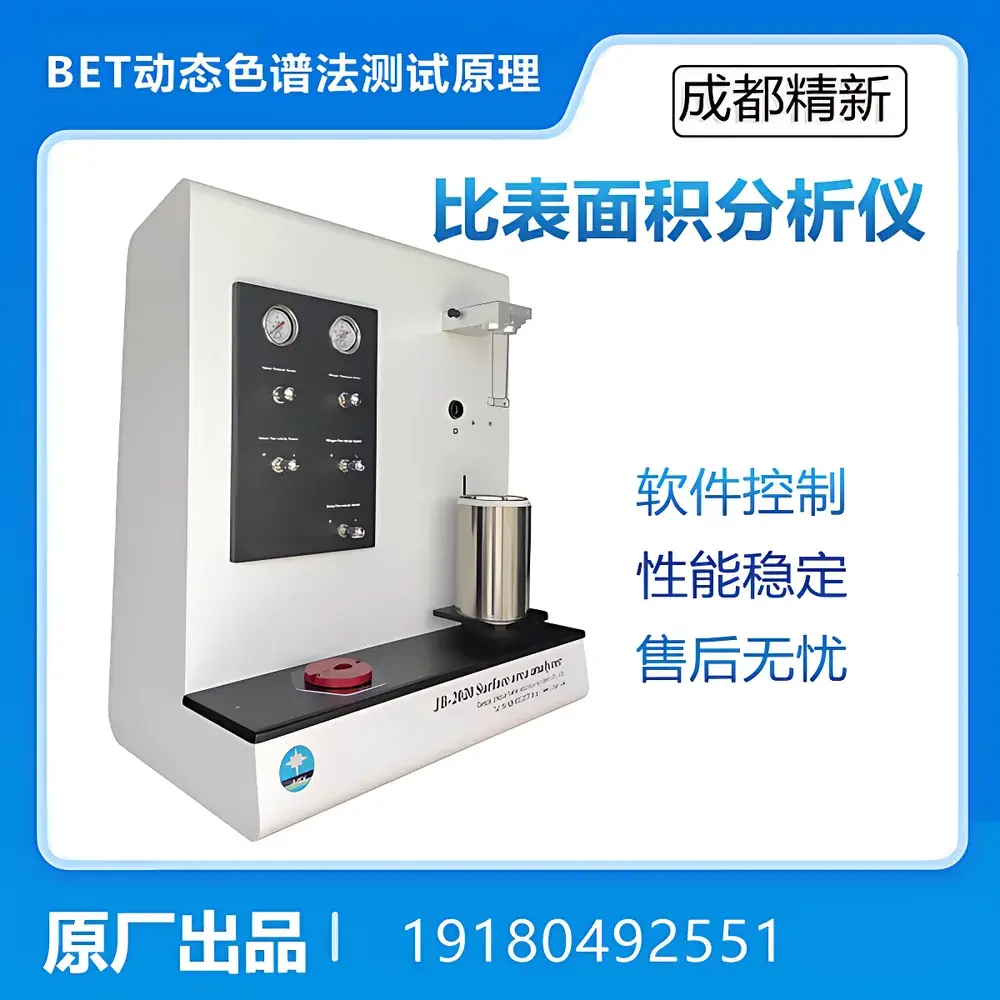
Chengdu Jingxin JB2020 Dynamic Nitrogen Adsorption Specific Surface Area Analyzer
| Brand | Chengdu Jingxin (CDJX) |
|---|---|
| Origin | Sichuan, China |
| Manufacturer Type | Direct Manufacturer |
| Instrument Type | Specific Surface Area Analyzer |
| Principle | Dynamic Flow Method (Low-Temperature Nitrogen Adsorption) |
| Analysis Stations | 1 |
| Measurement Range | 0.1–3500 m²/g |
| Pressure Control Range | 1–5 (arbitrary unit, calibrated via standard gas pulses) |
| Theoretical Basis | BET Theory |
| Repeatability | ≤ ±3% |
| Sample Tube Material | High-Temperature-Resistant GG Glass (U-Shaped) |
| Calibration Standard | GBW(E)130275 Certified Reference Material |
| Test Gases | Ultra-High-Purity Helium (carrier) and Nitrogen (adsorbate) |
| Software Compatibility | Windows 7 / Windows 10 |
| Dimensions | 700 × 360 × 710 mm |
| Weight | ~30 kg |
| Power Supply | AC 220 V ±22 V, 50 Hz ±0.5 Hz |
| Operating Environment | 5–35 °C, RH <85% |
| Test Duration per Sample | ~3 minutes |
| Data Output | Exportable reports with storage, query, comparison, editing, and deletion functions |
| Measurement Modes | Single-Point, Multi-Point BET, Comparative Analysis |
Overview
The Chengdu Jingxin JB2020 Dynamic Nitrogen Adsorption Specific Surface Area Analyzer is an engineered solution for rapid, reliable quantification of specific surface area in solid particulate materials using the dynamic flow (or continuous flow) method of low-temperature nitrogen adsorption. Unlike static volumetric or gravimetric systems, the JB2020 operates on a carrier-gas-based principle: high-purity helium serves as the inert carrier stream, while controlled pulses of nitrogen are introduced to interact with the sample surface immersed in liquid nitrogen (77 K). Adsorption occurs during cryogenic exposure; subsequent desorption is monitored in real time by a high-sensitivity thermal conductivity detector (TCD). The instrument calculates surface area by comparing the integrated desorption response against calibrated standard gas pulses—traceable to the national reference material GBW(E)130275—and applying the Brunauer–Emmett–Teller (BET) theory to multi-point data or single-point approximation where appropriate. Designed in compliance with GB/T 19587–2017, the JB2020 delivers traceable, laboratory-grade results without requiring vacuum manifold infrastructure or complex pressure transducers, making it particularly suited for routine QC environments where throughput, operational simplicity, and environmental robustness are prioritized.
Key Features
- Single-station architecture optimized for high-throughput laboratories: average analysis time of ≈3 minutes per sample, minimizing downtime and maximizing daily sample capacity.
- Dual-gas dynamic flow system with ultra-high-purity helium (≥99.999%) and nitrogen (≥99.999%) ensures consistent carrier stability and reproducible adsorption/desorption kinetics.
- Proprietary precision gas dosing module delivers repeatable standard gas pulses for in-situ calibration prior to each measurement cycle, directly supporting ≤±3% repeatability across operator shifts and instrument lifetimes.
- U-shaped sample tube fabricated from GG-grade borosilicate glass—rated for thermal shock resistance up to 500 °C—enables safe handling of reactive, hygroscopic, or catalytically active powders without cross-contamination or tube degradation.
- Low-drift, cryogenically stabilized TCD detector with extended operational lifetime: insensitive to gas composition changes and unaffected by trace moisture or hydrocarbon impurities common in industrial-grade gases.
- Compact benchtop footprint (700 × 360 × 710 mm) and standard AC220V power requirement eliminate need for dedicated utility lines, compressed air, or external chillers—ideal for shared lab spaces or satellite QC labs.
Sample Compatibility & Compliance
The JB2020 accommodates a broad spectrum of powdered and granular solids with surface areas ranging from 0.1 m²/g (e.g., dense ceramics, sintered metals) to >3500 m²/g (e.g., activated carbons, mesoporous silica). It is routinely deployed for quality control of battery cathode precursors (LiCoO₂, LiMn₂O₄, Li₄Ti₅O₁₂), pharmaceutical excipients, heterogeneous catalysts (Pt/C, Ni/Al₂O₃), cementitious phases (C₃S, C₂S), and ceramic raw materials (Al₂O₃, ZrO₂). All measurements adhere to the procedural rigor defined in GB/T 19587–2017, which aligns closely with ISO 9277:2010 (Characterization of porous solids — Determination of specific surface area by gas adsorption using the BET method). While not inherently 21 CFR Part 11 compliant, audit-ready data logs—including operator ID, timestamp, calibration history, raw detector output, and final BET slope/intercept—are fully exportable in CSV/PDF formats for internal GLP documentation or third-party regulatory review.
Software & Data Management
The JB2020’s native software suite runs natively on Windows 7 and Windows 10 platforms without virtualization layers or legacy OS dependencies. It provides full control over gas sequencing, temperature synchronization (liquid nitrogen level detection), baseline correction, peak integration, and BET linear regression diagnostics. Each test generates a structured metadata record containing instrument configuration, calibration parameters, raw TCD voltage vs. time traces, and calculated surface area with uncertainty estimates. Reports support customizable templates, batch comparisons across historical datasets, statistical summaries (mean, SD, CV%), and direct export to LIMS-compatible formats. All data files are stored in non-proprietary binary+XML hybrid containers, enabling long-term archival integrity and third-party script-based reprocessing (e.g., Python/Pandas pipelines).
Applications
- Battery Materials: Monitoring specific surface area drift during synthesis of lithium transition metal oxides—critical for electrode slurry rheology, binder coverage, and interfacial charge transfer efficiency.
- Pharmaceuticals: Verifying consistency of micronized APIs and excipients where surface area governs dissolution rate, blend uniformity, and tablet compaction behavior.
- Heterogeneous Catalysis: Correlating BET surface area with metal dispersion metrics (via chemisorption) to optimize catalyst loading and thermal stability protocols.
- Construction Chemistry: Quantifying hydration reactivity of clinker phases and supplementary cementitious materials (SCMs) such as fly ash or slag.
- Adsorbent Development: Screening activated carbons, MOFs, and zeolites for VOC capture capacity, where surface area remains a primary first-pass screening parameter.
FAQ
What standards does the JB2020 comply with?
The instrument implements the methodology specified in GB/T 19587–2017, which is technically equivalent to ISO 9277:2010 and consistent with ASTM D3037 for nitrogen adsorption surface area determination.
Can the JB2020 perform pore size distribution analysis?
No—the JB2020 is dedicated to specific surface area measurement via dynamic BET analysis. It does not acquire full isotherms or support BJH, DFT, or NLDFT modeling required for pore size distribution.
Is helium consumption high during routine operation?
Helium usage is minimal: typical flow rate is 30–50 mL/min, and total consumption per 8-hour shift averages <20 L for continuous operation across 100+ samples.
How is calibration maintained over time?
Calibration is performed before each analytical session using certified standard gas pulses and verified against GBW(E)130275 reference material; no hardware recalibration is required between annual service intervals.
Does the software support automated report generation for ISO/IEC 17025 accreditation?
Yes—reports include instrument ID, operator signature field, calibration certificate references, raw data traceability, and uncertainty propagation per GUM guidelines, satisfying core documentation requirements for accredited testing labs.



