
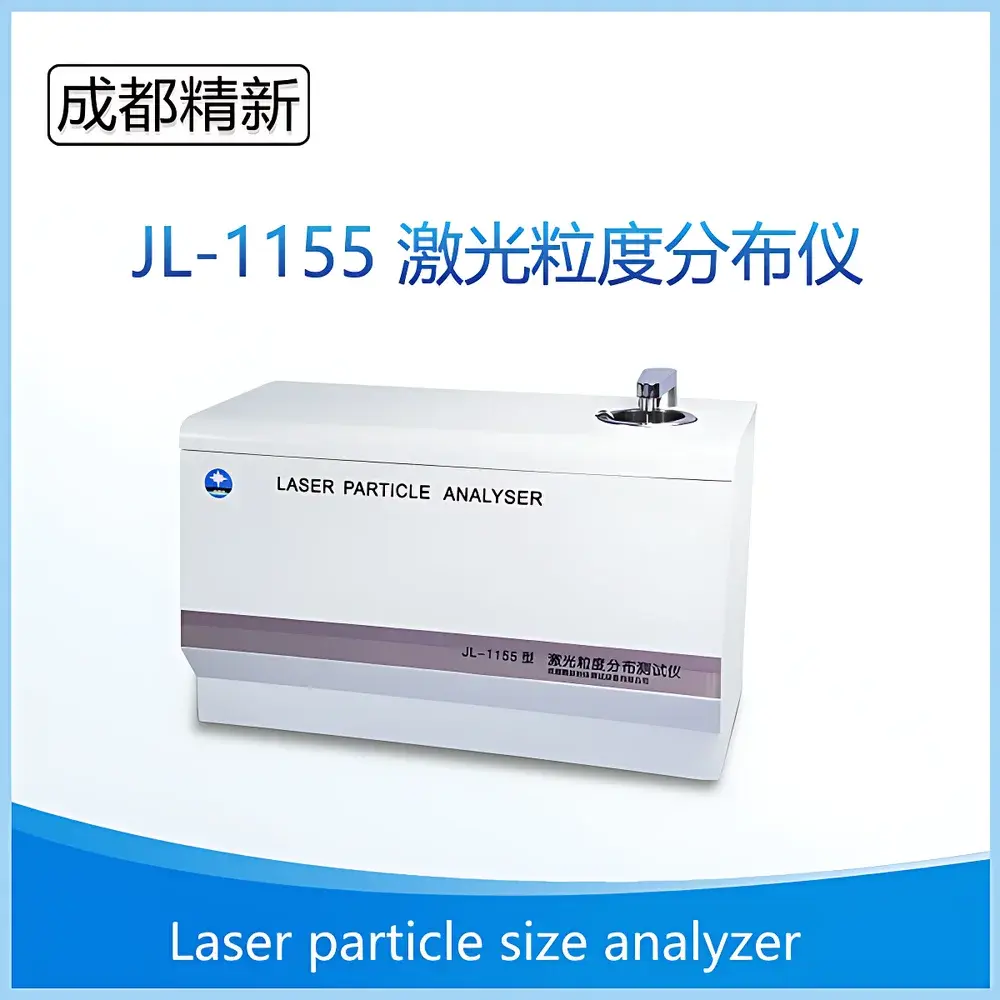
Chengdu Jingxin JL-1155 Wet-Dispersion Laser Particle Size Analyzer
| Brand | Chengdu Jingxin (CDJX) |
|---|---|
| Origin | Sichuan, China |
| Manufacturer Type | Direct Manufacturer |
| Instrument Type | Laboratory Laser Particle Size Analyzer |
| Measurement Range | 0.1–200 µm |
| Repeatability | ≤1% (D50 of NIST-traceable standard reference material) |
| Measurement Time | ~60 seconds per sample |
| Dispersion Method | Wet dispersion with 60 W ultrasonic probe |
| Sample Cell | 60 mm × 60 mm fused quartz |
| Circulation System | Integrated stainless-steel (304) 500 mL dispersion tank with peristaltic pump and mechanical stirrer |
| Optical Design | Inverted Fourier optical system |
| Detector | 52-channel multi-element photodiode array |
| Light Source | 650 nm, 30 mW semiconductor laser (lifetime >70,000 h) |
| Software | Windows-compatible analysis suite with volume/number distribution, D10/D50/D90, specific surface area, and GLP-compliant data export (PDF, CSV) |
Overview
The Chengdu Jingxin JL-1155 Wet-Dispersion Laser Particle Size Analyzer is a precision-engineered laboratory instrument designed for rapid, reproducible particle size distribution (PSD) characterization of fine ceramic powders, inorganic oxides, and other dense or refractory particulates in aqueous or organic suspensions. It operates on the fundamental principles of Mie scattering theory and Fraunhofer diffraction, optimized for submicron-to-coarse silt range analysis (0.1–200 µm). The inverted Fourier optical architecture minimizes stray light interference from cell–lens interface reflections, while the 52-channel detector array ensures high angular resolution across the full scattering cone—critical for resolving narrow PSDs typical of spray-dried ceramics, calcined alumina, or engineered zirconia powders. All optical components—including the collimation optics, beam shaping elements, and detection geometry—are proprietary designs developed and validated in-house by Chengdu Jingxin, ensuring full traceability and compliance with ISO 13320:2020 and GB/T 19077–2016.
Key Features
- Inverted Fourier optical system with fused quartz sample cell (60 mm × 60 mm), providing superior optical flatness, thermal stability, and resistance to chemical etching during repeated wet testing.
- Integrated circulation module: 500 mL 304 stainless-steel dispersion tank with dual-mode agitation—60 W ultrasonic probe (with dry-run protection) and low-shear mechanical stirrer—to achieve uniform deagglomeration without introducing excessive bubble formation or particle fracture.
- Peristaltic pumping system with constant-cross-section tubing; eliminates pressure differentials, vortex zones, and sedimentation during transport—ensuring representative sampling and minimizing re-agglomeration en route to the measurement zone.
- Automated fluid handling sequence: programmable auto-fill (via water-level sensor-controlled solenoid valve), real-time optical alignment verification, measurement, post-run rinse, and drain—all executed without manual intervention.
- High-stability optical bench: elastomer-isolated rigid mounting for laser diode, lens assembly, and detector array—maintains alignment under ambient temperature fluctuations (5–35 °C) and typical lab vibration profiles.
Sample Compatibility & Compliance
The JL-1155 is validated for use with ceramic precursors (e.g., Al₂O₃, SiO₂, ZrO₂, TiO₂), clay minerals (kaolin, bentonite), battery cathode materials (LiCoO₂, NMC), catalyst supports, and pigment-grade oxides. Its wet dispersion workflow accommodates both deionized water and low-surface-tension media (e.g., ethanol, isopropanol) for hydrophobic or high-density particles. All measurement protocols adhere to ISO 13320 Annex A (wet dispersion guidelines) and ASTM D4287 (for non-aqueous systems). The instrument’s software supports audit trail logging (user ID, timestamp, parameter set, raw intensity data), meeting basic GLP documentation requirements for QC labs. While not FDA 21 CFR Part 11 certified out-of-the-box, its data export structure (CSV, PDF with embedded metadata) enables integration into validated LIMS environments.
Software & Data Management
The native Windows-based analysis software provides dual-language UI (English/Chinese toggle), three preconfigured measurement modes—Standard, Fine Powder, and Ultrafine—each applying optimized inversion algorithms and background subtraction strategies. Volume-based and number-based distributions are computed simultaneously using non-negative least squares (NNLS) with unconstrained regularization, preserving true multimodal features without artificial smoothing. Output reports include D10, D50, D90, span, specific surface area (via equivalent spherical model), and histogram-based frequency plots. Raw scattering intensity files (.dat) are stored with full acquisition metadata (laser power, obscuration, sonication duration, refractive index input). Export options include print-ready PDFs, spreadsheet-compatible CSV, and batch-processing macros for routine production lot release.
Applications
This analyzer serves as a primary quality control tool in ceramic manufacturing facilities where batch-to-batch consistency of raw powders directly impacts green body density, sintering shrinkage, and final mechanical strength. It is routinely deployed for: monitoring spray-drying output uniformity; verifying milling endpoint in ball-milled zirconia slurries; characterizing particle agglomeration kinetics in slip-casting formulations; validating dispersion stability of conductive carbon black in electrode inks; and supporting DOE studies on grinding media selection. Academic users apply it to investigate hydrothermal growth kinetics of nanostructured titanates or colloidal stability of rare-earth doped phosphors in suspension polymerization processes.
FAQ
What sample volume is required per test?
Typical usage ranges from 10 mg to 2 g, depending on particle density, refractive index contrast with dispersant, and desired obscuration (8–12% optimal). The 500 mL dispersion tank allows dilution flexibility without compromising signal-to-noise ratio.
Can the instrument measure particles below 0.1 µm?
No—the lower detection limit is physically constrained by the 650 nm laser wavelength and detector angular coverage. Sub-100 nm analysis requires dynamic light scattering (DLS) or electron microscopy correlation.
Is calibration traceable to national standards?
Yes—repeatability validation uses NIST-traceable silica and polystyrene latex reference materials (e.g., NIST SRM 1963, 1690); D50 bias remains ≤1% across ≥10 replicate runs.
How often does the quartz sample cell require cleaning or replacement?
Under normal operation with filtered dispersants and post-test rinsing, the cell requires only weekly isopropanol wipe-down; no scheduled replacement is specified—its service life exceeds 5 years with proper handling.
Does the software support statistical process control (SPC) charting?
Basic trend plotting (D50 vs. time, ±3σ limits) is available; advanced SPC integration (X-bar/R, Cpk calculation) requires export to external platforms such as Minitab or JMP.



