
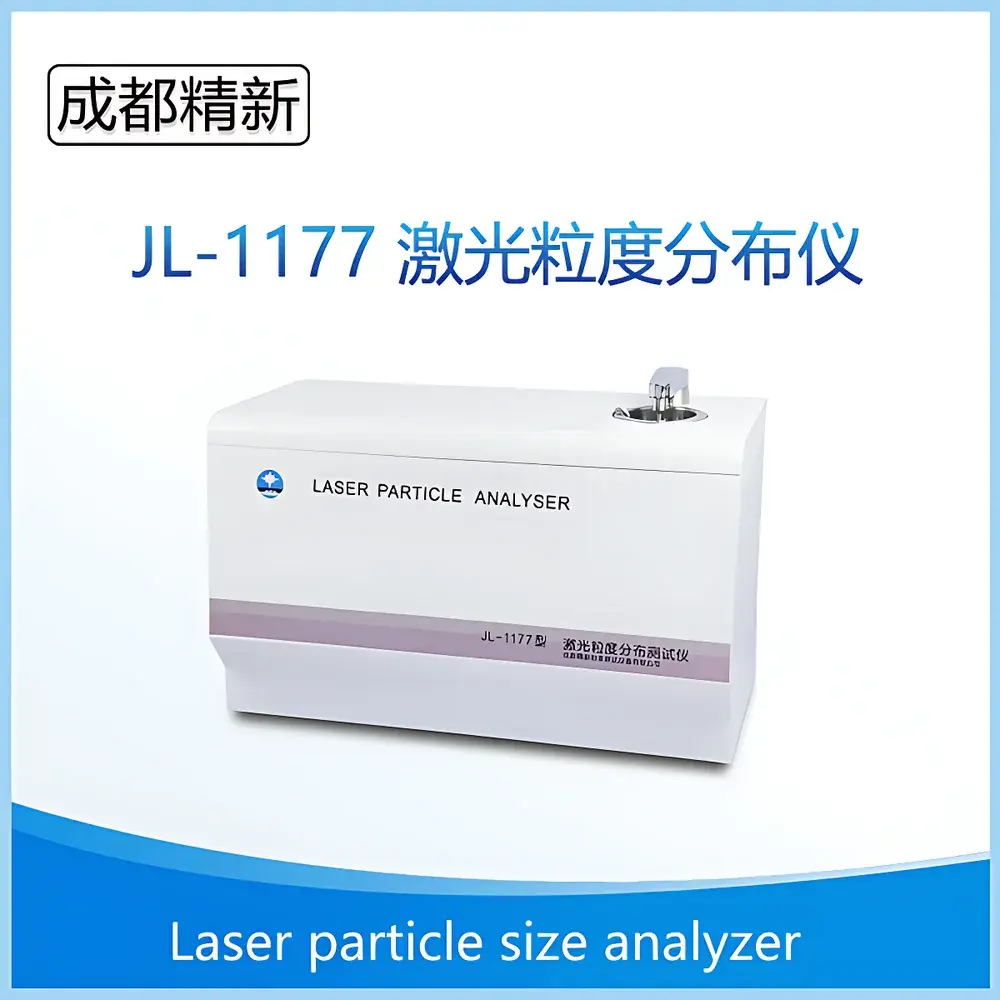
Chengdu Jingxin JL-1177 Fully Automated Laser Particle Size Analyzer
| Brand | Chengdu Jingxin (CDJX) |
|---|---|
| Origin | Sichuan, China |
| Manufacturer Type | Direct Manufacturer |
| Origin Category | Domestic |
| Model | JL-1177 |
| Price Range | USD 21,000–22,500 (FOB) |
| Dispersion Method | Wet Dispersion |
| Instrument Type | Laboratory Laser Particle Size Analyzer |
| Measurement Range | 0.01 µm to 3000 µm |
| Repeatability | ≤1% (D50 deviation against NIST-traceable standard reference materials) |
| Measurement Time | ≤120 s per sample |
Overview
The Chengdu Jingxin JL-1177 Fully Automated Laser Particle Size Analyzer is an ISO 13320:2020 and GB/T 19077–2016 compliant instrument engineered for high-fidelity particle size distribution (PSD) analysis of suspensions and slurries. It operates on the physical principles of Mie scattering theory—applied across the full measurement range—and Fraunhofer diffraction for coarse particles, enabling rigorous quantification of particle ensembles from sub-10 nm colloids to millimeter-scale granules. The system employs an inverted Fourier optical configuration with dual-wavelength laser illumination (650 nm primary, 405 nm auxiliary), delivering enhanced resolution in both fine and ultra-fine regions. Its 128-channel multi-element detector array captures forward-, side-, and backward-scattered light simultaneously, ensuring comprehensive angular signal coverage without aperture-induced truncation. The fully sealed metal enclosure and monolithic mechanical architecture provide electromagnetic immunity, thermal stability, and long-term optical alignment integrity—critical for GLP-compliant laboratories requiring audit-ready reproducibility.
Key Features
- Inverted Fourier optical design minimizes stray light from multiple reflections between cuvette and lens surfaces; eliminates aperture limitation on large-angle scattering signals.
- Dual-laser source: 30 mW, 650 nm semiconductor laser (≥70,000 h lifetime) + 20 mW, 405 nm auxiliary laser for improved sub-100 nm resolution.
- 128-channel detector array with per-channel background compensation, high-gain analog front-end, and real-time optical center auto-calibration.
- Integrated wet dispersion module: 500 mL 304 stainless steel dispersing cell, 60 W ultrasonic transducer with dry-run protection, and variable-speed mechanical stirrer to suppress bubble formation and ensure homogeneous suspension.
- Peristaltic circulation system with constant cross-section tubing, zero negative-pressure zones, and minimal shear—preserving fragile aggregates and preventing particle segregation during transport.
- Automated workflow: auto-water intake, optical alignment verification, measurement, post-run rinse, and drain—all executed without manual intervention.
- Robust optical path: elastomer-mounted rigid optical bench and bonded high-transmission quartz flow cell (60 mm × 60 mm) guarantee long-term photometric stability.
Sample Compatibility & Compliance
The JL-1177 supports aqueous and organic dispersions—including deionized water, tap water, ethanol, and isopropanol—as test media. It accommodates sample masses ranging from milligrams to grams per run, making it suitable for R&D screening and QC batch verification. The system complies with ISO 13320:2020 (Laser diffraction methods), GB/T 19077–2016 (Chinese national standard aligned with ISO), and ASTM D4291 (Standard Test Method for Particle Size Distribution of Pigments by Laser Diffraction). While not natively 21 CFR Part 11 certified, its software architecture supports audit trail logging, user access control, and electronic signature readiness—enabling validation under GMP/GLP frameworks when deployed with documented SOPs and IQ/OQ/PQ protocols.
Software & Data Management
The embedded analysis software offers bilingual (English/Chinese) interface switching, Windows XP/7/10 compatibility, and RS232 + USB 2.0 communication interfaces. It calculates standard metrics including D3, D10, D25, D50, D75, D84, D90, D97, volume-weighted mean diameter (D[4,3]), surface-area-weighted mean (D[3,2]), and specific surface area (SSA) via equivalent spherical model assumptions. Distribution outputs include cumulative curves, differential histograms, Rosin-Rammler (RR), normal, and free-form distributions. Raw intensity data and processed PSDs can be exported to CSV, PDF, or image formats; all measurement sessions are timestamped and stored with operator ID, method name, and instrument serial number—supporting traceability requirements in regulated environments.
Applications
The JL-1177 serves diverse industrial and academic sectors requiring robust, repeatable PSD characterization: electronic-grade metal oxides (e.g., Al2O3, TiO2, rare earth phosphors), battery cathode/anode slurries (LiCoO2, graphite), pharmaceutical excipients and APIs, ceramic raw materials (kaolin, talc, zirconia), pigment dispersions (organic/inorganic colorants), agrochemical formulations (wettable powders, SCs), construction materials (cement clinker, fly ash), food-grade additives (calcium carbonate, starch), and environmental samples (marine sediments, aerosol simulants). Its wide dynamic range and automated dispersion make it especially valuable for multi-product labs handling both nanostructured colloids and micron-scale abrasives.
FAQ
What standards does the JL-1177 comply with?
It conforms to ISO 13320:2020, GB/T 19077–2016, and ASTM D4291 for laser diffraction particle sizing.
Can the instrument measure nanoparticles below 100 nm accurately?
Yes—the 405 nm auxiliary laser enhances sensitivity in the 0.01–0.1 µm range, and Mie theory modeling with proper refractive index input ensures quantitative accuracy for colloidal systems.
Is the software compatible with LIMS integration?
Raw and processed data export via CSV and standardized timestamps enables seamless ingestion into common LIMS platforms; custom API integration is supported upon request.
How is optical alignment maintained over time?
The inverted Fourier geometry, elastomer-isolated optical bench, and real-time detector centering algorithm collectively ensure drift-free operation for ≥12 months between recalibrations.
Does the system support method validation for regulated industries?
While not pre-certified for 21 CFR Part 11, its logging capabilities, user authentication, and electronic record structure meet foundational requirements for GMP/GLP validation when implemented with site-specific procedures.



