
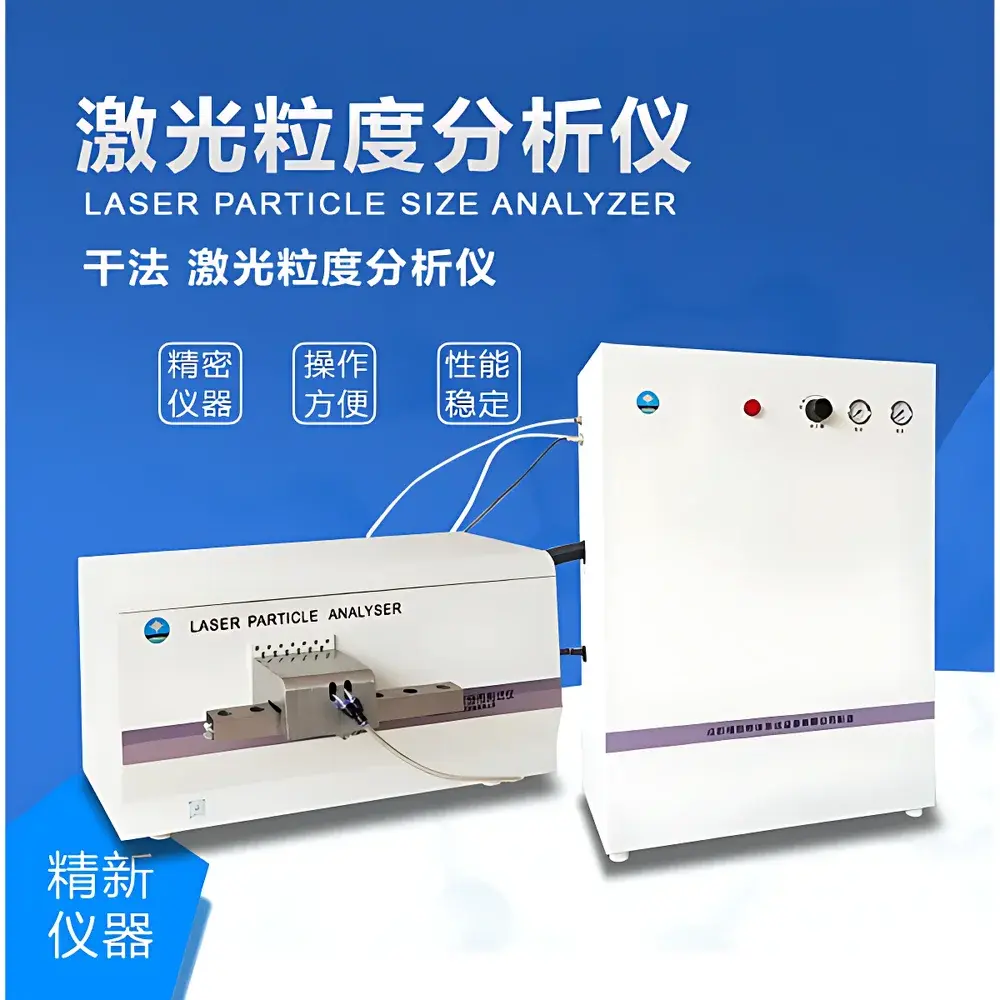
Chengdu Jingxin JL-1178 Dry-Method Laser Particle Size Analyzer
| Brand | Chengdu Jingxin (CDJX) |
|---|---|
| Origin | Sichuan, China |
| Manufacturer Type | Direct Manufacturer |
| Instrument Type | Laboratory Laser Particle Size Analyzer |
| Measurement Range | 0.01–3000 µm |
| Dispersion Method | Dry Air Jet Dispersion |
| Repeatability | ≤3% (D50 deviation against national standard reference materials) |
| Measurement Time | ≤60 seconds per sample |
| Optical Principle | Mie Scattering & Fraunhofer Diffraction |
| Detector Array | 128-channel multi-angle photodetector |
| Light Source | Dual-wavelength semiconductor laser (650 nm / 30 mW primary |
| Sample Consumption | 2–10 g per test |
| Dispersion Pressure | Adjustable 0.1–0.8 MPa |
| Power Supply | AC 220 V ±22 V, 50 Hz ±0.5 Hz |
| Operating Environment | 5–35 °C |
| Compliance | GB/T 19077–2016, ISO 13320 |
Overview
The Chengdu Jingxin JL-1178 Dry-Method Laser Particle Size Analyzer is a fully automated laboratory instrument engineered for precise, reproducible particle size distribution (PSD) analysis of dry, non-aqueous powders. Designed specifically for materials incompatible with wet dispersion—including pharmaceutical powders, rare-earth magnetic alloys (e.g., NdFeB), lithium carbonate, cement clinker, and oxidation-sensitive electronic ceramics—the system employs compressed air or inert gas as the dispersing medium. Its optical architecture integrates Mie scattering theory (for sub-micron particles where refractive index effects dominate) and Fraunhofer diffraction (for larger particles >10 µm), enabling rigorous physical modeling across the full 0.01–3000 µm measurement range. The inverted Fourier optical design eliminates aperture-induced truncation of high-angle scattered light, while rigid mechanical construction ensures long-term alignment stability—critical for regulatory compliance in GLP and GMP environments.
Key Features
- Integrated dry dispersion module featuring a coaxial nozzle-inlet assembly that minimizes transport distance and eliminates gravitational segregation or wall adhesion during feed.
- Dual-wavelength laser system: primary 650 nm/30 mW diode (≥70,000 h lifetime) and auxiliary 405 nm/20 mW diode, enhancing resolution in the sub-1 µm region through differential scattering contrast.
- 128-channel angular photodetector array covering forward, side, and backward scattering angles—each channel equipped with independent background compensation and high-speed analog signal amplification.
- Automated workflow: motorized sample tray indexing, pressure-regulated pneumatic dispersion (0.1–0.8 MPa), real-time chamber cleaning via integrated vacuum suction, and waste collection into sealed auxiliary cabinet with HEPA filtration.
- Electromagnetically shielded all-metal enclosure compliant with industrial EMC standards, suitable for operation near sensitive analytical instrumentation.
- Self-aligning optical path with fixed-focus Fourier lens; no user calibration or mechanical adjustment required during routine operation.
Sample Compatibility & Compliance
The JL-1178 accommodates free-flowing and cohesive dry powders with minimal pre-treatment. It is routinely deployed for QC testing of active pharmaceutical ingredients (APIs), excipients, and final drug product blends under USP and guidance. For magnetic materials (e.g., sintered NdFeB, ferrite, cobalt powder), the absence of liquid media prevents agglomeration artifacts and oxidation. Cement, ceramic precursors, and battery-grade LiCoO₂ are measured without hydration interference. The instrument conforms to GB/T 19077–2016 (equivalent to ISO 13320:2016), supporting audit-ready documentation including D10, D50, D90, D97, volume-weighted mean diameter (D[4,3]), and surface-area-weighted mean (D[3,2]). All raw scatter data and processing parameters are timestamped and stored with full traceability—enabling 21 CFR Part 11-compliant electronic records when paired with validated software configurations.
Software & Data Management
The embedded Windows-compatible analysis suite (XP/7/10) provides bilingual UI toggle (English/Chinese) and supports three standardized distribution models: cumulative, normal, and Rosin-Rammler. Output reports include tabular PSD data, graphical overlays, and statistical metrics such as span [(D90−D10)/D50] and relative width. Data export options include CSV, PDF, and XML formats; communication interfaces comprise USB 2.0 and RS-232 serial ports. Raw intensity vs. scattering angle profiles are retained for retrospective reprocessing using updated optical models or refractive index inputs. Audit trail functionality logs operator ID, test timestamp, instrument configuration, and any parameter modification—meeting GLP documentation requirements for regulated laboratories.
Applications
This analyzer serves quality control and R&D laboratories across multiple sectors: pharmaceutical solid dosage development (tablet granulation, inhalable dry powder formulations); advanced materials synthesis (battery cathodes, soft/hard magnetic powders); construction chemistry (cement fineness grading, fly ash classification); and functional pigments (titanium dioxide, iron oxide). It is also applied in academic research on nanoparticle aerosol behavior, catalyst support morphology, and additive manufacturing feedstock qualification (e.g., Ti-6Al-4V, Inconel 718 powders). Its rapid single-sample throughput (≤60 s) enables high-volume batch screening without compromising metrological integrity.
FAQ
What types of powders are unsuitable for wet dispersion but appropriate for this instrument?
Materials prone to hydration (e.g., cement, quicklime), oxidation (e.g., Fe, Co, NdFeB), solvent interaction (e.g., APIs with low water solubility or hydrolytic instability), or magnetic aggregation in suspension.
How is measurement repeatability verified?
Using NIST-traceable or GBW national standard reference materials (e.g., GBW(E)130009 silica), with D50 deviation ≤3% across ≥10 consecutive runs under identical conditions.
Can the system be integrated into a LIMS environment?
Yes—via ASCII-based RS-232 or USB CDC protocols; custom API wrappers are available for direct database ingestion and automated report routing.
Is helium or nitrogen required for inert atmosphere testing?
The system accepts any clean, dry, oil-free compressed gas; optional gas purging kits support controlled-atmosphere operation for pyrophoric or reactive powders.
What maintenance intervals are recommended for routine operation?
Optical window cleaning every 200 tests; HEPA filter replacement every 6 months or 1000 operating hours; annual verification of laser power output and detector linearity using factory calibration standards.



