
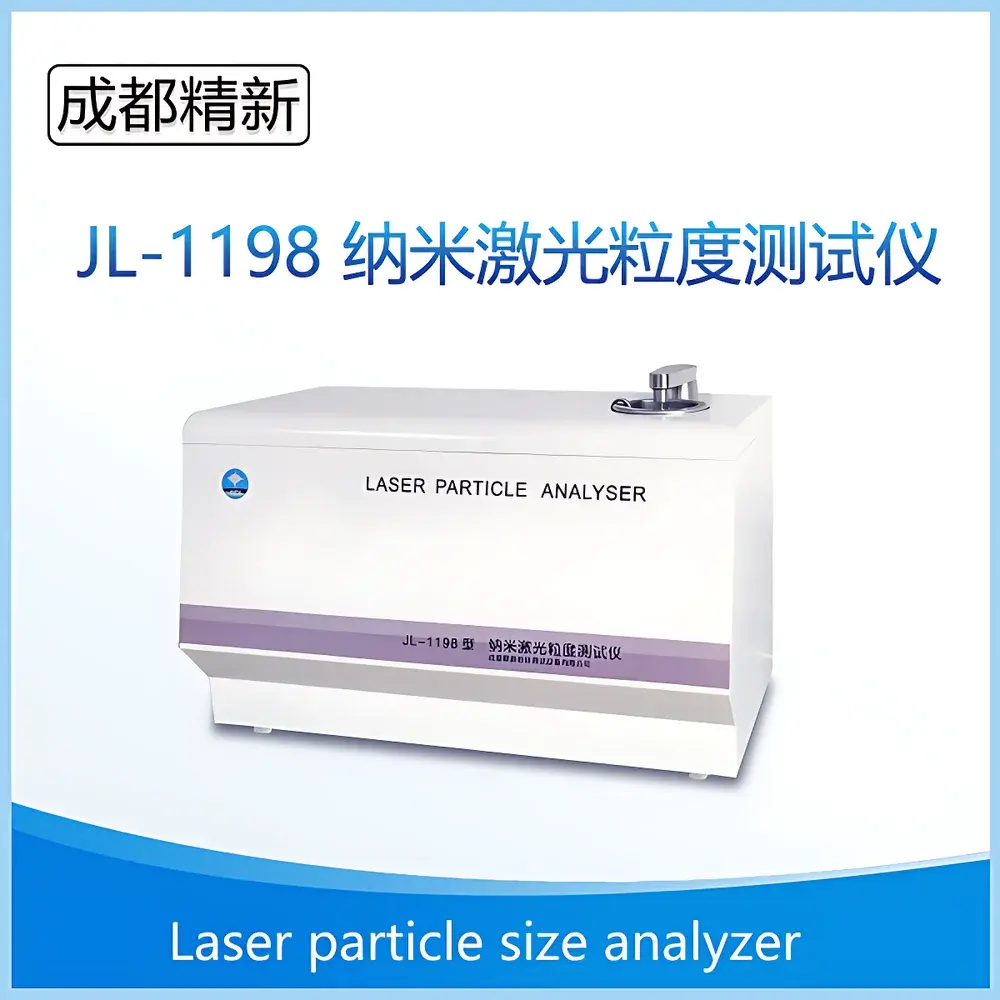
Chengdu Jingxin JL-1197/1198 Dual-Mode Nanoparticle and Microparticle Laser Diffraction Analyzer
| Brand | Chengdu Jingxin (CDJX) |
|---|---|
| Origin | Sichuan, China |
| Manufacturer Type | Direct Manufacturer |
| Country of Origin | China |
| Model | JL-1197 / JL-1198 |
| Price Range | USD 21,000–28,000 (FOB) |
| Particle Size Measurement Range | 1 nm – 3000 µm |
| Measurement Repeatability | ≤1% (D50 deviation against NIST-traceable standard materials) |
| Operating Temperature Range | 5–40 °C |
| Temperature Control Accuracy | ±0.2 °C |
| Optical Signal Sampling Frequency | 100 Hz |
| Sample Introduction Method | Fully Integrated Wet Dispersion Circulation System |
| Sample Volume Requirement | 0.1–5 mL per test (dependent on density, refractive index, and particle morphology) |
| Test Duration | 2–5 minutes per sample (automated sequence) |
| Detection Principle | Dual-mode — Photon Correlation Spectroscopy (PCS) for sub-100 nm particles |
| Detector Configuration | 128-element multi-channel photomultiplier tube array with high-gain, low-noise amplification |
| Optical Architecture | Inverted Fourier optical system with dual-laser path (635 nm semiconductor laser, >70,000 h lifetime) |
| Data Output Formats | CSV, PDF, TXT, XML |
| Software Language Options | English or Simplified Chinese UI |
| Compliance | Meets ISO 13321 (PCS), ISO 13320 (Laser Diffraction), and GB/T 19077–2016 (Chinese national standard for particle size analysis) |
Overview
The Chengdu Jingxin JL-1197/1198 Dual-Mode Nanoparticle and Microparticle Laser Diffraction Analyzer is an engineered solution for laboratories requiring traceable, high-reproducibility particle size characterization across the full nanoscale-to-micron spectrum. Unlike conventional single-principle instruments, this analyzer integrates two physically distinct measurement modalities within one unified platform: Photon Correlation Spectroscopy (PCS) for hydrodynamic diameter determination in the 1–10,000 nm range, and full-range Mie scattering theory-based laser diffraction for robust sizing from 0.01 µm to 3000 µm. The instrument employs an inverted Fourier optical configuration with a dual-laser pathway (635 nm wavelength, >70,000 h operational lifetime), minimizing stray light via optimized lens geometry and eliminating optical misalignment drift through rigid monolithic optical bench construction. All critical subsystems—including the 2.5 mL precision quartz flow cell, ultrasonic dispersion unit, magnetic stirrer, peristaltic circulation pump, and temperature-controlled fluid path—are fully enclosed in a shielded metal chassis, ensuring electromagnetic compatibility (EMC) and long-term signal stability under routine QC or R&D conditions.
Key Features
- Dual-principle operation: Seamless, software-triggered switching between PCS and Mie scattering modes—no hardware reconfiguration required.
- Inverted Fourier optical design with large-aperture primary lens and secondary collimation optics, enabling high angular resolution detection without aperture-induced truncation of forward-scattered light.
- 128-channel photomultiplier tube (PMT) detector array with programmable gain control and real-time noise suppression algorithms.
- Fully automated wet dispersion system featuring integrated ultrasonication (0–100 W, adjustable duty cycle), mechanical stirring (0–1200 rpm), and peristaltic sample circulation (flow rate 0–500 mL/min).
- Real-time temperature monitoring at the flow cell interface (±0.2 °C accuracy), decoupled from ambient chamber temperature to eliminate thermal gradient artifacts.
- Two sample introduction options: dynamic circulation mode for routine batch analysis; static mode with 2.5 mL thin-slit quartz cuvette for precious or low-volume samples (recovery >95%).
- Comprehensive data processing engine supporting both unimodal and multimodal distribution fitting, volume-, number-, and surface-area-weighted distributions, D10/D50/D90, specific surface area estimation, and polydispersity index (PDI) calculation.
Sample Compatibility & Compliance
The JL-1197/1198 supports aqueous and organic dispersions—including water, ethanol, isopropanol, and low-viscosity oils—across a broad concentration range (transmittance-adjusted from 1–10 dilution levels). It accommodates particles with refractive indices from 1.3 to 3.0 and absorption coefficients up to 0.1, covering ceramics, metal oxides, polymers, biological colloids, and pharmaceutical nanocarriers. Instrument validation follows ISO 13321 (for PCS) and ISO 13320 (for laser diffraction), with built-in reference calibration using NIST-traceable polystyrene latex standards (e.g., NIST SRM 1963, 1964). Data integrity complies with GLP and GMP documentation requirements, including electronic signature support, audit trail logging (per FDA 21 CFR Part 11), and exportable raw correlation functions and intensity histograms.
Software & Data Management
Jingxin’s proprietary ParticleSight™ v4.2 software provides a dual-language interface (English/Simplified Chinese) with role-based access control, method templates, and SOP-driven workflows. All measurements are timestamped, user-logged, and stored with full metadata (instrument parameters, environmental conditions, dispersion settings). Raw autocorrelation functions (PCS) and angular scattering profiles (Mie) are retained alongside processed results. Export formats include CSV (for statistical analysis in MATLAB or Python), PDF (print-ready reports with embedded graphics), and XML (LIMS integration). Batch processing supports up to 99 samples in unattended mode, with auto-generated pass/fail flags based on user-defined acceptance criteria (e.g., repeatability ≤1%, residual fit error <5%).
Applications
This analyzer serves quality control and formulation development labs in industries where nanoparticle stability, agglomeration behavior, and batch-to-batch consistency are critical: silicon dioxide sols, TiO₂ pigment slurries, carbon black dispersions, liposomal drug carriers, ceramic precursors (Al₂O₃, ZrO₂), catalyst supports (Pt/C, Ni/Al₂O₃), battery electrode slurries (LiCoO₂, graphite), cosmetic emulsions, pesticide suspensions, and mineral fillers (CaCO₃, talc, kaolin). Its ability to resolve bimodal distributions—such as aggregated nanoparticles coexisting with micron-scale fragments—is routinely applied in failure analysis of grinding processes, stability assessment of shelf-life studies, and regulatory submission dossiers requiring orthogonal sizing validation.
FAQ
Does the instrument support zeta potential measurement?
No. The JL-1197/1198 is dedicated exclusively to particle size distribution analysis via PCS and Mie scattering. Zeta potential requires electrophoretic light scattering (ELS), which is not implemented in this platform.
Can it measure dry powders directly?
No. This model operates only in wet dispersion mode. Dry powder analysis requires optional pneumatic dispersion accessories not included in the base configuration.
Is the software compatible with LIMS or ELN systems?
Yes. ParticleSight™ supports ASTM E1482-compliant data export and offers ODBC connectivity for direct database ingestion into laboratory information management systems.
What maintenance is required for long-term accuracy?
Annual verification using NIST-traceable standards is recommended. Optical alignment remains stable due to the rigid internal optical mount; no user-accessible collimation adjustments are necessary.
How is sample cross-contamination prevented between runs?
The integrated rinse cycle uses programmable solvent volume (up to 200 mL), flow rate, and dwell time, followed by air purge. Residual carryover is verified via blank run baseline checks before each sample series.



