
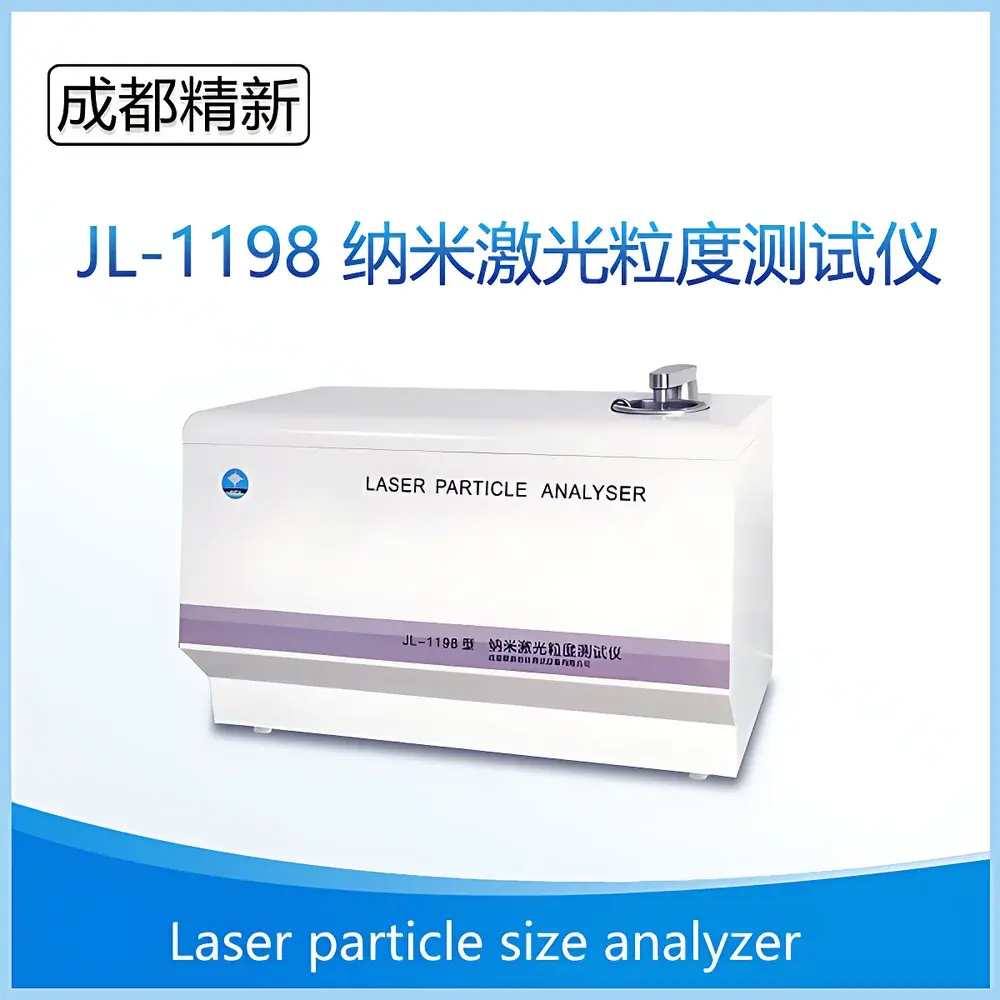
Chengdu Jingxin JL-1197 Dual-Mode Nanoparticle & Microparticle Laser Diffraction Particle Size Analyzer
| Brand | Chengdu Jingxin (CDJX) |
|---|---|
| Origin | Sichuan, China |
| Manufacturer Type | Direct Manufacturer |
| Instrument Type | Laboratory Laser Particle Size Analyzer |
| Dispersion Method | Wet Dispersion |
| Measurement Range | 1 nm – 3000 µm |
| Repeatability | ≤1% RSD for D50 (micron- and nano-grade reference standards) |
| Measurement Time | 2–3 minutes per sample |
Overview
The Chengdu Jingxin JL-1197 Dual-Mode Laser Particle Size Analyzer is an engineered solution for comprehensive particle size characterization across the full nanoscale-to-micron spectrum. It uniquely integrates two physically distinct measurement principles within a single platform: photon correlation spectroscopy (PCS), also known as dynamic light scattering (DLS), for sub-100 nm particles; and Mie theory-based laser diffraction for particles ranging from 0.01 µm to 3000 µm. This dual-mode architecture eliminates the need for separate instruments or manual reconfiguration of optical paths—mode switching is executed automatically with a single software command, completing transition in under five seconds. The system employs an inverted Fourier optical design with a large-aperture primary lens and optimized multi-element collimation, minimizing stray light from cell-window reflections and enabling high-fidelity detection of wide-angle scattering signals. All critical subsystems—including the 128-channel multi-element photodetector array, low-noise photomultiplier tubes (PMTs), dual-laser path optics, and integrated fluidic module—are housed within a fully shielded, rigid metal enclosure to ensure electromagnetic compatibility (EMC) and long-term thermal-mechanical stability.
Key Features
- Dual-principle operation: Seamless, software-triggered switching between PCS (1–10,000 nm) and Mie-scattering laser diffraction (0.01–3000 µm)
- Inverted Fourier optical system with large-diameter lens and anti-reflection coated optical glass components, reducing optical artifacts and enhancing resolution at both extremes of the range
- 128-channel high-gain, low-noise PMT detector array with adjustable delay time (20 ns–100 ms) and 64–4000 correlation channels for robust DLS analysis
- Integrated wet dispersion module featuring auto-fill water level control, ultrasonic bath (20–40 kHz, adjustable duration), magnetic stirring, and peristaltic circulation pump with programmable flow rate and cycle count
- 2.5 mL precision quartz cuvette optimized for low-volume, high-value nanoparticle samples; supports both static and recirculating measurement modes with tool-free interchangeability
- Real-time temperature monitoring at the sample cell interface—eliminating thermal gradient errors common in external bath-based systems
- Automated parameter optimization: software dynamically selects optimal channel count, delay time, and measurement duration based on signal-to-noise ratio and autocorrelation decay profile
Sample Compatibility & Compliance
The JL-1197 accommodates aqueous and organic dispersions—including deionized water, distilled water, ethanol, and isopropanol—as standard liquid media. Its wet dispersion system is compatible with a broad range of particulate materials: colloidal silica, metal oxides (e.g., Al₂O₃, TiO₂), polymer latices, pigment dispersions, pharmaceutical nanosuspensions, catalysts, and ceramic precursors. The instrument meets mechanical and electrical safety requirements per GB/T 29902–2013 (Chinese national standard for laser particle analyzers) and complies with ISO 13320:2020 for laser diffraction methodology. While not pre-certified for FDA 21 CFR Part 11, its audit-trail-capable software architecture supports validation protocols required for GLP and GMP environments—full electronic records, user access logs, parameter change history, and digital signature readiness are configurable via optional software modules.
Software & Data Management
The proprietary Jingxin Particle Analysis Suite (v4.2+) provides bilingual UI (English/Chinese), real-time scatter plot visualization, and automated report generation. Data output includes volume-weighted (D[v,0.1]–D[v,99.9]), number-weighted (D[n,10]–D[n,90]), and intensity-weighted distributions; key metrics such as D10, D50, D90, span, specific surface area (via spherical assumption), and polydispersity index (PdI) are calculated per ISO 22412. Raw correlation functions and diffraction patterns are exportable in ASCII format; reports may be saved as PDF, CSV, or plain text. The software supports batch processing of up to 99 samples with customizable pass/fail criteria and statistical trending across sequences. All measurement parameters, environmental logs (temperature, humidity, laser power), and operator IDs are embedded in metadata for traceability.
Applications
This analyzer serves laboratories engaged in advanced materials development and quality control where cross-regime particle sizing is routine. Typical use cases include: optimization of sol-gel synthesis for transparent ceramics; stability assessment of oil-in-water emulsions in cosmetics; agglomeration kinetics studies of nanoscale catalysts under thermal stress; D50 verification of milled pharmaceutical excipients (e.g., microcrystalline cellulose); rheological preconditioning of cementitious suspensions; and QC release testing of pigment dispersions in inkjet inks. Its ability to quantify both absolute mass concentration (mg/mL) and relative scattering intensity enables semi-quantitative formulation screening without calibration standards.
FAQ
Does the JL-1197 require external temperature control for nanoscale measurements?
No—the system incorporates an integrated Pt100 sensor directly adjacent to the sample cell, enabling real-time thermal feedback and automatic compensation for viscosity-driven diffusion coefficient shifts.
Can the instrument measure dry powders?
No—it is configured exclusively for wet dispersion analysis. Dry powder measurement requires optional add-on dry dispersion modules not included in the base JL-1197 configuration.
What is the minimum required sample volume for static mode analysis?
As low as 0.3 mL is sufficient when using the 2.5 mL quartz cuvette in static mode, with full recovery of unaltered material post-measurement.
Is compliance with ISO 13321 (DLS) supported?
Yes—the PCS module implements autocorrelation analysis per ISO 13321:2020, including cumulant, CONTIN, and NNLS algorithms, with built-in validation against NIST-traceable latex standards.
How is data integrity maintained during regulatory audits?
All raw data files carry embedded timestamps, operator credentials, instrument serial ID, and complete acquisition parameters; optional 21 CFR Part 11 compliance packages provide electronic signatures, role-based access control, and immutable audit trails.



