
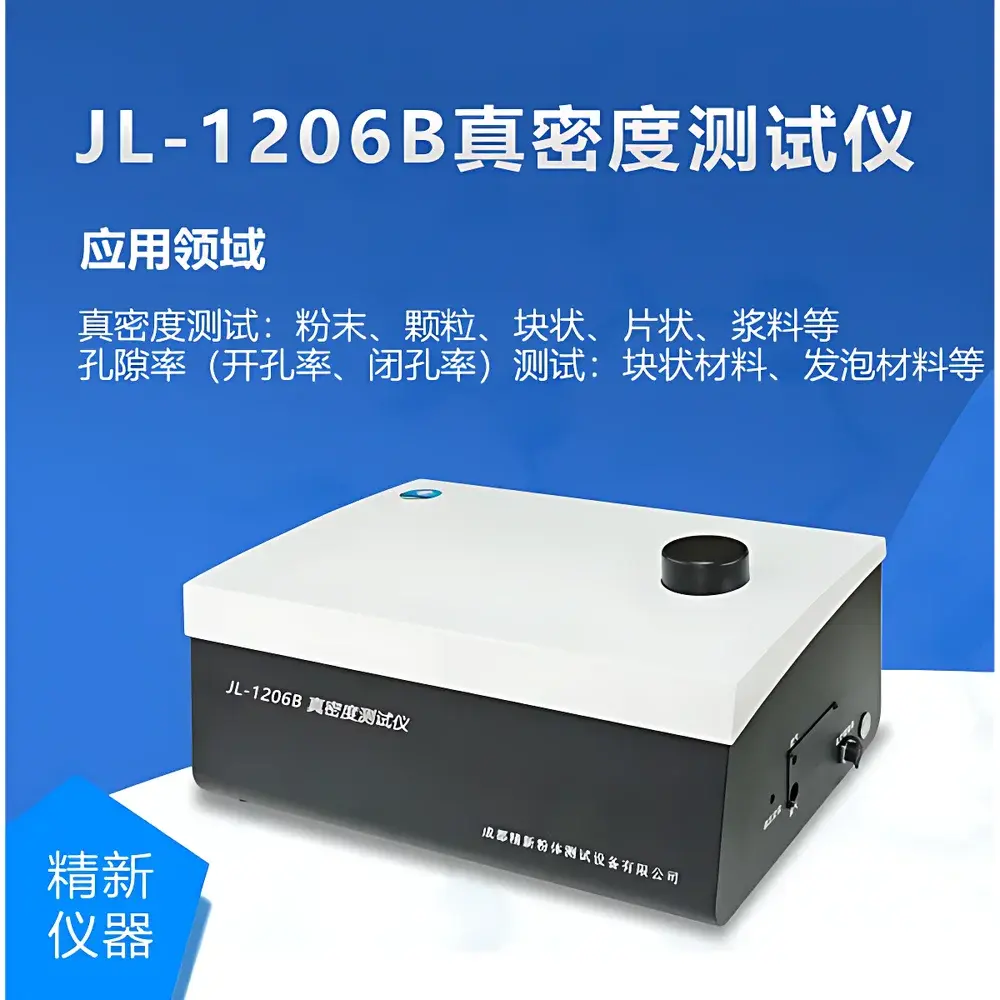
Chengdu Jingxin JL-1206B Automatic True Density Analyzer
| Brand | Chengdu Jingxin (CDJX) |
|---|---|
| Origin | Sichuan, China |
| Manufacturer Type | Original Equipment Manufacturer (OEM) |
| Regional Category | Domestic (China) |
| Model | JL-1206B |
| Instrument Type | True Density Analyzer |
| Form Factor | Benchtop (not portable — corrected per technical specification: 14 kg, fixed installation required) |
| Sample Type | Solid powders, granules, bulk solids, foams, slurries, and filtration media |
| Measurement Principle | Gas Pycnometry (Nitrogen or Helium Displacement, ISO 12154:2014 compliant) |
| Volume Range | 0.01–100 cm³ |
| Temperature Range | 5–35 °C |
| Resolution | 0.00001 g/cm³ |
| Accuracy | ±0.01% (relative) |
| Analysis Stations | 1 |
| Standard Chamber Volume | 100 mL |
| Optional Sample Cups | 10 mL, 30 mL, 60 mL |
| Pressure Control | Absolute pressure mode (0–130 kPa), vacuum-assisted degassing |
| Test Gas | 99.99% N₂ or He (user-supplied) |
| Software Interface | Windows 7 or later |
| Communication | RS-232 or USB |
| Power | AC 220 V ±22 V, 50 Hz |
| Dimensions | 485 × 350 × 220 mm (L×W×H) |
| Weight | 14 kg |
| Compliance | GB/T 24586–2009, ISO 12154:2014, ASTM D5550–22 |
Overview
The Chengdu Jingxin JL-1206B Automatic True Density Analyzer is a benchtop gas pycnometer engineered for high-precision determination of true density and open/closed porosity in solid materials. It operates on the principle of gas displacement—specifically nitrogen or helium volumetric substitution—governed by the ideal gas law under controlled absolute pressure conditions. Unlike liquid-based methods (e.g., mercury intrusion or Archimedean immersion), this instrument eliminates surface tension, wetting, and dissolution artifacts, delivering reproducible measurements of the intrinsic skeletal density of powders, granules, monolithic ceramics, metal foams, polymer composites, and porous filtration media. The system integrates a sealed measurement chamber, precision pressure transducers, electromechanical valves, and an integrated vacuum pump to enable full degassing of adsorbed gases prior to analysis—a critical requirement for materials with high surface area or microporous structure. Its design conforms to ISO 12154:2014 (“Determination of true density of powders and solids by gas pycnometry”) and GB/T 24586–2009, ensuring metrological traceability and regulatory acceptability in QC laboratories operating under GLP or GMP frameworks.
Key Features
- Single-station automated analysis with integrated 100 mL reference chamber and interchangeable sample cups (10 mL, 30 mL, 60 mL) for optimized volume matching across diverse sample geometries and masses.
- True density resolution of 0.00001 g/cm³ and accuracy better than ±0.01% (relative), validated using certified stainless-steel calibration spheres traceable to national standards.
- Vacuum-assisted degassing protocol: removes physisorbed ambient gases from sample surfaces and closed pores prior to gas introduction—essential for accurate measurement of activated carbons, zeolites, MOFs, and nanomaterials.
- Intelligent pressure regulation: absolute pressure range 0–130 kPa; adjustable relative working pressure (5–90%) to minimize mechanical deformation of compressible or fragile samples (e.g., aerogels, soft polymers).
- Self-diagnostic gas circuitry: automatic leak detection, valve actuation verification, and real-time pressure curve acquisition via high-speed, high-resolution sampling (≥1 kHz) for robust data integrity.
- Thermally stabilized architecture: monolithic sealed housing minimizes thermal drift and ensures consistent temperature distribution across sensor, chamber, and valve manifold during measurement cycles.
Sample Compatibility & Compliance
The JL-1206B accommodates a broad spectrum of physically heterogeneous solids—including free-flowing powders (e.g., pharmaceutical APIs, battery cathode materials), irregular granules (catalyst supports, abrasives), rigid blocks (ceramic tiles, graphite electrodes), low-density foams (polyurethane, melamine), and semi-fluid slurries (ceramic slips, electrode pastes). It supports both open-pore and closed-pore porosity calculations when combined with known bulk volume data (e.g., from laser scanning or geometric measurement). Regulatory alignment includes compliance with ISO 12154:2014, ASTM D5550–22, and GB/T 24586–2009. While not inherently 21 CFR Part 11–compliant, its software architecture permits audit-trail configuration and electronic signature integration upon customer-requested customization—enabling deployment in FDA-regulated environments where raw data integrity and operator accountability are mandated.
Software & Data Management
The proprietary Windows-based control software provides full automation of test sequences: sample loading confirmation, vacuum evacuation, gas dosing, equilibration monitoring, and density calculation—all executed without manual intervention. Each test generates timestamped metadata (operator ID, environmental T/P, cup ID, degas duration), stored locally in an encrypted SQLite database. Reporting supports export to PDF (with embedded calibration certificates), Excel (.xlsx), and plain-text (.txt) formats, preserving full decimal precision and uncertainty annotations. Batch processing allows user-defined repetition (1–99 cycles) with automatic outlier rejection based on standard deviation thresholds. All raw pressure-time curves are archived alongside derived results, satisfying ALCOA+ data integrity principles (Attributable, Legible, Contemporaneous, Original, Accurate, Complete, Consistent, Enduring, Available).
Applications
- Pharmaceutical development: true density profiling of active ingredients and excipients for tablet compaction modeling and dissolution kinetics prediction.
- Battery R&D: characterization of cathode/anode powder density and interparticle porosity to correlate with electrode coating uniformity and ionic conductivity.
- Advanced ceramics: quantification of sintering density evolution and residual closed porosity in SiC, Al₂O₃, or ZrO₂ components.
- Carbon materials: differentiation between skeletal density (graphitic domains) and apparent density (including micro/mesopores) in activated carbon and carbon black.
- Geological sciences: mineral density fingerprinting for provenance studies and porosity mapping in reservoir rock analogs.
- Quality control labs: routine verification of material lot consistency against master reference values, with statistical process control (SPC) charting capability.
FAQ
What gases are compatible with the JL-1206B, and why is helium sometimes preferred over nitrogen?
The instrument supports 99.99% pure nitrogen or helium. Helium is recommended for ultra-microporous materials (pore diameter < 2 nm) due to its smaller kinetic diameter (0.26 nm vs. 0.36 nm for N₂), enabling more complete pore access and minimizing Knudsen diffusion limitations.
Does the system require external calibration standards?
No—each unit ships with a traceable stainless-steel calibration sphere. Routine verification is performed automatically at startup or manually via software command, ensuring ongoing measurement fidelity without third-party reference materials.
Can the JL-1206B measure liquids or volatile organics?
No. It is strictly designed for non-volatile, thermally stable solids. Liquids, solvents, or low-boiling-point compounds may condense in the gas path or damage pressure sensors.
Is vacuum operation mandatory, or can the instrument run in positive-pressure mode?
Both modes are supported. Vacuum mode is required for high-surface-area or adsorptive samples; positive-pressure mode suffices for inert, non-porous solids (e.g., metals, dense glasses), reducing power consumption and cycle time.
How does the system handle moisture-sensitive samples?
The instrument does not include in-situ drying. Users must pre-condition samples externally (e.g., vacuum oven, desiccator) prior to loading. Residual moisture will displace test gas and bias results upward.



