
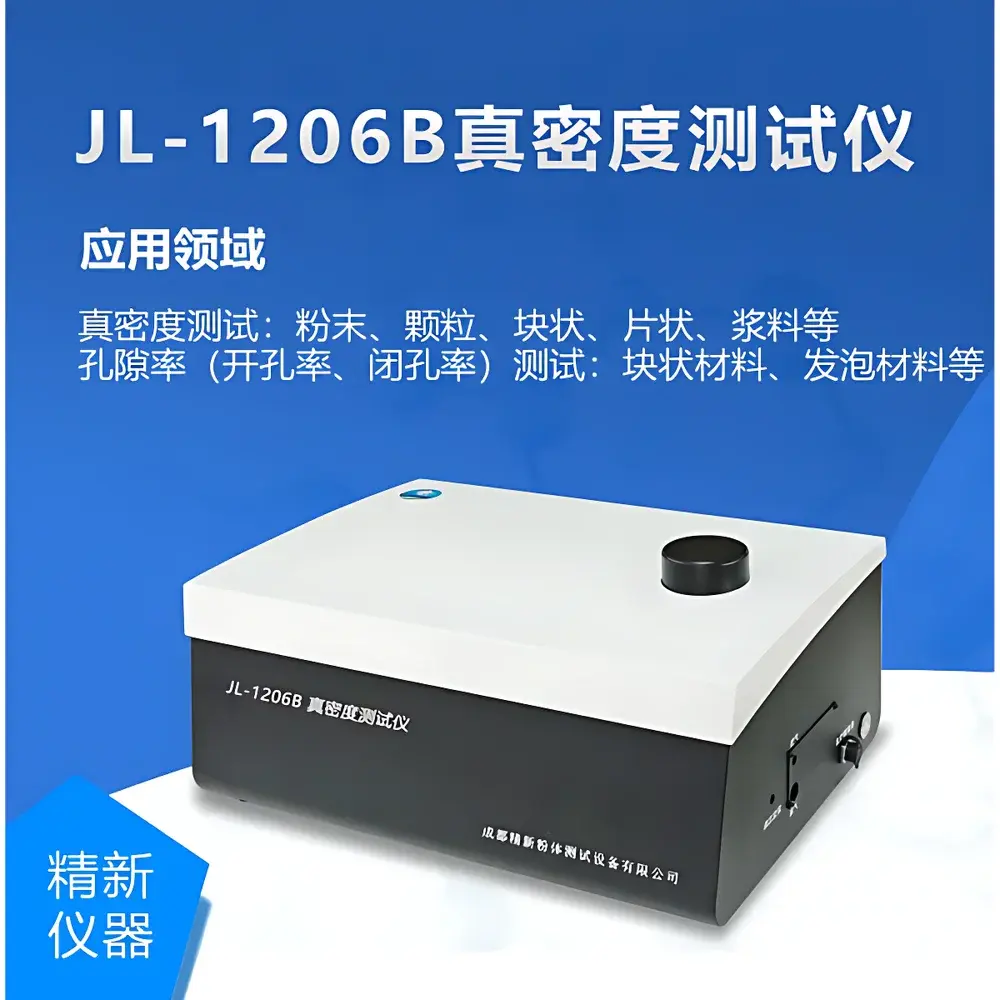
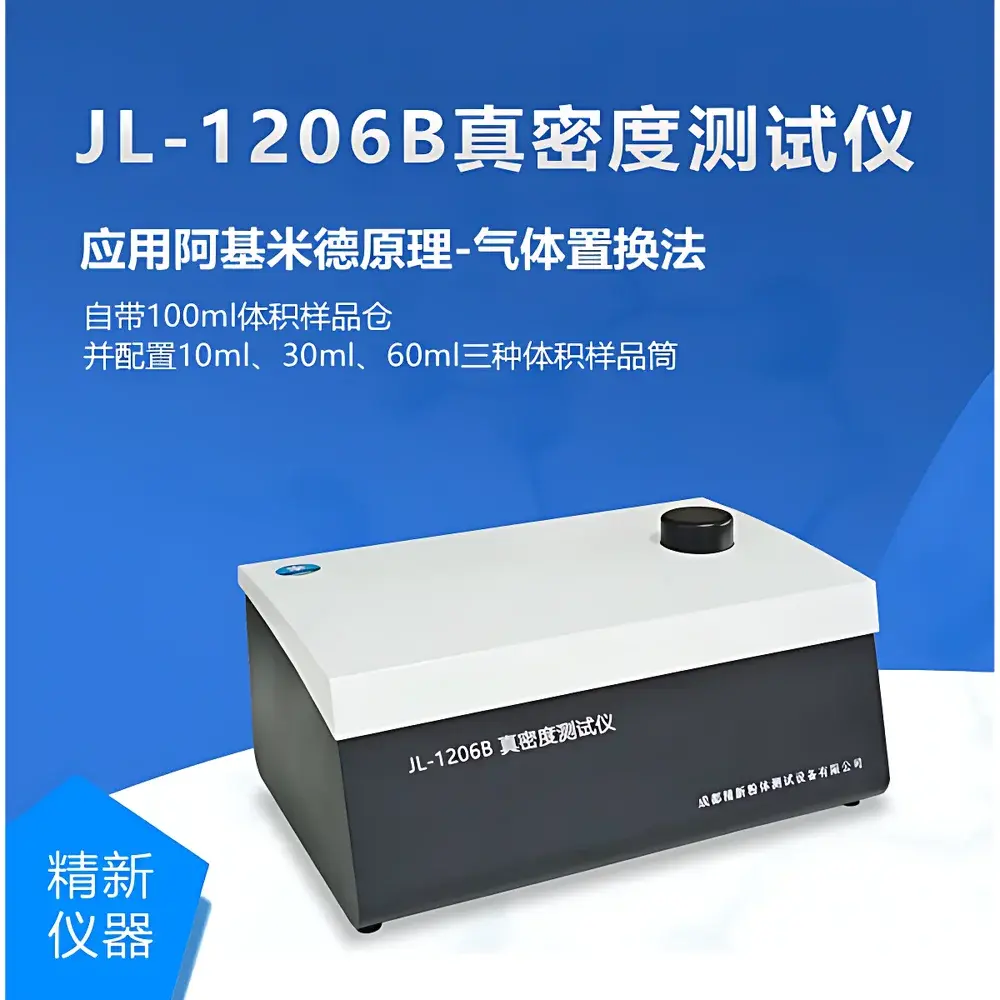
Chengdu Jingxin JL-1206B Automatic True Density Analyzer
| Brand | Chengdu Jingxin (CDJX) |
|---|---|
| Origin | Sichuan, China |
| Manufacturer Type | Direct Manufacturer |
| Regional Category | Domestic (China) |
| Model | JL-1206B |
| Price Range | USD 5,600 – 7,000 (est.) |
| Application Field | General-purpose true density analysis |
| Instrument Type | True Density Analyzer |
| Form Factor | Benchtop (not portable — correction per technical specs) |
| Sample Type | Solid materials (powders, granules, monoliths, foams, slurries, filters) |
| Measurement Principle | Gas Pycnometry (Nitrogen or Helium displacement, based on ideal gas law) |
| Volume Range | 0.01–100 cm³ |
| Temperature Operating Range | 5–35 °C |
| Density Resolution | 0.00001 g/cm³ |
| Accuracy | ±0.01% (relative) |
| Analysis Stations | 1 |
| Standard Chamber Volume | 100 mL (with interchangeable sample cups: 10 mL, 30 mL, 60 mL) |
| Pressure Control | Absolute pressure mode (vacuum-based), 0–130 kPa absolute |
| Test Gas | 99.99% purity N₂ or He (user-supplied) |
| Data Interface | RS232 or USB |
| Software Platform | Windows 7 or later |
| Power Supply | AC 220 V ±10%, 50 Hz, <200 W (vacuum mode) |
| Dimensions | 485 × 350 × 220 mm |
| Weight | 14 kg |
| Compliance | GB/T 24586–2009, ISO 12154:2014 (gas pycnometry), ASTM D5550–22 |
Overview
The Chengdu Jingxin JL-1206B Automatic True Density Analyzer is a benchtop gas pycnometer engineered for high-precision determination of true density and open/closed porosity in solid materials. It operates on the principle of gas displacement—specifically, nitrogen or helium volumetric displacement under controlled absolute pressure conditions—enabling measurement of the volume occupied exclusively by solid matter, excluding all interstitial voids, pores, and interparticle spaces. Unlike hydrostatic (Archimedean) methods, which are susceptible to surface tension, liquid penetration, and sample solubility artifacts, gas pycnometry provides non-destructive, operator-independent quantification compliant with ISO 12154:2014 and GB/T 24586–2009. The instrument integrates a sealed, thermostatically stable measurement manifold comprising a reference chamber, sample chamber, high-stability pressure transducers, precision solenoid valves, and an integrated vacuum pump. This architecture ensures thermal equilibrium across the system during pressurization and equilibration phases—critical for minimizing drift and maximizing reproducibility.
Key Features
- Single-station automated analysis with built-in 100 mL reference chamber and interchangeable sample cups (10 mL, 30 mL, 60 mL) for optimal volume matching across diverse sample geometries and masses.
- True density resolution of 0.00001 g/cm³ and accuracy better than ±0.01% (relative), validated using certified stainless-steel calibration spheres traceable to national standards.
- Full system self-diagnostic capability: automatic leak detection, valve response verification, pressure sensor zeroing, and real-time gas integrity monitoring prior to each test cycle.
- Intelligent pressure management: absolute pressure control from 0 to 130 kPa; adjustable relative working pressure (5–90%) to minimize deformation effects on compressible or fragile samples (e.g., aerogels, polymer foams).
- Vacuum-first methodology: complete degassing of adsorbed ambient gases from sample surfaces and closed pores before introduction of analysis gas—essential for high-surface-area powders and microporous ceramics.
- High-speed digital pressure acquisition with >1 kHz sampling rate and thermal drift compensation algorithms, ensuring robust curve fitting and consistent volume calculation via the ideal gas law.
Sample Compatibility & Compliance
The JL-1206B accommodates a broad spectrum of solid-phase materials, including metal and ceramic powders, pharmaceutical granules, battery electrode composites, geological core fragments, polymer monoliths, reticulated foams, filtration membranes, and aqueous or organic slurries (with appropriate cup sealing). It supports both true density and derived porosity calculations—including total, open, and closed porosity—when combined with independent bulk volume measurements (e.g., via caliper or laser profilometry). The system meets regulatory expectations for analytical instrumentation used in GLP and GMP environments: audit-trail-enabled software logging (user actions, timestamps, parameter changes), electronic signature support, and data export in PDF, Excel (.xlsx), and plain-text (.txt) formats compatible with LIMS integration. It conforms to ISO 12154:2014 (determination of true density by gas pycnometry), ASTM D5550–22 (standard test method for true density of calcined petroleum coke), and Chinese national standard GB/T 24586–2009.
Software & Data Management
The proprietary Windows-based control software provides full automation of test sequencing—from vacuum evacuation and gas dosing to pressure equilibration, calculation, and reporting. Each test cycle records raw pressure-time profiles, intermediate calibration values, environmental temperature/humidity metadata, and final density/porosity outputs. All data are stored in a structured local database with configurable auto-backup intervals. Users may define multi-cycle test protocols with programmable repetition counts, statistical post-processing (mean, SD, RSD), outlier rejection criteria, and pass/fail thresholds aligned with internal SOPs. Exported reports include instrument ID, operator ID, calibration status, gas type and purity, chamber volumes, and full uncertainty propagation per ISO/IEC 17025 guidelines. The software supports 21 CFR Part 11 readiness through optional configuration (electronic signatures, role-based access control, immutable audit logs).
Applications
- Quality control of catalyst supports, battery cathode/anode powders, and additive manufacturing feedstocks where density correlates directly with sinterability and electrochemical performance.
- Pore structure characterization of thermal insulation materials, lightweight composites, and biomedical scaffolds—differentiating open-cell permeability from closed-cell buoyancy effects.
- Raw material verification in pharmaceutical manufacturing per USP <699> and ICH Q5C, supporting stability-indicating assays and batch release testing.
- Research-grade density mapping in geoscience labs for mineralogical phase identification and porosity evolution modeling under thermal or mechanical stress.
- Validation of powder compaction behavior in metallurgy and ceramics processing, where true density serves as a proxy for green density and final part integrity.
FAQ
What gases are compatible with the JL-1206B?
Nitrogen (99.99% purity minimum) and helium are supported. Helium is recommended for ultra-microporous materials (<2 nm pore diameter) due to its smaller kinetic diameter and improved intraparticle diffusion.
Is sample drying required before testing?
Drying is recommended for hygroscopic or moisture-sensitive materials. The instrument does not include an integrated oven; samples must be pre-conditioned externally per material-specific protocols (e.g., 105°C for 2 h for metal oxides).
Can the system measure liquids or low-viscosity suspensions?
No—it is designed exclusively for solid-phase samples. Slurries may be measured only if fully filter-dried and stabilized in the sample cup without migration or settling artifacts.
How is system calibration performed?
Using supplied certified stainless-steel calibration spheres (10–60 mL volumes). Calibration is executed automatically within the software and includes both volume and pressure linearity verification.
Does the analyzer support networked operation or remote monitoring?
Local operation only via USB or RS232. Ethernet or cloud connectivity is not natively supported, though third-party SCADA integration is possible via ASCII command protocol documentation.



