
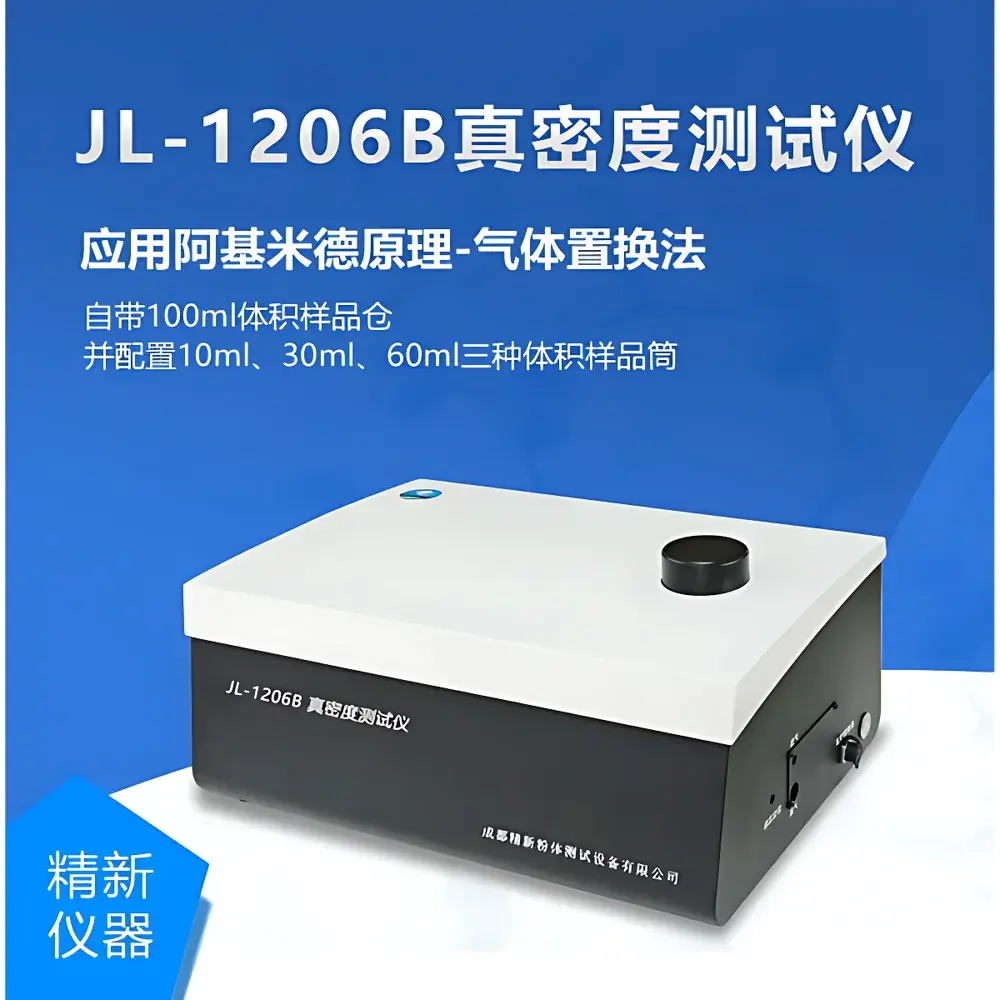
Chengdu Jingxin JL-1206B Gas Pycnometer for True Density and Porosity Analysis
| Brand | Chengdu Jingxin (CDJX) |
|---|---|
| Origin | Sichuan, China |
| Manufacturer Type | OEM Manufacturer |
| Region of Manufacture | Domestic (China) |
| Model | JL-1206B |
| Instrument Type | True Density Analyzer |
| Category | Portable Solid Density Analyzer |
| Measurement Principle | Gas Displacement Pycnometry (ISO 12154:2014, GB/T 24586–2009) |
| Sample Volume Range | 0.01–100 cm³ |
| Temperature Operating Range | 5–35 °C |
| Density Resolution | 0.00001 g/cm³ |
| Accuracy | ±0.01% (relative) |
| Analysis Stations | 1 |
| Standard Chamber Volume | 100 mL (with interchangeable sample cups: 10 mL, 30 mL, 60 mL) |
| Pressure Mode | Absolute Vacuum Mode (0–130 kPa absolute) |
| Test Gas | 99.99% N₂ or He (user-supplied) |
| Data Interface | RS232 or USB |
| Software Platform | Windows 7 or later |
| Power Supply | AC 220 V ±22 V, 50 Hz |
| Vacuum Mode Power Consumption | <200 W |
| Dimensions (L×W×H) | 485 × 350 × 220 mm |
| Weight | 14 kg |
Overview
The Chengdu Jingxin JL-1206B Gas Pycnometer is a precision-engineered instrument designed for the accurate determination of true density and porosity (open- and closed-cell porosity) of solid materials using gas displacement pycnometry—a method standardized under ISO 12154:2014 and GB/T 24586–2009. Unlike liquid-based methods such as mercury intrusion or Archimedean immersion, which risk sample dissolution, surface adsorption interference, or operator-induced meniscus errors, this system employs inert gas (N₂ or He) to measure the geometric volume occupied exclusively by solid matter—excluding all interstitial voids, open pores, and interparticle spaces. The principle relies on Boyle’s Law: a known quantity of gas is introduced into a calibrated reference chamber, then allowed to expand into a second chamber containing the sample; pressure equilibration across both volumes enables calculation of the sample’s non-porous volume with high reproducibility. This approach yields true density values critical for quality control in advanced ceramics, battery electrode materials, pharmaceutical excipients, metal powders, and porous polymers.
Key Features
- Integrated vacuum-type gas pycnometry architecture with built-in diaphragm vacuum pump (absolute pressure range: 0–130 kPa), ensuring complete desorption of ambient gases from high-surface-area or microporous samples prior to measurement.
- Modular sample chamber design featuring a fixed 100 mL reference cell and three interchangeable stainless-steel sample cups (10 mL, 30 mL, 60 mL), enabling optimal volume matching for diverse sample geometries—from fine powders to irregular bulk solids and foams.
- High-resolution pressure acquisition system with intelligent flow stabilization and sub-millisecond sampling rate, delivering consistent repeatability (<0.01% RSD) and resolution down to 0.00001 g/cm³.
- Automated self-diagnostic routines—including leak detection, valve actuation verification, and real-time pressure drift monitoring—to validate system integrity before each analysis cycle.
- Adjustable relative test pressure (5–90% of full scale) to minimize compressive deformation effects on soft or fragile samples such as aerogels, polymer foams, or sintered compacts.
- Factory-calibrated with certified stainless-steel reference spheres traceable to national metrology standards, supporting routine performance verification per ISO/IEC 17025 requirements.
Sample Compatibility & Compliance
The JL-1206B accommodates a broad spectrum of solid-phase materials: free-flowing powders (e.g., TiO₂, SiO₂, LiCoO₂), granules, tablets, monolithic ceramics, metallic sintered parts, polymeric foams, carbon felts, and filter media. Slurries and pastes may be analyzed after controlled drying or solvent removal. Its methodology aligns with international regulatory expectations for material characterization in GMP-compliant environments, including ASTM D5550 (Standard Test Method for True Density of Calcined Petroleum Coke), ISO 12154 (Determination of true density of powders and porous bodies), and USP (Density Measurements). While not inherently 21 CFR Part 11 compliant, audit-trail-enabled software versions support GLP/GMP documentation workflows when deployed with validated IT infrastructure.
Software & Data Management
The bundled Windows-based application provides full automation of test sequencing—from vacuum evacuation and gas dosing to equilibrium detection and density computation. Each run logs timestamped metadata (ambient temperature, chamber pressure, sample mass, cup ID), raw pressure-time curves, and final results. Data export options include PDF reports (with customizable headers, logos, and QA stamps), Excel (.xlsx) spreadsheets for statistical process control (SPC), and plain-text (.txt) files for integration into LIMS or MES platforms. Batch processing supports user-defined repetition protocols (1–99 cycles), automatic outlier rejection, and mean±SD reporting. All data files are stored in non-proprietary formats to ensure long-term accessibility and interoperability.
Applications
- Quality assurance of battery cathode/anode powders where true density correlates directly with tap density, packing efficiency, and electrochemical performance.
- Pore structure characterization of catalyst supports, filtration membranes, and thermal insulation materials via combined true density and apparent density inputs.
- Raw material release testing in pharmaceutical manufacturing, particularly for excipients requiring tight density specifications per ICH Q5C guidelines.
- R&D evaluation of additive manufacturing feedstocks (e.g., Ni-based superalloys, Ti-6Al-4V), where interstitial porosity impacts mechanical anisotropy and fatigue life.
- Geotechnical analysis of engineered soils and lightweight aggregates used in sustainable construction composites.
FAQ
What gases can be used for testing?
Nitrogen (99.99% purity) is standard; helium is recommended for ultra-low-density or highly microporous samples due to its smaller kinetic diameter and improved diffusion kinetics.
Is sample preparation required before analysis?
Yes—samples must be dry and free of volatile contaminants. Thermal drying (≤105 °C) or vacuum desiccation is advised for hygroscopic or solvent-wet materials.
Can the instrument measure open vs. closed porosity separately?
Yes—when paired with an external skeletal density measurement (e.g., mercury porosimetry or liquid pycnometry), the JL-1206B’s true density output enables calculation of total, open, and closed porosity per ASTM D6286.
How often should calibration verification be performed?
Daily verification using the supplied stainless-steel calibration sphere is recommended; full recalibration every six months or after major maintenance is advised per ISO/IEC 17025.
Does the system support networked operation or remote monitoring?
The RS232/USB interface supports local PC control only; Ethernet or Wi-Fi connectivity is not natively available but may be enabled via third-party industrial gateways compatible with Modbus RTU protocol.



