
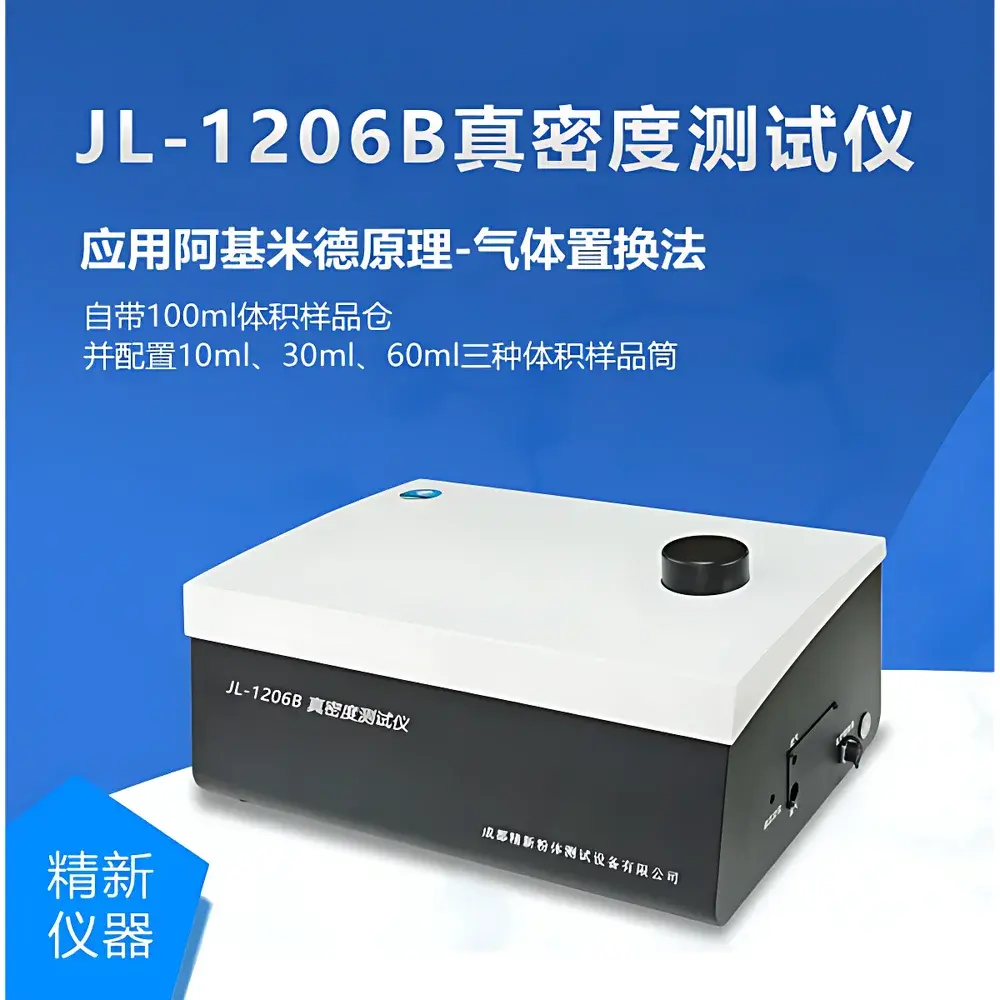
Chengdu Jingxin JL-1206B True Density Analyzer
| Brand | Chengdu Jingxin (CDJX) |
|---|---|
| Origin | Sichuan, China |
| Manufacturer Type | Direct Manufacturer |
| Origin Category | Domestic (China-made) |
| Model | JL-1206B |
| Instrument Type | True Density Analyzer |
| Form Factor | Benchtop (not portable — corrected per technical specification: 14 kg, fixed installation) |
| Sample Type | Solids (powders, granules, bulk solids, foams, filter media, slurries) |
| Measurement Principle | Gas Pycnometry (Nitrogen or Helium Displacement, ASTM D5550 / ISO 12154 compliant) |
| Density Range | 0.01–100 g/cm³ |
| Temperature Control Range | 15–39 °C |
| Repeatability | ±0.02% RSD |
| Resolution | 0.00001 g/cm³ |
| Sample Volume Capacity | 0.01–100 cm³ (with interchangeable sample chambers: 10 mL, 30 mL, 60 mL, and fixed 100 mL reference chamber) |
| Test Duration | ~3 min per analysis (fully automated) |
| Pressure Mode | Absolute pressure vacuum system (0–130 kPa absolute), integrated vacuum pump |
| Calibration Standard | Certified stainless steel sphere (included) |
| Software Interface | Windows 7 or later, RS232/USB |
| Compliance | GB/T 24586–2009, ASTM D5550–22, ISO 12154:2014, USP <699> (for density determination in pharmaceutical excipients) |
Overview
The Chengdu Jingxin JL-1206B True Density Analyzer is a benchtop gas pycnometer engineered for high-precision measurement of true (skeletal) density and open/closed porosity of solid materials. It operates on the fundamental principle of gas displacement—specifically, nitrogen or helium volumetric substitution—governed by the ideal gas law under controlled isothermal conditions. Unlike hydrostatic (Archimedean) methods, gas pycnometry eliminates liquid penetration artifacts, surface tension errors, and solubility-induced bias, making it the internationally recognized standard for inert, reactive, hygroscopic, or ultra-microporous solids. The instrument conforms to GB/T 24586–2009, ASTM D5550–22 (Standard Test Method for True Density of Solid Materials by Gas Pycnometry), and ISO 12154:2014 (Determination of true density of powders and porous materials). Its design integrates a thermally stabilized, fully sealed measurement manifold—including a fixed 100 mL reference chamber, precision pressure transducers (±0.05% FS), electromagnetically actuated isolation valves, and an integrated vacuum pump—to ensure thermal equilibrium and minimize drift during equilibration.
Key Features
- Fully automated gas pycnometry workflow: vacuum evacuation → gas dosing → pressure equilibration → calculation → reporting—all executed in ≤180 seconds per cycle.
- Modular sample chamber system: supports interchangeable stainless-steel sample tubes (10 mL, 30 mL, 60 mL) mounted within a rigid 100 mL calibrated reference volume, enabling optimal volume-to-sample ratio for improved signal-to-noise across diverse morphologies (e.g., low-density foams vs. dense ceramics).
- True density resolution of 0.00001 g/cm³ and repeatability better than ±0.02% RSD (n ≥ 10, certified reference material), validated using NIST-traceable stainless-steel calibration spheres.
- Intelligent pressure management: absolute pressure control (0–130 kPa) with programmable fill pressure (5–90% of full scale) to prevent deformation of compressible or fragile samples (e.g., aerogels, polymer foams).
- Self-diagnostic pneumatic integrity check: automatic leak-rate assessment prior to each analysis; real-time valve timing verification and pressure decay monitoring.
- Thermally isolated, monolithic chamber architecture minimizes ambient temperature fluctuations, ensuring stable isothermal conditions during pressure equilibration (critical for <0.01% accuracy).
Sample Compatibility & Compliance
The JL-1206B accommodates a broad spectrum of solid-phase materials: free-flowing powders (metallic, ceramic, pharmaceutical), irregular granules, sintered compacts, porous monoliths, reticulated foams, membrane filters, and low-viscosity slurries (when pre-dried or solvent-stabilized). It excludes volatile organics, reactive metals (e.g., alkali metals), or samples that chemically interact with N₂/He under vacuum. Regulatory alignment includes support for GLP-compliant data acquisition (audit trail enabled), FDA 21 CFR Part 11–ready software configuration (user authentication, electronic signatures, immutable raw data logs), and traceability per ISO/IEC 17025 requirements when operated with documented calibration schedules and uncertainty budgets. All firmware and software updates are version-controlled and documented per ICH Q9 quality risk management principles.
Software & Data Management
The proprietary Windows-based control software (v3.2+) provides guided workflow navigation, real-time pressure curve visualization, multi-point calibration routines, and configurable test sequences (single-shot, batch, repeat-with-auto-average). Raw pressure-time datasets are stored in binary format with embedded metadata (timestamp, operator ID, chamber ID, gas type, temperature, atmospheric pressure). Export options include PDF (formatted test reports), Excel (.xlsx with statistical summaries), and ASCII (.txt) for LIMS integration. Audit trails record all user actions, parameter changes, and instrument status events with tamper-proof timestamps. Optional API support enables direct SCADA or MES connectivity via TCP/IP or OPC UA.
Applications
- Pharmaceuticals: true density of active pharmaceutical ingredients (APIs) and excipients for dissolution modeling and tablet compaction prediction (USP ).
- Battery materials: skeletal density of cathode/anode powders (LiCoO₂, graphite, silicon composites) to quantify tap density and porosity for electrode slurry formulation.
- Advanced ceramics: closed-porosity quantification in sintered Al₂O₃, ZrO₂, or SiC components to correlate with mechanical strength and thermal conductivity.
- Carbon materials: distinguishing open vs. closed porosity in activated carbons, carbon blacks, and graphene aerogels for adsorption capacity modeling.
- Geosciences: grain density of mineral aggregates and shale cuttings for porosity-permeability modeling in reservoir characterization.
- Quality control labs: routine verification of material lot consistency against master reference standards (e.g., SRM 1921b).
FAQ
What gases are compatible with the JL-1206B?
Nitrogen (99.99% purity) is standard; helium may be substituted for low-density or ultra-microporous samples requiring higher diffusion rates and reduced adsorption effects.
Is vacuum preconditioning mandatory?
Yes—for samples with high surface area, strong gas adsorption (e.g., zeolites, MOFs), or residual moisture; vacuum degassing removes physisorbed species to ensure measurement reflects only skeletal volume.
Can the instrument measure apparent density or bulk density?
No—the JL-1206B measures only true (envelope-free) density and derived porosity; bulk or tapped density requires separate instrumentation (e.g., Hall flowmeter or tap density tester).
How often must the system be recalibrated?
Annual calibration is recommended; however, daily verification using the included stainless-steel calibration sphere satisfies routine performance qualification (PQ) requirements per ISO/IEC 17025.
Does the software support network deployment or remote operation?
Yes—client-server mode allows centralized database hosting and concurrent multi-user access; remote desktop control is supported under IT-administered secure networks.



