
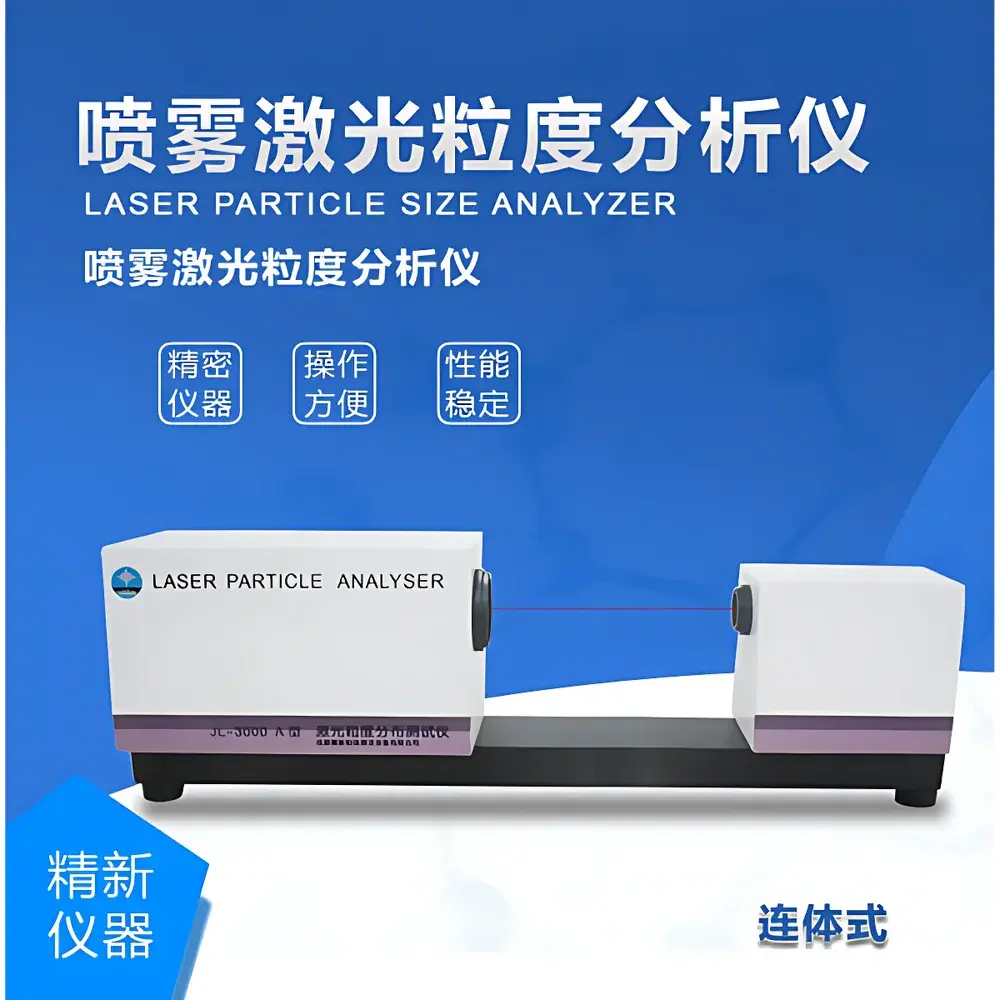
Chengdu Jingxin JL-3000 Integrated Spray Laser Diffraction Particle Size Analyzer
| Brand | Chengdu Jingxin (CDJX) |
|---|---|
| Origin | Sichuan, China |
| Manufacturer Type | Direct Manufacturer |
| Region of Origin | Domestic (China) |
| Model | JL-3000 |
| Price Range | USD 14,000–21,000 |
| Dispersion Method | Wet Dispersion |
| Instrument Type | Laboratory Laser Diffraction Particle Size Analyzer |
| Measurement Range | 0.01–3000 µm |
| Measurement Time | 10 s per analysis |
| Measurement Principle | Full-range Mie Scattering Theory |
| Optical System | Parallel-beam Fourier Configuration with f-Theta Lens |
| Light Source | Imported Semiconductor Laser, 650 nm, 30 mW, >70,000 h Lifetime |
| Detector | 128-channel Multielement Photodiode Array |
| Repeatability Error | ≤3% (D50 of NIST-traceable Standard Reference Material) |
| Accuracy Error | ≤3% (D50 of SRM) |
| Main Unit to Auxiliary Unit Spacing | 400 mm |
| Dimensions (L×H×W) | 1130 × 340 × 200 mm |
| Weight | ~50 kg |
| Power Supply | AC 220 V ±10%, 50 Hz ±0.5 Hz |
| Operating Environment | 5–35 °C, RH <85% |
| Data Output | Cumulative Distribution, Frequency Distribution, D10/D50/D90/D97, Mean Diameter, Specific Surface Area |
| Trigger Options | Software-initiated, TTL-level, or External Switch Trigger (up to 50 full analyses/sec) |
| Interface | RS-232 and USB 2.0 (transmission distance up to 100 m) |
| Software Compatibility | Windows XP / 7 / 10 |
| Language Support | English and Chinese UI |
| Data Export | PDF, CSV, XML, and direct print |
Overview
The Chengdu Jingxin JL-3000 Integrated Spray Laser Diffraction Particle Size Analyzer is a purpose-built laboratory instrument engineered for high-fidelity, real-time characterization of droplet size distributions in low-volume, transient aerosol streams—including medical nebulizer outputs, humidifier mists, inhaler actuations, and fine industrial sprays. It operates on first-principles Mie scattering theory across the full measurement range (0.01–3000 µm), eliminating assumptions inherent in Fraunhofer approximations and enabling rigorous quantification of submicron and coarse-mode particles within the same acquisition. Its integrated dual-unit architecture—comprising a main optical unit and a dedicated auxiliary sampling module spaced precisely 400 mm apart—is mechanically optimized to accommodate small-footprint nozzles and confined spray zones without optical realignment. The system employs a collimated parallel-beam Fourier optical path with a large-aperture f-theta lens, ensuring maximal angular signal capture from highly divergent, low-density mist plumes while maintaining optical stability under ambient lab conditions.
Key Features
- Full-range Mie-based inversion algorithm with unconstrained free distribution modeling—resolving particle size classes at ≤0.1% interval resolution across the entire dynamic range.
- 128-channel photodiode array detector with per-channel background light compensation and high-gain analog signal amplification, delivering superior signal-to-noise ratio for weak-scatter events typical of dilute sprays.
- Imported 650 nm semiconductor laser (30 mW output, >70,000 h operational lifetime) with continuously adjustable power control—enabling optimal signal saturation management across wide droplet concentration gradients.
- Rigid monolithic optical bench design; zero-field alignment required after installation—ensuring long-term reproducibility without recalibration between routine QC runs.
- Dual-trigger capability: software command, TTL pulse (5 V logic), or mechanical switch input—supporting synchronized acquisition with pump cycles, valve actuations, or high-speed imaging systems.
- Real-time data acquisition at up to 50 complete analyses per second when triggered externally—essential for time-resolved dynamics studies of pulsating or intermittent sprays.
- Sealed, EMI-shielded chassis meeting IEC 61326-1 Class A electromagnetic compatibility requirements for shared laboratory environments.
Sample Compatibility & Compliance
The JL-3000 is validated for aqueous mists, oil-based aerosols, pharmaceutical propellant-driven formulations (e.g., HFA-134a, HFA-227ea), and combustion-generated smoke particulates. It supports wet dispersion mode using standard carrier liquids (deionized water, ethanol, isopropanol) compatible with ISO 13320:2020 and ASTM E799-22 guidelines for laser diffraction particle sizing. While not certified to FDA 21 CFR Part 11 out-of-the-box, its audit-trail-capable software (v4.2+) logs operator ID, timestamp, instrument parameters, and raw scattering patterns—providing foundational traceability for GLP-compliant laboratories. All calibration verification procedures align with NIST-traceable polystyrene latex (PSL) reference standards (e.g., NIST SRM 1963, SRM 2800). The instrument meets CE marking requirements for electrical safety (EN 61010-1) and EMC (EN 61326-1).
Software & Data Management
Jingxin Particle Analysis Suite (JPAS) v4.2+ provides bilingual (English/Chinese) GUI with intuitive workflow navigation. Raw intensity vs. scattering angle matrices are stored in HDF5 format for long-term archival and third-party reprocessing. Standard outputs include volumetric cumulative distribution (D10, D50, D90, D97), frequency distribution histograms, specific surface area (SSA), and moment-ratio descriptors (e.g., span = (D90−D10)/D50). Batch processing supports statistical comparison across multiple runs with ANOVA-ready export to CSV or Excel. PDF reports embed instrument metadata, calibration history, and pass/fail flags against user-defined specification limits—facilitating internal QA review and regulatory submission documentation. Data encryption and role-based access control (admin/operator) are configurable per site policy.
Applications
- Pharmaceutical development: Quantifying emitted dose uniformity and droplet size distribution (DSD) of metered-dose inhalers (MDIs) and soft-mist inhalers (SMIs) per USP & Ph. Eur. aerosol testing protocols.
- Medical device validation: Performance benchmarking of ultrasonic and jet nebulizers used in respiratory therapy and pediatric drug delivery.
- Industrial process optimization: Correlating nozzle geometry, pressure, and fluid viscosity with DSD to refine humidifier, pesticide sprayer, and coating atomizer designs.
- Environmental research: Characterizing fog condensation nuclei, fire suppression mist efficacy, and cold-smoke generator outputs.
- Academic aerosol physics: Investigating breakup mechanisms, coalescence kinetics, and evaporation-driven size shifts in transient sprays via high-speed triggered acquisition.
FAQ
What sample types can be measured with the JL-3000?
The system is optimized for liquid-based aerosols—water mists, saline solutions, ethanol sprays, hydrocarbon oils, and pharmaceutical suspensions—delivered via pressurized or piezoelectric nozzles.
Does the instrument require daily calibration?
No. The optical path is factory-aligned and thermally stabilized; only periodic verification using NIST-traceable PSL standards (recommended quarterly) is required to maintain ISO 13320 compliance.
Can the JL-3000 measure particles smaller than 0.1 µm?
Yes—the specified lower limit is 0.01 µm, achieved through high-sensitivity detector electronics and optimized Mie kernel computation for sub-100 nm scatterers in low-concentration regimes.
Is the software compatible with LIMS integration?
Yes. JPAS supports ODBC-compliant database exports and includes a documented API for custom middleware integration with laboratory information management systems.
What environmental conditions must be maintained during operation?
Ambient temperature must remain between 5–35 °C with relative humidity below 85% non-condensing; no air filtration or vibration isolation table is required for standard use.



