
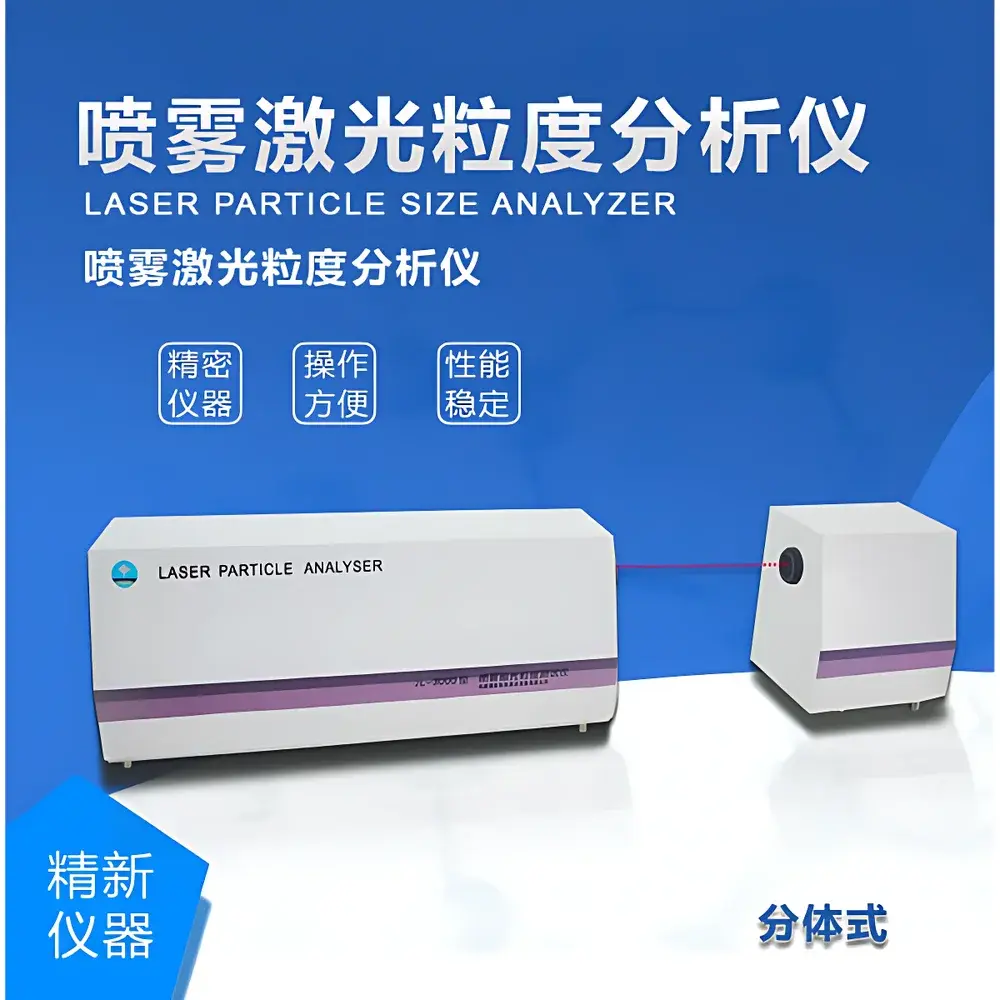
Chengdu Jingxin JL-3000 Split-Design Spray Laser Particle Size Analyzer
| Brand | Chengdu Jingxin (CDJX) |
|---|---|
| Origin | Sichuan, China |
| Manufacturer Type | Direct Manufacturer |
| Origin Category | Domestic (China) |
| Model | JL-3000 |
| Price Range | USD 21,000 – 22,500 (FOB) |
| Dispersion Method | Wet Dispersion |
| Instrument Type | Laboratory Laser Diffraction Particle Size Analyzer |
| Measurement Range | 0.01–3000 µm |
| Measurement Time | ≤10 s per analysis |
| Measurement Principle | Full-Range Mie Scattering Theory |
| Detector Channels | 128 |
| Repeatability Error | ≤1% (D50 of NIST-traceable standard reference material) |
| Accuracy Error | ≤1% (D50 of NIST-traceable standard reference material) |
| Optical System | Fourier Transform Lens, 80 mm Aperture |
| Light Source | Imported Semiconductor Laser, 650 nm, 30 mW, >70,000 h Lifetime |
| Host-Footprint Dimensions | 900 × 370 × 270 mm |
| Auxiliary Unit Dimensions | 330 × 250 × 370 mm |
| Host–Auxiliary Separation Distance | 1–10 m (adjustable) |
| Data Interface | RS-232 & USB 2.0 (transmission up to 100 m) |
| Operating System Compatibility | Windows XP / 7 / 10 |
| Environmental Requirements | 5–35 °C, RH <85% non-condensing |
| Power Supply | AC 220 V ±10%, 50 Hz ±0.5 Hz |
Overview
The Chengdu Jingxin JL-3000 Split-Design Spray Laser Particle Size Analyzer is a purpose-built instrument engineered for high-fidelity, real-time characterization of atomized droplets in industrial and research spray applications. It operates on the fundamental principles of full-range Mie scattering theory—rigorously applied across the entire 0.01–3000 µm dynamic range—to deliver mathematically robust particle size distribution (PSD) data without segmentation or interpolation artifacts. Unlike conventional benchtop laser diffraction analyzers, the JL-3000 adopts a physically decoupled architecture: the optical detection unit (host) and sample interaction chamber (auxiliary unit) are independently mounted and connected via fiber-optic-coupled signal paths and synchronized digital control lines. This split configuration enables flexible spatial deployment—up to 10 meters separation—making it uniquely suitable for in-situ measurements at spray nozzles, combustion test rigs, pharmaceutical nebulizers, and aerospace fuel injectors where physical access constraints preclude integrated designs.
Key Features
- Modular split-system design with fully independent host and auxiliary units—enabling installation around large-scale equipment (e.g., gas turbine combustors, agricultural spray booms, or HVAC ducts) without structural modification.
- Fourier-transform optical system featuring an 80 mm aperture lens and parallel collimated illumination—maximizing scattering signal capture angle (±45°) and ensuring representative sampling of wide-angle spray plumes.
- 128-channel high-resolution silicon photodiode array with per-channel background-light compensation and real-time gain adjustment—supporting dynamic range >10⁴ and enabling accurate resolution of bimodal or polydisperse fog distributions.
- Integrated CCD-based beam profiling module behind the detector plane—continuously monitoring laser spot uniformity, shape, and alignment drift to validate optical integrity prior to each measurement cycle.
- Imported 650 nm semiconductor laser (30 mW output, >70,000 h lifetime) with digitally controlled power modulation—allowing adaptive attenuation to prevent detector saturation during high-concentration mist events while preserving signal-to-noise ratio at sub-micron levels.
- Rigid monolithic optical baseplate and passive thermal stabilization—eliminating need for manual realignment; verified long-term stability under continuous operation (>500 h) per ISO 13320 Annex B protocols.
- Hardware-triggered acquisition mode supporting TTL or mechanical switch inputs—enabling synchronized burst-mode capture at 50 full PSDs per second for transient spray dynamics analysis (e.g., pulsed nozzle discharge, pressure-swirl instability).
Sample Compatibility & Compliance
The JL-3000 is validated for aqueous mists, hydrocarbon sprays (diesel, kerosene), pharmaceutical aerosols (HFA-propelled metered-dose inhalers), fire-suppression water fog, and agrochemical atomization streams. Its wet dispersion pathway integrates seamlessly with pressurized spray nozzles operating from 0.5 to 15 bar. All optical components comply with IEC 61000-6-3 (EMC immunity) and IP54-rated enclosure standards (dust- and splash-resistant stainless steel chassis). Data acquisition and reporting workflows support audit-ready traceability per FDA 21 CFR Part 11 requirements when deployed with optional electronic signature and change-log modules. Measurement accuracy and repeatability have been verified against NIST-traceable latex sphere standards (SRM 1960, SRM 2800) per ISO 13320:2020 Annex A procedures.
Software & Data Management
JL-3000 Control Suite v4.x is a native Windows application (XP/7/10 compatible) offering dual-language UI (English/Chinese), GLP-compliant data logging, and configurable report templates. Raw scattering intensity matrices are stored in HDF5 format with embedded metadata (timestamp, operator ID, environmental conditions, trigger source). Analysis algorithms apply rigorous Mie inversion with complex refractive index input (user-definable for water, ethanol, diesel, etc.) and iterative regularization to minimize inversion artifacts. Output includes D10/D50/D90, span, specific surface area, volume-weighted vs. number-weighted distributions, and histogram-based frequency plots. Export options include CSV, PDF, XML, and direct integration with MATLAB® and Python (via included API DLL). All software updates and calibration certificates are digitally signed and version-controlled per ISO/IEC 17025 documentation requirements.
Applications
- Optimization of nozzle geometry and injection pressure in aviation fuel systems—correlating Sauter Mean Diameter (SMD) with flame stability and soot formation indices.
- Quality-by-Design (QbD) development of pressurized metered-dose inhalers (pMDIs), where aerodynamic particle size distribution directly impacts lung deposition efficiency per USP & Ph. Eur. guidelines.
- R&D validation of electrostatic spray coating systems—quantifying droplet charging effects on size distribution and transfer efficiency.
- Combustion research in gas turbine and internal combustion engine test cells—capturing transient spray breakup under elevated temperature/pressure conditions.
- Regulatory testing of agricultural adjuvants and pesticide formulations—verifying compliance with EPA PRN 2012-1 and EU Regulation (EC) No 1107/2009 spray drift mitigation criteria.
- Fundamental studies of Rayleigh–Taylor and Kelvin–Helmholtz instabilities in laminar and turbulent liquid jets.
FAQ
What is the minimum detectable droplet size, and how is sub-micron resolution achieved?
The instrument achieves 0.01 µm lower detection limit through optimized laser coherence length, high-sensitivity detector electronics, and Mie model fitting constrained by known optical properties of common carrier fluids. Sub-micron accuracy is validated using polystyrene nanolatex standards certified to ISO 22412.
Can the system operate in hazardous environments (e.g., flammable vapor zones)?
The standard JL-3000 is rated for general laboratory use (non-hazardous location). For Class I Div 1 or ATEX Zone 1 deployment, optional explosion-proof enclosures and intrinsically safe laser drivers are available upon engineering review.
Is third-party software integration supported?
Yes—DLL-based SDK and TCP/IP command protocol enable bidirectional communication with LabVIEW™, Python (PySerial, h5py), and SCADA platforms. Custom OPC UA gateway implementation is available as an OEM service.
How is optical alignment maintained during extended field operation?
The system incorporates an onboard auto-alignment routine initiated before each measurement sequence, utilizing the integrated CCD beam profiler and motorized mirror actuators to recenter the laser path within ±0.5 µrad tolerance.
Does the instrument meet regulatory requirements for GMP/GLP environments?
When configured with audit trail logging, user access controls, and electronic signature modules, the JL-3000 satisfies core elements of FDA 21 CFR Part 11, EU Annex 11, and ISO/IEC 17025 for regulated particle characterization workflows.



