
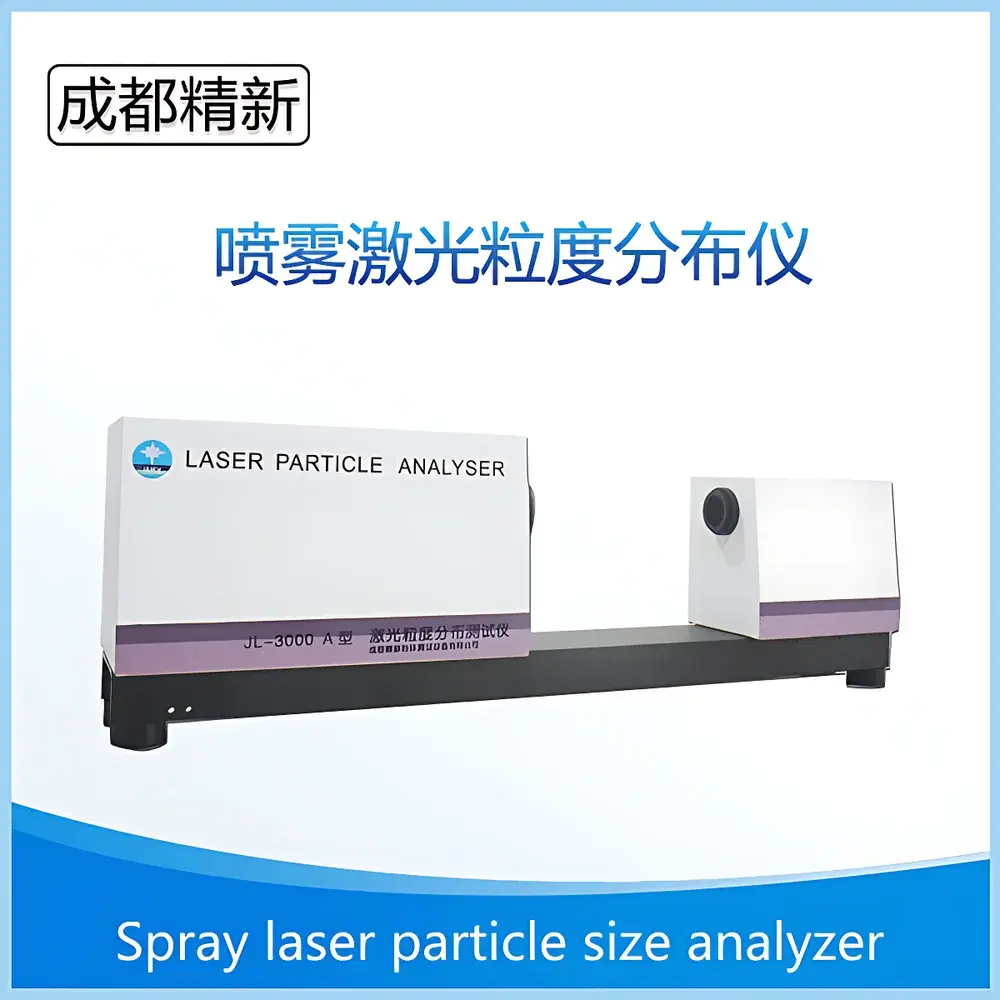
Chengdu Jingxin JL-3000A Integrated Spray Laser Particle Size Analyzer
| Brand | Chengdu Jingxin (CDJX) |
|---|---|
| Origin | Sichuan, China |
| Manufacturer Type | Direct Manufacturer |
| Region of Origin | Domestic (China) |
| Model | JL-3000A |
| Price Range | USD 14,000–21,000 |
| Dispersion Method | Wet Dispersion |
| Instrument Type | Laboratory Laser Particle Size Analyzer |
| Measurement Range | 0.01–3000 µm |
| Repeatability | <1% (RSD for D50) |
| Measurement Time | 10 s per analysis |
| Optical Principle | Full-range Mie Scattering Theory |
| Sampling Mode | Open-flow spray sampling |
| Optical System | Parallel-beam Fourier configuration with large-diameter lens |
| Light Source | Imported semiconductor laser, 650 nm, 30 mW, >70,000 h lifetime |
| Detector | 128-channel multi-element photodiode array with per-channel background compensation |
| Data Interface | RS232 and USB 2.0 (up to 100 m transmission distance) |
| Trigger Options | Software control, TTL pulse, mechanical switch (up to 50 full analyses/sec) |
| Software Compatibility | Windows XP / 7 / 10 |
| Output Parameters | Cumulative distribution, frequency distribution, D10/D50/D90/D97, mean diameter, specific surface area, span, relative width |
| Environmental Requirements | 5–35 °C, RH <85%, AC 220 V ±10%, 50 Hz ±0.5 Hz |
| Dimensions (L×H×W) | 1130 × 340 × 200 mm |
| Weight | ~50 kg |
| Host-to-Spray-Stage Distance | Fixed 400 mm |
Overview
The Chengdu Jingxin JL-3000A Integrated Spray Laser Particle Size Analyzer is a purpose-built laboratory instrument engineered for high-fidelity, real-time characterization of atomized droplets in low-volume, transient spray systems. It operates on full-range Mie scattering theory—rigorously applied across the entire 0.01–3000 µm dynamic range—enabling physically accurate inversion without empirical constraints or preset distribution assumptions. Unlike conventional dry- or wet-dispersion laser diffraction analyzers, the JL-3000A adopts an open-flow, fixed-gap (400 mm) optical configuration optimized for aerosolized liquid streams: pharmaceutical metered-dose inhalers (MDIs), nasal sprays, ultrasonic humidifiers, piezoelectric nebulizers, and microfluidic nozzle development platforms. Its parallel-beam Fourier optical design—featuring a large-aperture f-theta lens and collimated 650 nm semiconductor laser (30 mW, >70,000 h operational life)—ensures uniform illumination of the spray cross-section and wide-angle scattering signal capture (up to ±60°). The system delivers single-shot measurement in ≤10 seconds, with repeatability better than 1% RSD (D50, NIST-traceable polystyrene latex standards), meeting core metrological requirements for GLP-compliant method development and QC release testing.
Key Features
- Fixed 400 mm host-to-spray-stage separation: Eliminates alignment drift and enables rapid, repeatable setup for small-footprint spray sources—no optical recalibration required between tests.
- 128-channel high-resolution photodetector array with per-pixel dark-current compensation: Enables fine-grained size binning (≤0.05 µm resolution in sub-micron region) and maximizes signal-to-noise ratio under low-scatter conditions typical of dilute sprays.
- Dual-mode triggering support: Software-initiated, TTL-pulse (rising-edge), or mechanical switch input—synchronized acquisition at up to 50 full-size-distribution measurements per second for time-resolved spray dynamics analysis.
- Robust optical architecture: Monolithic aluminum optical bench, vibration-damped mounting, and sealed enclosure (IP54-rated) ensure long-term stability in shared lab environments with variable EMI/RFI exposure.
- Adjustable laser power (0–100%): Dynamically optimizes signal saturation threshold across diverse media—aqueous mists, hydrocarbon aerosols, glycerol-based propellants—without hardware modification.
- Real-time image-assisted diagnostics: Integrated beam-profile monitoring system provides live feedback on laser alignment, spray positioning, and obscuration level—critical for troubleshooting intermittent or asymmetric plumes.
Sample Compatibility & Compliance
The JL-3000A accommodates open-path liquid and gas-phase aerosols without sample containment or dilution—ideal for non-invasive, in-line monitoring of pressurized or gravity-fed nozzles. It supports aqueous, organic, and viscous carrier fluids (e.g., ethanol, propylene glycol, silicone oil) within standard operating temperature (5–35 °C) and humidity (<85% RH) limits. While not certified to IEC 61000-4 or ISO/IEC 17025 out-of-the-box, its measurement traceability aligns with ASTM E2915–22 (Standard Practice for Analysis of Aerosol Particle Size Distribution Data) and ISO 13320:2020 (Particle size analysis — Laser diffraction methods). Raw data export (CSV, TXT) and audit-trail-enabled software logging facilitate internal validation against USP , FDA 21 CFR Part 11, and EU GMP Annex 11 requirements when deployed in regulated development workflows.
Software & Data Management
Jingxin’s proprietary ParticleSight™ v4.x software (Windows XP/7/10 compatible) provides dual-language UI (English/Chinese), automated report generation (PDF, Excel, print-ready), and granular data export—including cumulative % undersize, differential frequency distribution, D10/D50/D90/D97, span (D90−D10)/D50), specific surface area (m²/g), and distribution skewness/kurtosis. All analyses retain full detector raw counts and timestamp metadata. The software enforces user-level access control, electronic signature prompts for critical actions, and immutable audit logs compliant with ALCOA+ principles. Exported datasets integrate seamlessly with MATLAB, Python (Pandas/NumPy), and JMP for advanced statistical modeling—supporting DOE-driven nozzle optimization, CFD validation, and batch-to-batch consistency assessment.
Applications
- Pharmaceutical R&D: Quantitative evaluation of MDI and DPI spray plume geometry, droplet size distribution stability across actuation cycles, and formulation excipient effects on atomization efficiency.
- Medical device validation: Performance benchmarking of nasal spray pumps, nebulizer output fidelity, and breath-actuated inhaler dose uniformity per ISO 27427.
- Industrial aerosol engineering: Nozzle geometry optimization for agricultural adjuvants, precision coating sprays, and fire suppression mist systems.
- Academic research: Fundamental studies of breakup regimes (Rayleigh, Taylor, catastrophic), secondary droplet formation, and evaporation kinetics in confined spray fields.
- Environmental monitoring: Characterization of calibration aerosols for optical particle counters and condensation particle counters (CPCs).
FAQ
Can the JL-3000A measure oil-based or high-viscosity sprays?
Yes—its adjustable laser power and wide dynamic range (0.01–3000 µm) accommodate refractive index variations typical of hydrocarbon, silicone, and polymer solution mists. Viscosity itself does not affect measurement; however, droplet evaporation rate must be considered during transit through the sensing zone.
Is external sheath air or dilution required for stable measurements?
No—the open-flow design measures undiluted sprays directly. Optional laminar co-flow air shrouds are available to stabilize plume trajectory but are not mandatory for basic operation.
How is instrument calibration verified?
Calibration is performed using NIST-traceable polystyrene latex (PSL) standards (e.g., 1.00 ± 0.02 µm, 10.0 ± 0.1 µm). Daily verification includes D50 repeatability checks; annual full-system verification is recommended per ISO/IEC 17025 guidelines.
Does the system support GMP-compliant data integrity?
Out-of-the-box, it provides electronic signatures, audit trails, and exportable raw data. Full 21 CFR Part 11 compliance requires site-specific validation protocols, including role-based permissions, backup/recovery procedures, and periodic review of audit logs.
What maintenance is required?
Routine tasks include weekly lens cleaning with spectroscopic-grade methanol and monthly verification of laser power output and detector baseline stability. No optical realignment is needed under normal use due to rigid monolithic construction.



