
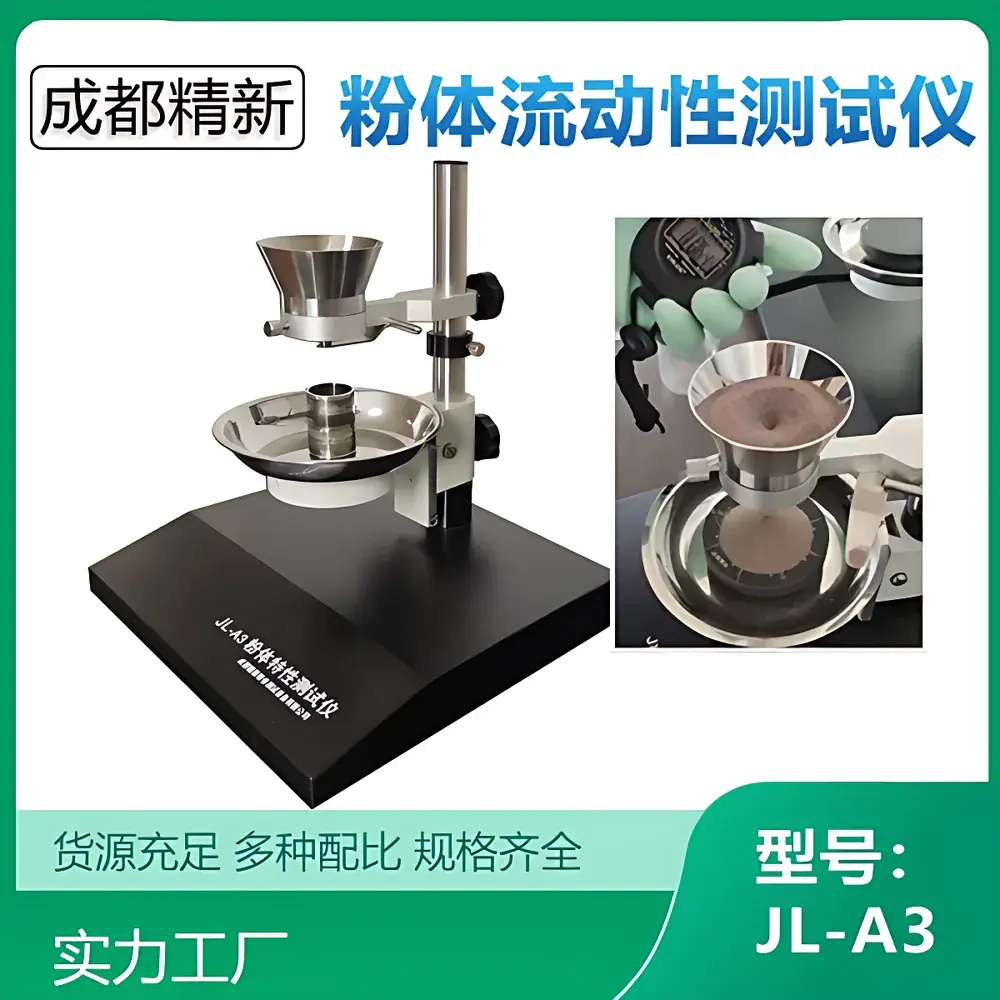
Chengdu Jingxin JL-A3 Powder Characterization Tester – Hall Flowmeter, Bulk Density Analyzer & Angle of Repose Instrument
| Brand | Chengdu Jingxin (CDJX) |
|---|---|
| Origin | Sichuan, China |
| Manufacturer Type | OEM/ODM Producer |
| Instrument Type | Hall Flowmeter, Bulk Density Tester, Angle of Repose Analyzer |
| Measurable Parameters | Flow Time (s/50g), Angle of Repose (°), Bulk Density (g/cm³) |
| Standard Funnel Orifice | 5 mm (optional 2.5 mm or custom) |
| Stainless Steel Cup Capacity | 25 mL |
| Minimum Sample Mass | 50 g |
| Maximum Sample Mass | 100 g |
| Compliance | GB/T 1482–2010, GB/T 1479.1–2017, GB/T 16913–2008, ISO 4490:2018 (referenced), ASTM B213–22 (method-equivalent) |
Overview
The Chengdu Jingxin JL-A3 Powder Characterization Tester is an integrated, benchtop physical property analyzer engineered for standardized evaluation of dry free-flowing powders and granular materials. It implements three fundamental powder flow and packing behavior tests—Hall flow rate (flow time per 50 g), angle of repose (static stability under gravity), and bulk density (loose packing density)—within a single mechanically stable platform. The instrument operates on well-established gravitational principles: flow rate is determined by timed discharge through a precision-calibrated stainless-steel funnel (conical angle 60°, orifice 5 mm); angle of repose is derived from geometric measurement of the natural conical pile formed upon vertical deposition onto a defined-diameter stainless steel plate (80 mm); and bulk density is calculated from the mass of powder freely filling a calibrated 25 mL stainless steel cup under controlled drop height. All measurements conform to national and internationally harmonized test methodologies—including GB/T 1482–2010 (equivalent to ISO 4490:2018), GB/T 1479.1–2017 (ISO 3953:1993), and GB/T 16913–2008—ensuring traceable, repeatable data suitable for QC release, formulation development, and regulatory documentation.
Key Features
- Tri-functional mechanical design: Single instrument performs Hall flow, angle of repose, and bulk density measurements without hardware reconfiguration.
- High-stability 304 stainless-steel construction: Funnel, cup, and leveling ruler feature precision-machined surfaces with enhanced wall thickness to resist deformation, wear, and surface adhesion during repeated use.
- Adjustable vertical positioning system: Micrometer-style height adjustment knob enables precise alignment between funnel outlet and sample receptor (cup or powder disc), ensuring consistent drop height and centering across all test modes.
- Integrated mechanical gate: Spring-loaded stainless-steel shutter at the funnel base eliminates manual occlusion—prevents premature powder discharge and ensures synchronized start timing.
- Modular orifice options: Standard 5 mm outlet complies with GB/T 1482–2010; optional 2.5 mm orifice supports finer-particle applications per ASTM B213–22 Annex A1.
- Benchtop footprint: Compact dimensions (300 × 260 × 260 mm) and net weight (~5 kg) enable deployment in QA labs, R&D cleanrooms, and production line testing stations.
Sample Compatibility & Compliance
The JL-A3 is validated for use with non-cohesive, dry, free-flowing powders including metal powders (e.g., Ni, Co, Al alloys), battery cathode/anode materials (LiCoO₂, graphite), pharmaceutical excipients (microcrystalline cellulose, lactose), food-grade starches and flours, ceramic precursors, and polymer granules. It is not intended for hygroscopic, electrostatically charged, or cohesive powders without prior conditioning (e.g., drying at 105 °C per GB/T 1479.1–2017). All test procedures align with Chinese National Standards (GB) and maintain methodological equivalence to ISO 4490 (flow), ISO 3953 (bulk density), and ISO 902 (angle of repose). While the instrument itself does not carry CE or FDA certification, its test outputs are fully compatible with GLP-compliant documentation workflows and support audit readiness for ISO 9001, IATF 16949, and USP powder characterization requirements.
Software & Data Management
The included Windows-based calculation software (v3.2+) accepts manual entry of raw measurements—flow time (s), pile height (mm), disc radius (mm), cup mass (g), and filled cup mass (g)—and automatically computes final values per standard equations. Results are displayed in real time with intermediate validation checks (e.g., flow time outlier detection via ±10% deviation warning). Reports export natively to Word (.docx), Excel (.xlsx), and PDF formats—with bilingual (English/Chinese) template selection. All reports embed instrument ID, operator name, date/time stamp, environmental notes (e.g., “dried at 105 °C for 2 h”), and full traceability of input parameters. Audit trail functionality logs user actions, but full 21 CFR Part 11 compliance requires integration with a validated LIMS or ELN platform.
Applications
- Quality control of metal powders in additive manufacturing feedstock qualification (per ASTM F3049).
- Batch-to-batch consistency verification for lithium-ion battery electrode materials during slurry mixing process development.
- Excipient screening in solid dosage form design—correlating flowability metrics with tablet press performance.
- Regulatory submission support for generic drug filings requiring powder characterization per ICH Q5C and Q6A.
- Academic research on particle–particle interaction forces using comparative repose angle and flow index trends.
- Raw material acceptance testing in food ingredient manufacturing per Codex Alimentarius standards.
FAQ
What standards does the JL-A3 comply with?
It implements GB/T 1482–2010 (Hall flow), GB/T 1479.1–2017 (bulk density), and GB/T 16913–2008 (angle of repose), with methodological equivalency to ISO 4490, ISO 3953, and ISO 902.
Can the instrument measure cohesive or damp powders?
No—it is designed for dry, free-flowing powders. Hygroscopic samples must be dried at 105 °C prior to testing per GB/T 1479.1–2017 Section 6.2.
Is calibration certificate provided with purchase?
A factory verification report is included; NIST-traceable calibration of the stainless-steel cup and ruler is available as an optional service.
How many replicates are recommended per test?
Three independent flow time measurements (minimum), two bulk density determinations, and one angle of repose measurement per sample batch—as specified in respective GB standards.
Does the software support automated data export to LIMS?
Raw data exports via CSV; direct LIMS API integration requires third-party middleware or custom configuration by the end-user IT team.



