
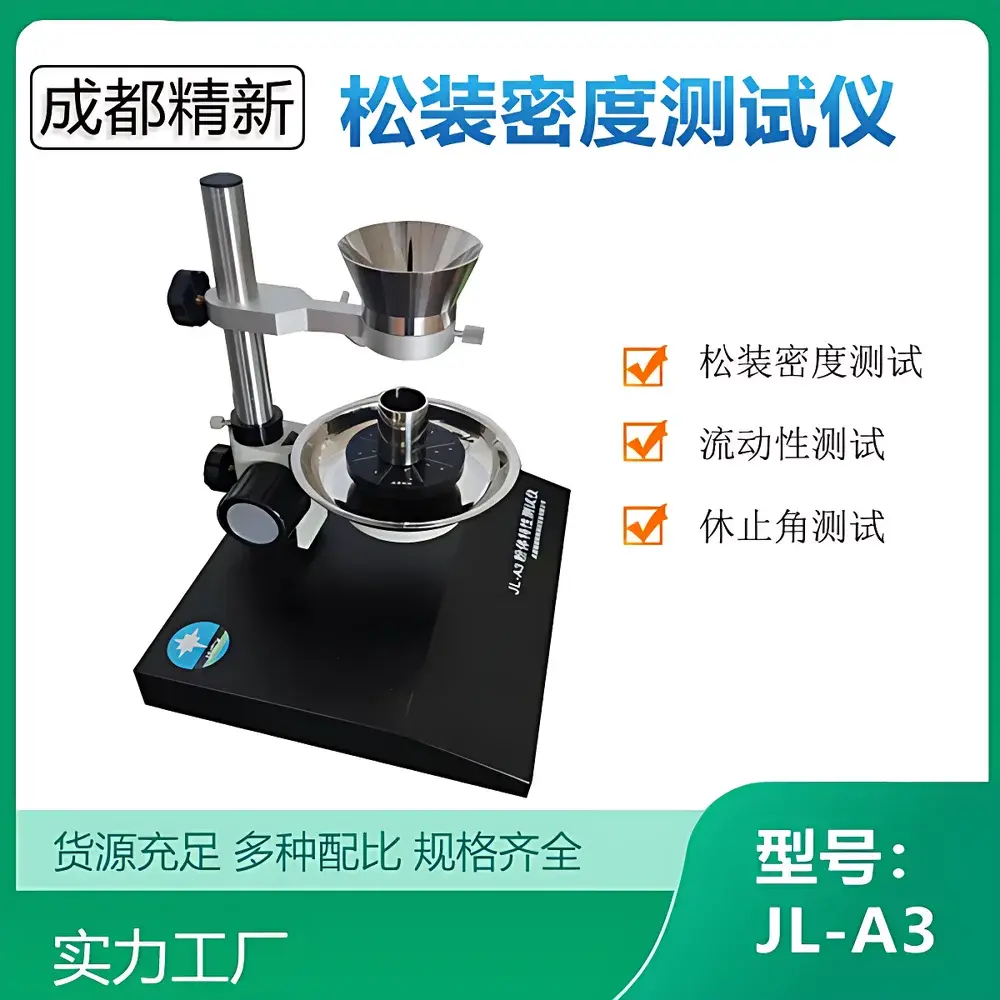
Chengdu Jingxin JL-A3 Powder Flowability & Bulk Density Tester
| Brand | Chengdu Jingxin (CDJX) |
|---|---|
| Origin | Sichuan, China |
| Manufacturer Type | Direct Manufacturer |
| Instrument Type | Angle of Repose Tester, Bulk Density Tester, Powder Flowability Tester |
| Measurable Parameters | Angle of Repose, Bulk Density, Flow Time (Haller Flow Rate), Flowability Index |
| Maximum Sample Cup Capacity | 100 g |
| Minimum Sample Requirement | 50 g |
| Standard Funnel Orifice Diameter | 5 mm (optional 2.5 mm or custom) |
| Stainless Steel Cup Volume | 25 mL |
| Funnel Cone Angle | 60° |
| Repose Plate Diameter | 80 mm |
| Scale Ruler Width | 25 mm |
| Instrument Dimensions | 300 × 260 × 260 mm |
| Net Weight | ~5 kg |
| Compliance Standards | GB/T 1482–2010, GB/T 1479.1–2017, GB/T 16913–2008 |
Overview
The Chengdu Jingxin JL-A3 Powder Flowability & Bulk Density Tester is a benchtop, manually operated physical property analyzer engineered for standardized measurement of three fundamental powder characteristics: angle of repose (also known as the angle of rest or static avalanche angle), bulk density (loose-packed density), and flow time-based flowability — commonly reported as Haller flow rate per GB/T 1482–2010. Based on classical gravitational powder dynamics, the instrument implements fixed-geometry funnel discharge, controlled-height free-fall deposition, and conical heap formation under ambient conditions. Its design adheres to widely adopted national standards for metallic powders, pharmaceutical excipients, battery cathode/anode materials, food-grade granules, and ceramic precursors. Unlike automated shear cell or rotational rheometry systems, the JL-A3 provides rapid, low-cost, first-tier screening of powder handling behavior — particularly relevant for quality control in batch release, formulation development, and raw material qualification.
Key Features
- Triple-function modular architecture enabling sequential execution of angle of repose, bulk density, and Haller flow time measurements without hardware reconfiguration.
- Stainless steel (AISI 304) construction for funnel, sample cup, repose plate, and ruler — all surfaces precision-polished to minimize adhesion and ensure consistent discharge kinetics.
- Adjustable vertical positioning system with calibrated micrometer-style height adjustment knob, allowing precise control over funnel-to-plate or funnel-to-cup distance per GB/T 1479.1–2017 and GB/T 16913–2008 requirements.
- Integrated shutter gate mechanism at the funnel orifice — actuated via lever — eliminating manual finger blocking and improving repeatability during flow initiation.
- Dual-orifice funnel option (standard 5 mm, optional 2.5 mm) supports comparative testing across particle size distributions and enables method adaptation per ASTM B212 or ISO 3953 where applicable.
- Pre-calibrated 25 mL stainless steel volumetric cup with defined wall thickness and dimensional tolerance, compliant with GB/T 1479.1–2017 specifications for loose-density determination.
Sample Compatibility & Compliance
The JL-A3 is validated for dry, free-flowing, non-cohesive to moderately cohesive powders with median particle sizes ranging from 10 µm to 500 µm. It accommodates metal powders (e.g., Ni, Co, Al alloys), lithium-ion battery active materials (NMC, LFP, graphite), pharmaceutical APIs and excipients (microcrystalline cellulose, lactose), food powders (milk powder, starch, cocoa), and catalysts. All test protocols align with Chinese National Standards: GB/T 1482–2010 (Haller flow rate), GB/T 1479.1–2017 (bulk density by funnel method), and GB/T 16913–2008 (angle of repose). While not certified to ISO/IEC 17025, the instrument supports GLP-compliant documentation when used with traceable calibration weights and validated environmental controls (temperature 20–25°C, RH < 50%). Data output meets basic audit-trail readiness for internal QC reporting.
Software & Data Management
The bundled Windows-based calculation software (v3.2+) accepts manual entry of raw measurements — including flow time (s), heap height (mm), repose plate radius (mm), cup mass (g), and filled cup mass (g). It applies standardized formulas per referenced GB standards to compute: Haller flow rate (g/s), angle of repose (°), and bulk density (g/cm³). Reports are exportable in editable Word (.docx), tabular Excel (.xlsx), and print-optimized PDF formats — all supporting bilingual (English/Chinese) label toggling. No real-time instrument interfacing is implemented; data entry remains manual to preserve compatibility with offline lab environments. Software-generated reports include test date, operator ID, sample ID, environmental notes, and statistical summary (mean, SD, CV%) for triplicate flow time runs — satisfying minimum documentation requirements for ISO 9001 Clause 8.5.2 and FDA 21 CFR Part 11 Annex A (if deployed with controlled user access and electronic signature protocol).
Applications
- Quality assurance of metal powders in additive manufacturing feedstock qualification (ASTM F3049 pre-screening).
- Batch-to-batch consistency monitoring of cathode materials (e.g., NMC811) prior to slurry mixing in lithium-ion battery production.
- Excipient selection and blend uniformity assessment in oral solid dosage form development (USP <1174> guidance).
- Routine incoming inspection of food-grade functional ingredients where flowability impacts dosing accuracy in high-speed filling lines.
- Academic research into humidity-induced cohesion effects — when paired with controlled desiccation (105°C oven drying per GB/T 1479.1–2017).
- Regulatory submission support for powder process validation dossiers requiring empirical flow descriptors.
FAQ
What standards does the JL-A3 comply with?
It implements GB/T 1482–2010 (flow time), GB/T 1479.1–2017 (bulk density), and GB/T 16913–2008 (angle of repose) — all nationally recognized methods for industrial powder characterization.
Can the instrument measure cohesive or hygroscopic powders?
Yes, but results require careful environmental control. Samples must be dried at 105°C prior to testing if moisture content exceeds 0.5%, per GB/T 1479.1–2017 Annex A.
Is calibration traceable to national metrology institutes?
The device itself is not calibrated; however, users must employ NIST-traceable balances (±0.01 g resolution) and calibrated depth gauges (±0.1 mm) to meet standard compliance requirements.
Does the software support networked data archiving or LIMS integration?
No — the software operates locally and saves files to user-defined directories. Exported Excel/PDF reports may be ingested into third-party LIMS via manual upload.
What maintenance is required?
Monthly visual inspection of funnel interior for scratches or residue buildup; quarterly cleaning with ethanol and lint-free wipes; annual verification of ruler zero-point alignment and funnel concentricity using optical centering tools.



