
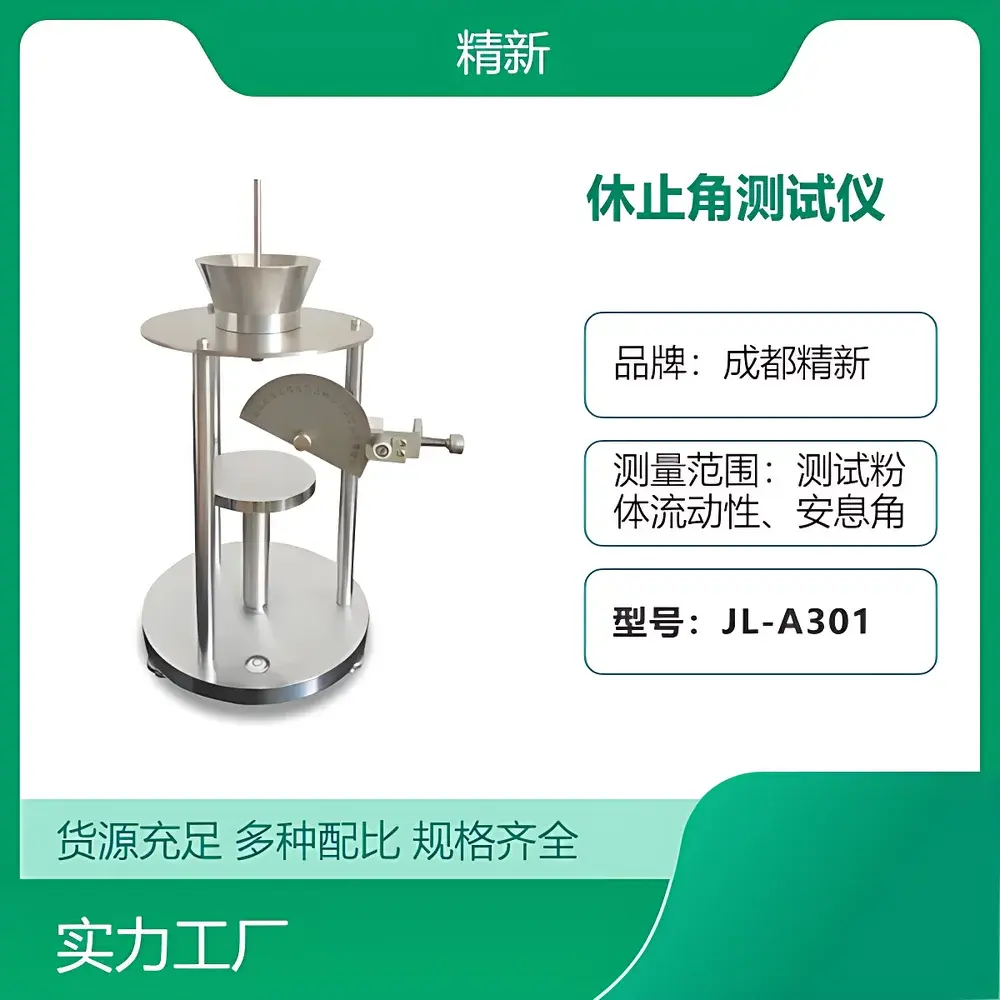
Chengdu Jingxin JL-A301 Powder Flowability Tester (Angle of Repose Analyzer)
| Brand | Chengdu Jingxin (CDJX) |
|---|---|
| Origin | Sichuan, China |
| Manufacturer Type | Direct Manufacturer |
| Country of Origin | China |
| Model | JL-A301 |
| Price Range | USD 310 – 395 |
| Standards Compliance | GB/T 16913–2008, GB/T 31057.3–2018 |
| Funnel Cone Angle | 60° ± 0.5° |
| Funnel Orifice Diameter | 5 mm (optional 10 mm) |
| Receiving Pan Diameter | 80 mm |
| Vertical Distance Between Funnel Tip and Pan Surface | 80 mm ± 2 mm |
| Protractor Scale | 10 cm (adjustable range: 7.5–10 cm) |
| Probe Rod Material | Stainless Steel |
| Measurement Principle | Fixed-Base Funnel Deposition Method (Cone Formation on Horizontal Plate) |
Overview
The Chengdu Jingxin JL-A301 Powder Flowability Tester is a precision-engineered instrument designed for the standardized determination of the angle of repose — a fundamental physical property quantifying the bulk flow behavior of dry, free-flowing powders and granular materials. Based on the fixed-base funnel deposition method defined in GB/T 16913–2008 and GB/T 31057.3–2018, the device enables reproducible formation of a conical powder pile on a horizontal stainless steel receiving plate. The angle between the cone’s sloping surface and the horizontal plane is measured directly using an integrated calibrated protractor or calculated trigonometrically from the cone’s height and base diameter. As a static flow index, the angle of repose correlates inversely with powder mobility: lower values (e.g., 45°) suggest cohesive or poorly flowing behavior. This parameter is critical in process engineering contexts including hopper design, pneumatic conveying system validation, tablet compression formulation development, and dust collection system sizing.
Key Features
- Compliance-certified mechanical architecture adhering to national standards GB/T 16913–2008 and GB/T 31057.3–2018 for angle-of-repose testing.
- Precision-machined stainless steel funnel with tightly controlled cone angle (60° ± 0.5°) and interchangeable orifices (standard 5 mm; optional 10 mm) to accommodate varying particle size distributions.
- Stable, level-adjustable test platform with integrated spirit level and rigid mounting for repeatable orientation.
- High-contrast, dual-scale protractor (7.5–10 cm range) with vernier-assisted reading capability for angular resolution up to ±0.5°.
- Durable stainless steel probe rod for gentle powder initiation without introducing shear artifacts.
- Modular assembly design facilitating cleaning, calibration verification, and ISO/IEC 17025-compliant maintenance protocols.
Sample Compatibility & Compliance
The JL-A301 accommodates a broad spectrum of dry particulate solids, including pharmaceutical excipients (e.g., lactose, microcrystalline cellulose), metal powders (Al, Ti, Ni alloys), ceramic precursors, food-grade starches, and agrochemical granules. It is unsuitable for hygroscopic, electrostatically charged, or highly cohesive materials requiring dynamic shear testing (e.g., FT4, Schulze ring shear). All measurements follow strictly defined sample conditioning (e.g., 100 mL volumetric cup, controlled pouring rate, no vibration unless specified per standard). The instrument meets requirements for routine QC laboratories operating under GLP frameworks and supports audit-ready documentation when paired with controlled procedural records. While not intrinsically compliant with ASTM D6393 or ISO 4490, its methodology aligns closely with the principles underlying those international standards.
Software & Data Management
The JL-A301 is a manually operated, hardware-only instrument with no embedded electronics or digital interface. Data acquisition relies on operator-recorded angular readings and manual calculation of mean values across ≥3 replicate tests — consistent with GB/T 16913–2008’s statistical requirements. Laboratories may integrate results into LIMS or ELN systems via structured CSV templates. For traceability, users are advised to maintain logbooks documenting ambient temperature/humidity, sample lot ID, operator name, and raw measurement values — practices aligned with FDA 21 CFR Part 11 expectations for paper-based workflows under GMP environments.
Applications
- Hopper and silo design validation for gravity-fed material handling systems.
- Batch-to-batch consistency monitoring during powder blending and granulation processes.
- Pre-formulation screening of excipient flow performance in solid dosage form development.
- Quality control release testing for metal powders used in additive manufacturing (AM) feedstock qualification.
- Supporting root-cause analysis of caking, bridging, or ratholing phenomena in bulk storage facilities.
- Educational use in materials science and chemical engineering laboratories for teaching powder rheology fundamentals.
FAQ
What standards does the JL-A301 comply with?
It is engineered and verified to meet GB/T 16913–2008 and GB/T 31057.3–2018 for angle-of-repose determination.
Can it measure cohesive or damp powders?
No — the method assumes free-flowing, dry particles. Cohesive samples require complementary techniques such as shear cell or dynamic powder rheometry.
Is calibration traceable to national metrology institutes?
The protractor and dimensional components can be verified using NIST-traceable angle blocks and micrometers; formal calibration certificates are available upon request.
What is the recommended sample volume?
100 mL per test, delivered from a standardized volumetric cup as specified in GB/T 16913–2008.
Does the instrument include data export functionality?
No — it is a purely mechanical tester. Data recording and analysis are performed externally using laboratory notebooks or digital spreadsheets.
Related Products



