
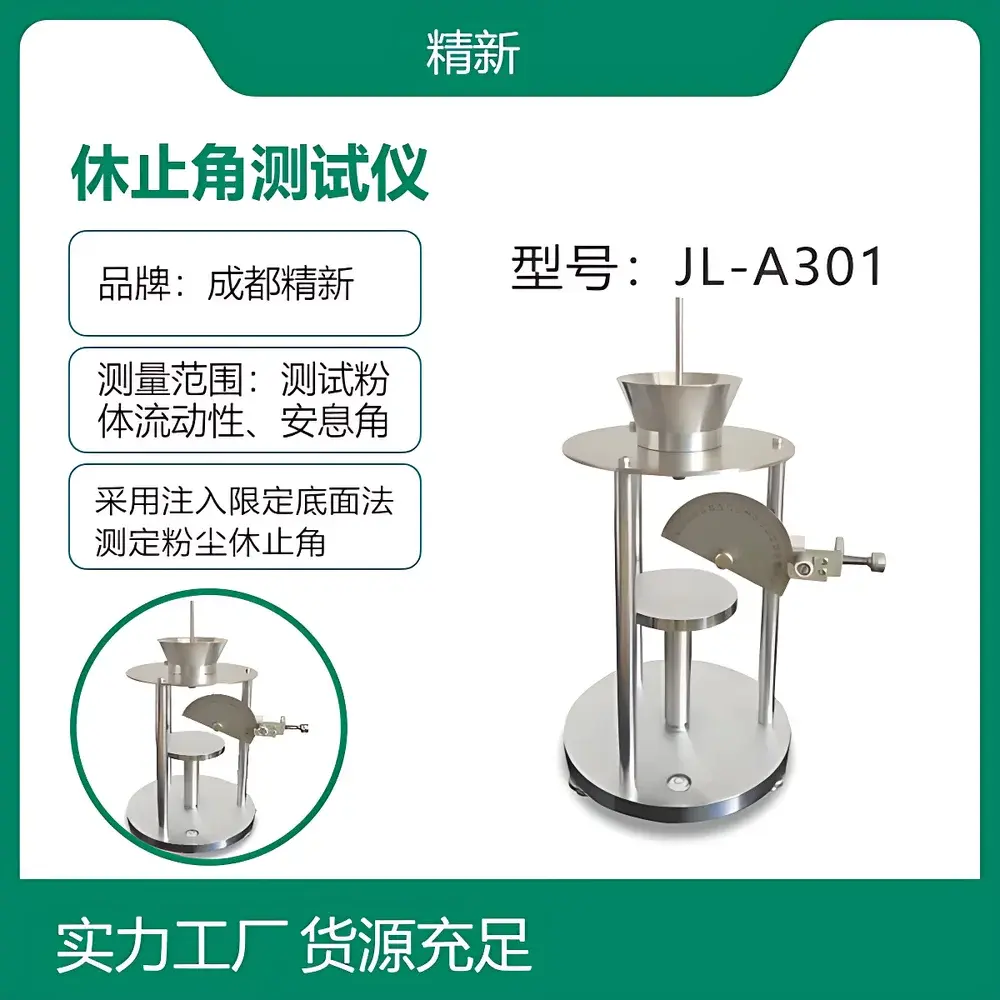
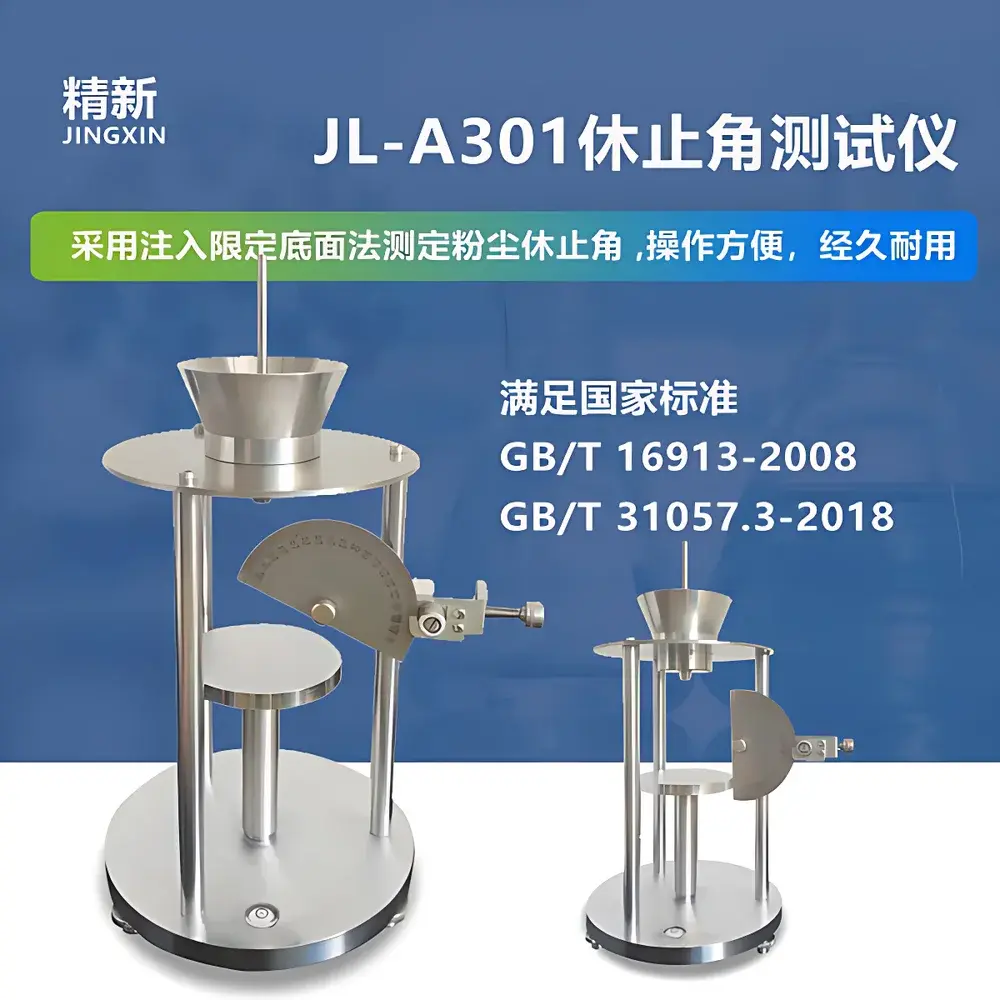
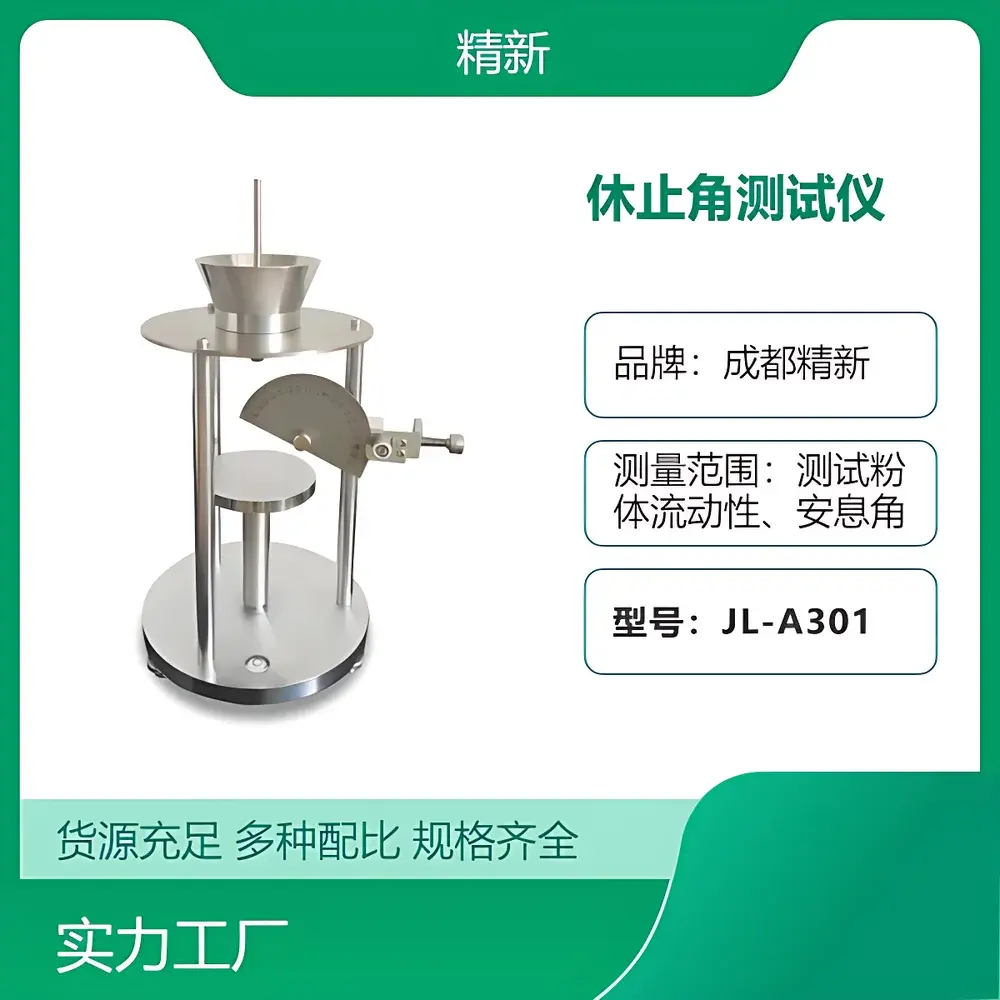
Chengdu Jingxin JL-A301 Powder Flowability Tester (Angle of Repose Analyzer)
| Brand | Chengdu Jingxin (CDJX) |
|---|---|
| Origin | Sichuan, China |
| Manufacturer Type | Direct Manufacturer |
| Region of Origin | Domestic (China) |
| Model | JL-A301 |
| Price Range | USD 310 – 395 |
| Standard Compliance | GB/T 16913–2008, GB/T 31057.3–2018 |
| Funnel Cone Angle | 60° ± 0.5° |
| Funnel Orifice Diameter | 5 mm (optional 10 mm) |
| Receiving Pan Diameter | 80 mm |
| Vertical Distance Between Funnel Tip and Pan Surface | 80 mm ± 2 mm |
| Protractor Scale Range | 10 cm (graduated in degrees) |
| Probe Rod Material | Stainless Steel |
| Measurement Principle | Fixed-Height Funnel Deposition Method (Cone Formation on Horizontal Plate) |
Overview
The Chengdu Jingxin JL-A301 Powder Flowability Tester is an engineered instrument designed for the standardized determination of the angle of repose — a fundamental physical property quantifying the flow behavior of dry, free-flowing powders and granular materials. Based on the fixed-height funnel deposition method defined in GB/T 16913–2008 and GB/T 31057.3–2018, the device operates by allowing a controlled volume of powder to discharge under gravity from a precision-machined stainless steel funnel onto a flat, horizontal receiving surface. The resulting conical pile is geometrically analyzed to determine the static angle between the cone’s sloping surface and the horizontal plane — the angle of repose. This parameter serves as a critical indicator of bulk powder mobility, interparticle friction, and cohesion, directly informing process design in pneumatic conveying, hopper geometry optimization, tablet compression, dust collection system sizing, and bulk material storage.
Key Features
- Precision-engineered stainless steel funnel with certified 60° ± 0.5° conical angle and interchangeable orifices (5 mm standard; optional 10 mm for coarse or low-density materials)
- Stable, rigid base assembly ensuring level orientation during measurement — essential for reproducible cone formation
- Calibrated protractor (10 cm arc scale) with fine-degree resolution for direct visual angular reading of the powder cone profile
- 80 mm diameter aluminum receiving pan with machined flatness tolerance ≤ 0.05 mm, mounted at fixed 80 mm ± 2 mm vertical clearance beneath the funnel tip
- Integrated stainless steel probe rod for gentle powder initiation without mechanical disturbance — compliant with standard protocol for marginally flowing materials
- Modular, tool-free assembly enabling rapid setup, cleaning, and calibration verification per ISO/IEC 17025 traceable procedures
Sample Compatibility & Compliance
The JL-A301 accommodates dry, non-cohesive to moderately cohesive powders ranging from fine pharmaceutical excipients (e.g., microcrystalline cellulose, lactose) to industrial minerals (e.g., silica sand, calcium carbonate), metal powders (e.g., stainless steel 316L, Ti-6Al-4V), and agricultural granules. It excludes hygroscopic, electrostatic-prone, or fibrous materials requiring environmental control (e.g., humidity-regulated chambers or anti-static housings). The instrument fully supports compliance with national standards GB/T 16913–2008 (“Method for Determination of Angle of Repose of Dust”) and GB/T 31057.3–2018 (“Powder Technology — Part 3: Determination of Flow Properties — Angle of Repose”), both aligned with ASTM D6393 (Standard Test Method for Flowability of Powders Using the Angle of Repose) and ISO 4490:2017 (Metallic powders — Determination of flow rate using the Hall flowmeter). Routine use satisfies GLP documentation requirements when paired with laboratory-controlled test logs and operator training records.
Software & Data Management
The JL-A301 is a manual, hardware-only instrument with no embedded electronics or digital output. All measurements are recorded manually in laboratory notebooks or LIMS-compatible spreadsheets. Users are advised to implement standardized data entry templates including: sample ID, batch number, ambient temperature/humidity, operator name, three replicate angle readings, arithmetic mean, and deviation from mean. For regulated environments (e.g., pharmaceutical QC labs), this workflow integrates seamlessly with 21 CFR Part 11–compliant electronic lab notebooks (ELN) when combined with scanned protractor images and signed digital records. Calibration verification is performed annually using NIST-traceable angle gauge blocks and documented per internal SOPs.
Applications
- Pre-formulation screening of active pharmaceutical ingredients (APIs) and excipients for tablet and capsule manufacturing
- Quality control of metal powders used in additive manufacturing (powder bed fusion processes)
- Hopper and silo design validation in food processing, chemical, and cement industries
- Dust explosion risk assessment — correlating angle of repose with minimum ignition energy (MIE) and layer ignition temperature (LIT)
- Comparative flow evaluation during raw material supplier qualification
- Educational demonstration of powder rheology principles in university materials science laboratories
FAQ
What is the recommended sample volume for each test?
A nominal 100 mL volume, measured using the supplied calibrated cup, ensures consistent cone geometry across replicates.
Can the JL-A301 be used for wet or agglomerated powders?
No — the instrument is validated only for dry, free-flowing powders. Moisture content > 0.5% w/w or visible agglomeration invalidates results per GB/T 16913–2008 Section 5.2.
Is the 10 mm orifice available as a factory-installed option?
Yes — the 10 mm orifice is offered as a configurable accessory; users must specify preference at time of order.
How often should the funnel and pan be cleaned between tests?
Thorough cleaning with lint-free wipes and compressed air is required before each new sample to prevent cross-contamination and residual buildup.
Does the instrument include calibration certification?
A factory-issued calibration report (traceable to Chinese National Metrology Institute) is provided with each unit; users must maintain calibration logs per ISO/IEC 17025 Clause 6.5.



