
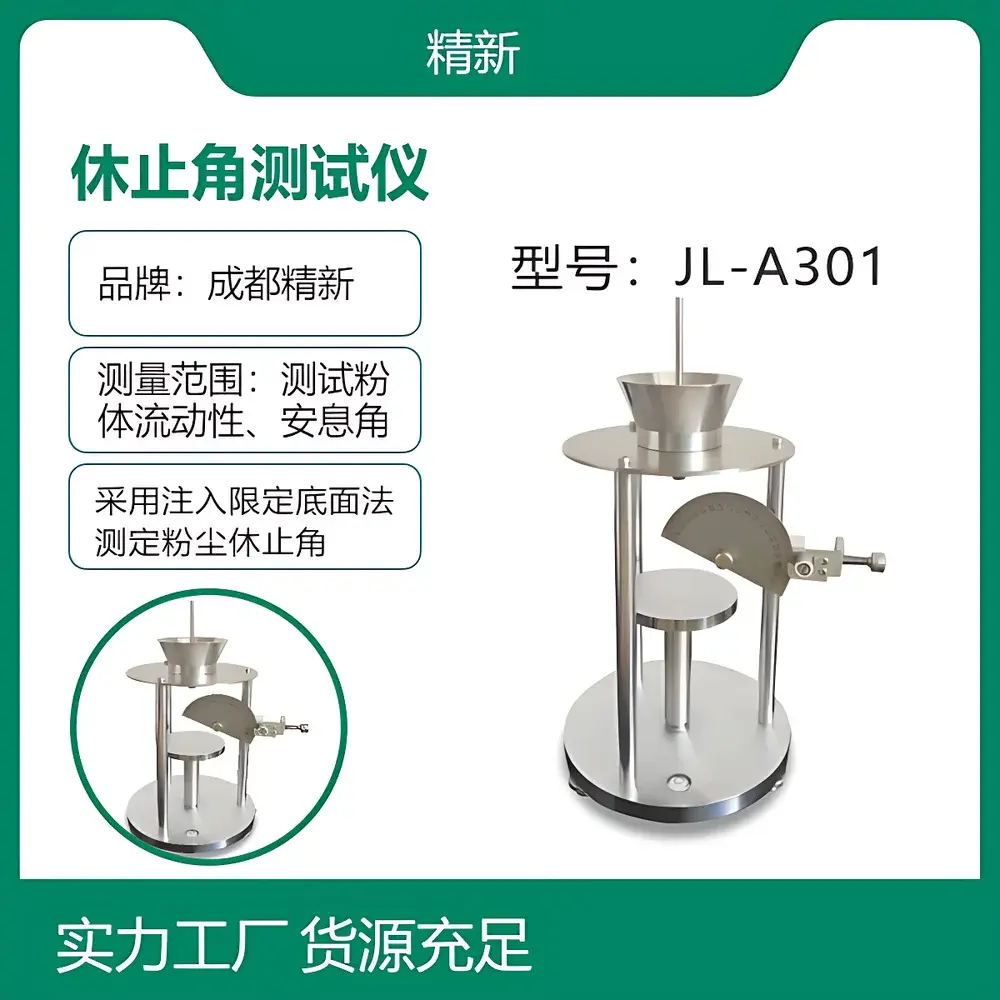
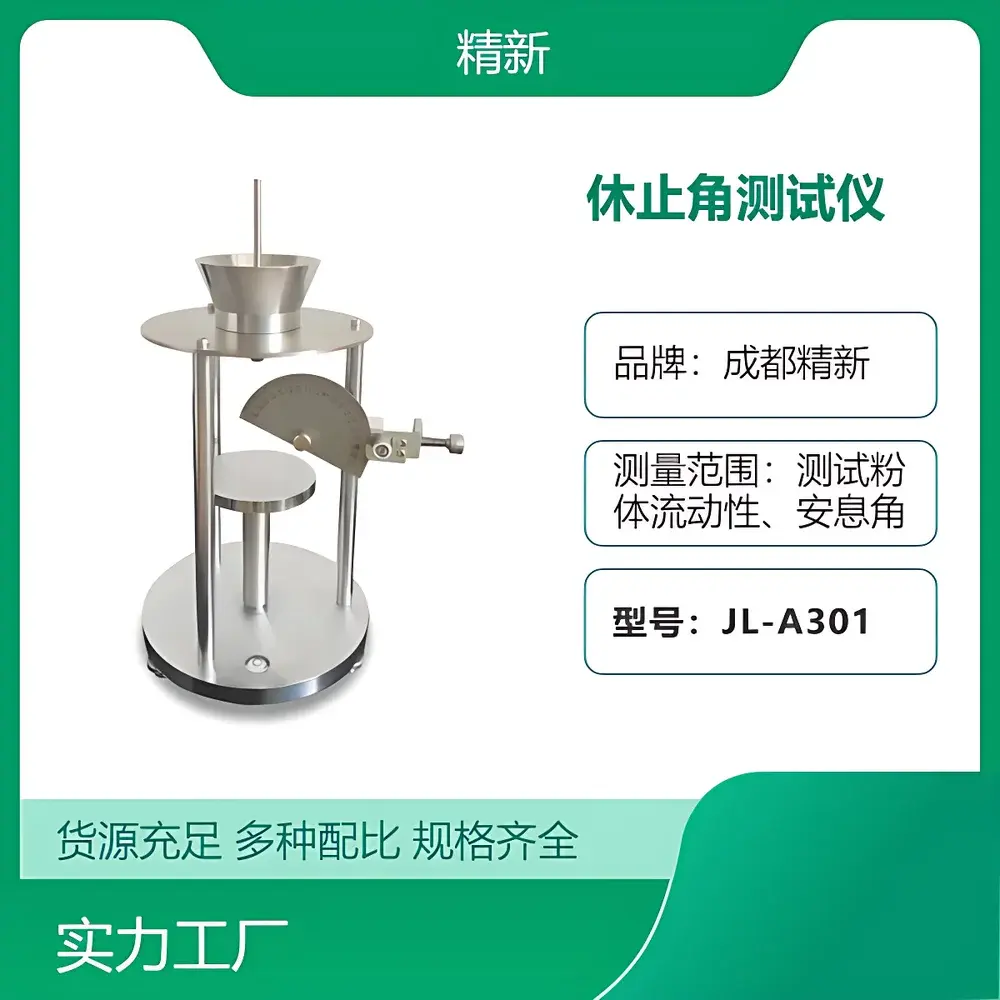
Chengdu Jingxin JL-A301 Powder Flowability Tester (Angle of Repose Analyzer)
| Brand | Chengdu Jingxin (CDJX) |
|---|---|
| Origin | Sichuan, China |
| Manufacturer Type | Direct Manufacturer |
| Country of Origin | China |
| Model | JL-A301 |
| Price Range | USD 310 – 395 |
| Standard Compliance | GB/T 16913–2008, GB/T 31057.3–2018 |
| Funnel Cone Angle | 60° ± 0.5° |
| Funnel Orifice Diameter | 5 mm (optional 10 mm) |
| Receiving Pan Diameter | 80 mm |
| Vertical Distance Between Funnel Tip and Pan Surface | 80 mm ± 2 mm |
| Protractor Scale Range | 7.5–10 cm |
| Probe Material | Stainless Steel |
| Measurement Principle | Fixed-Base Funnel Deposition Method (Cone Formation on Horizontal Plate) |
Overview
The Chengdu Jingxin JL-A301 Powder Flowability Tester is a precision-engineered instrument designed to determine the angle of repose — a fundamental physical property quantifying the flow behavior of dry, free-flowing powders and granular materials. Based on the standardized fixed-base funnel deposition method, the device operates by allowing a defined mass of powder to flow under gravity from a calibrated conical funnel onto a flat, horizontal stainless steel receiving plate. The resulting conical pile is geometrically characterized, and its angle of repose is measured either directly via integrated protractor or calculated trigonometrically from cone height and base diameter. This parameter serves as a primary indicator of interparticle friction, cohesion, and surface energy effects — critical inputs for process design in pharmaceutical manufacturing, bulk solid handling, catalyst formulation, additive manufacturing feedstock qualification, and dust control engineering.
Key Features
- Compliant with internationally referenced national standards: GB/T 16913–2008 “Determination of angle of repose for powders” and GB/T 31057.3–2018 “Powder technology — Part 3: Methods for characterization of flowability” — ensuring traceable, auditable test procedures.
- Precision-machined stainless steel funnel with nominal 60° cone angle (±0.5° tolerance) and interchangeable orifices (5 mm standard; optional 10 mm) to accommodate varying particle size distributions and flow regimes.
- Stable, rigid aluminum alloy frame with adjustable leveling feet ensures consistent horizontal alignment of the receiving pan — a prerequisite for measurement reproducibility.
- Dual-mode measurement capability: direct angular readout using a calibrated 7.5–10 cm protractor arm, or indirect calculation via digital caliper-measured cone geometry (height and base diameter), supporting both visual and dimensional verification protocols.
- Integrated stainless steel probe rod for gentle agitation during discharge — enabling controlled assessment of marginally cohesive powders without introducing external vibration sources that may compromise test integrity.
Sample Compatibility & Compliance
The JL-A301 accommodates powders ranging from fine micronized APIs (<10 µm) to coarse agglomerates up to 500 µm, provided they exhibit sufficient dryness and lack strong electrostatic or hygroscopic tendencies that could distort cone formation. It is not intended for slurries, pastes, or moisture-sensitive materials requiring inert atmosphere handling. All mechanical components comply with ISO 8502-3 surface cleanliness requirements for laboratory-grade instrumentation. While not certified to ASTM D6393 or ISO 4490, its operational methodology aligns closely with the principles defined therein, facilitating cross-standard correlation studies. Data generated meets GLP documentation prerequisites when paired with standardized SOPs and operator training records.
Software & Data Management
The JL-A301 is a manual, non-electronic instrument with no embedded firmware or connectivity features. All measurements are recorded manually in laboratory notebooks or LIMS-compatible spreadsheets. To support regulatory compliance, users are advised to implement a documented calibration schedule for the protractor scale (annually or per 100 tests), maintain logbooks for each test run (including ambient temperature/humidity, operator ID, sample lot number, and replicate values), and retain raw cone images where available. When integrated into quality systems governed by FDA 21 CFR Part 11, electronic data capture requires third-party digitization tools — such as calibrated USB microscopes or image analysis software — validated per user-defined protocols.
Applications
- Pharmaceutical pre-formulation screening: early-stage ranking of excipient flow performance prior to roller compaction or direct compression.
- Process validation of pneumatic conveying systems: correlating angle of repose with minimum fluidization velocity and hopper discharge rates.
- Quality control of ceramic powders and metal AM feedstocks: detecting batch-to-batch variability linked to particle morphology or surface treatment.
- Design input for dust collection hoppers and silo geometry: estimating arching and ratholing thresholds using Jenike shear cell correlations.
- Educational laboratories: teaching core principles of powder rheology, granular mechanics, and ASTM/ISO test methodology fundamentals.
FAQ
What is the recommended sample volume for each test?
A nominal 100 mL volumetric sample, delivered via standardized graduated cylinder or calibrated scoop, is specified in GB/T 16913–2008 to ensure statistical representativeness and minimize wall effects.
Can the instrument be used for hygroscopic powders?
No — ambient humidity exposure during cone formation may alter surface adhesion. For moisture-sensitive materials, testing must occur inside a controlled RH glovebox with pre-conditioned samples.
Is calibration certification included with purchase?
The unit ships with a factory inspection report verifying dimensional tolerances of funnel geometry and protractor linearity; formal metrological calibration per ISO/IEC 17025 requires third-party service.
How many replicate measurements are required per sample?
GB/T 16913–2008 mandates a minimum of three independent determinations, with the arithmetic mean reported as the final angle of repose; outliers exceeding ±2° from the mean must be investigated and retested.
Does the JL-A301 meet USP <1174> requirements for powder flow evaluation?
While USP <1174> references angle of repose as one of several qualitative indicators, it does not prescribe apparatus specifications. The JL-A301 satisfies the method’s procedural intent but should be supplemented with other flow metrics (e.g., compressibility index, Hausner ratio) for full USP compliance.



