
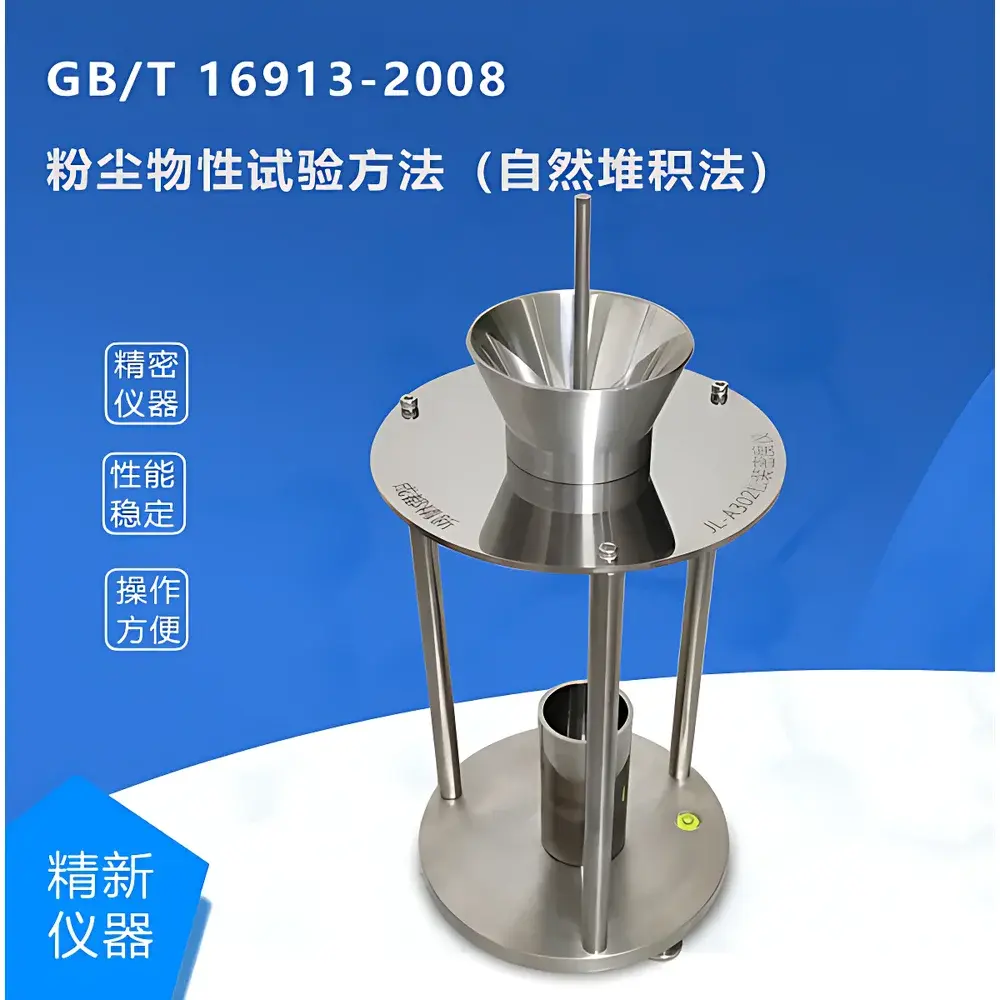
Chengdu Jingxin JL-A302 Bulk Density Tester for Ceramic Powders
| Brand | Chengdu Jingxin (CDJX) |
|---|---|
| Origin | Sichuan, China |
| Manufacturer Type | Direct Manufacturer |
| Instrument Type | Bulk Density Tester |
| Design | Portable Benchtop Unit |
| Sample Form | Dry Solid Powders and Granules |
| Compliance Standard | GB/T 16913–2008 (Natural Pile Method) |
| Funnel Orifice Diameter | 12.7 mm |
| Cylinder Volume | 100 mL |
| Funnel-to-Cylinder Height | 115 mm ± 2 mm |
| Funnel Cone Angle | 60° |
| Cylinder Material | AISI 304 Stainless Steel |
| Scraper & Plug Rod | AISI 304 Stainless Steel |
| Dimensions | ≈ 160 × 160 × 300 mm |
| Weight | 3.7 kg |
| Required External Balance | Capacity ≥ 1000 g, Readability ≤ 0.02 g |
Overview
The Chengdu Jingxin JL-A302 Bulk Density Tester is a precision-engineered, manually operated instrument designed specifically for the determination of bulk (loose) density of free-flowing ceramic powders, pharmaceutical granules, battery electrode materials, food ingredients, and other dry particulate solids. It operates on the principle of natural pile formation under gravity—consistent with the standardized static funnel method defined in GB/T 16913–2008, which aligns closely with internationally recognized protocols such as ASTM D1473 and ISO 3953. In this method, powder is allowed to flow freely from a fixed-height funnel with a precisely calibrated orifice onto a standardized cylindrical receiver. The resulting uncompacted mass per unit volume reflects the material’s aerated, loosely packed state—critical for downstream handling, storage, dosing, and process simulation in industrial R&D and quality control environments.
Key Features
- Stainless steel (AISI 304) construction throughout—including funnel, cylinder, scraper blade, and plug rod—ensuring corrosion resistance, mechanical stability, and long-term dimensional integrity.
- Optimized funnel geometry: 60° conical angle and 12.7 mm orifice diameter, validated for reproducible flow initiation and minimal wall adhesion across a broad range of particle sizes (typically 10 µm to 2 mm).
- Precision height control: Fixed vertical distance of 115 mm ± 2 mm between funnel outlet and cylinder rim ensures consistent gravitational energy input and minimizes operator-induced variability.
- Calibrated 100 mL stainless steel cylinder with smooth internal finish, enabling accurate volumetric definition and easy cleaning between samples.
- Integrated steel scraper (25 mm width) for repeatable planar leveling of excess powder—critical for eliminating parallax and volumetric overestimation.
- Compact, portable benchtop footprint (160 × 160 × 300 mm) and lightweight design (3.7 kg) support deployment in QC labs, production floors, and field testing stations without requiring dedicated infrastructure.
Sample Compatibility & Compliance
The JL-A302 is suitable for non-cohesive to moderately cohesive dry powders exhibiting sufficient flowability to pass through a 12.7 mm orifice without bridging or rat-holing. It has been routinely applied to ceramic oxides (e.g., Al₂O₃, ZrO₂), lithium-ion cathode precursors (e.g., NMC, LFP), excipients (microcrystalline cellulose, lactose), metal powders (stainless steel, Ti-6Al-4V), and agrochemical granules. While GB/T 16913–2008 is its primary reference standard, test procedures are compatible with ASTM D1473 (Standard Test Method for Bulk Density (“Unit Weight”) of Molded Plastic Refuse Compaction) and ISO 3953 (Determination of Bulk Density of Metal Powders). For regulated environments (e.g., pharmaceutical GMP or battery material qualification), users may document full procedural traceability—including balance calibration records, environmental conditions (temperature/humidity), and operator training—supporting GLP-compliant reporting.
Software & Data Management
The JL-A302 is a manual, non-electronic instrument and does not incorporate embedded software, sensors, or digital interfaces. All measurements are performed using external laboratory-grade analytical balances (≥1000 g capacity, ≤0.02 g readability) and recorded manually or via LIMS-integrated spreadsheets. This analog architecture eliminates firmware dependencies, reduces validation burden, and supports audit-ready documentation under FDA 21 CFR Part 11 when paired with controlled electronic record systems. Users are advised to implement standardized SOPs covering sample conditioning (e.g., 24 h desiccator equilibration), replicate count (n = 3 minimum), outlier rejection criteria (e.g., Grubbs’ test), and uncertainty estimation per GUM (Guide to the Expression of Uncertainty in Measurement).
Applications
- Quality assurance of ceramic raw materials prior to slip casting or dry pressing—ensuring batch-to-batch consistency in green body density and sintering behavior.
- Formulation development for solid-state battery cathodes, where bulk density directly influences electrode coating uniformity and volumetric energy density.
- Pharmaceutical powder characterization during blend uniformity studies and capsule fill weight prediction.
- Regulatory submission support for food additive registration (e.g., silica, calcium carbonate), where bulk density affects flowability in pneumatic conveying and packaging lines.
- Academic research into powder rheology fundamentals, including the correlation between bulk density, particle size distribution, and surface energy.
FAQ
What standards does the JL-A302 comply with?
It is engineered and validated for GB/T 16913–2008 (Chinese national standard for dust property testing), with functional equivalence to ASTM D1473 and ISO 3953.
Is the instrument supplied with a balance?
No. A calibrated external balance (≥1000 g capacity, ≤0.02 g readability) must be provided by the user.
Can it measure tapped density?
No. The JL-A302 is configured exclusively for loose (untapped) bulk density. Tapped density requires a separate tap density tester (e.g., ASTM D5964-compliant device).
What maintenance is required?
Routine cleaning with isopropyl alcohol and lint-free wipes; periodic inspection of funnel orifice for debris or wear; verification of cylinder volume accuracy annually using certified water displacement method.
Is calibration certification included?
The instrument is supplied with a factory verification report confirming dimensional conformity (orifice diameter, height, cylinder volume). NIST-traceable calibration of auxiliary equipment (balance, calipers) remains the user’s responsibility.



