
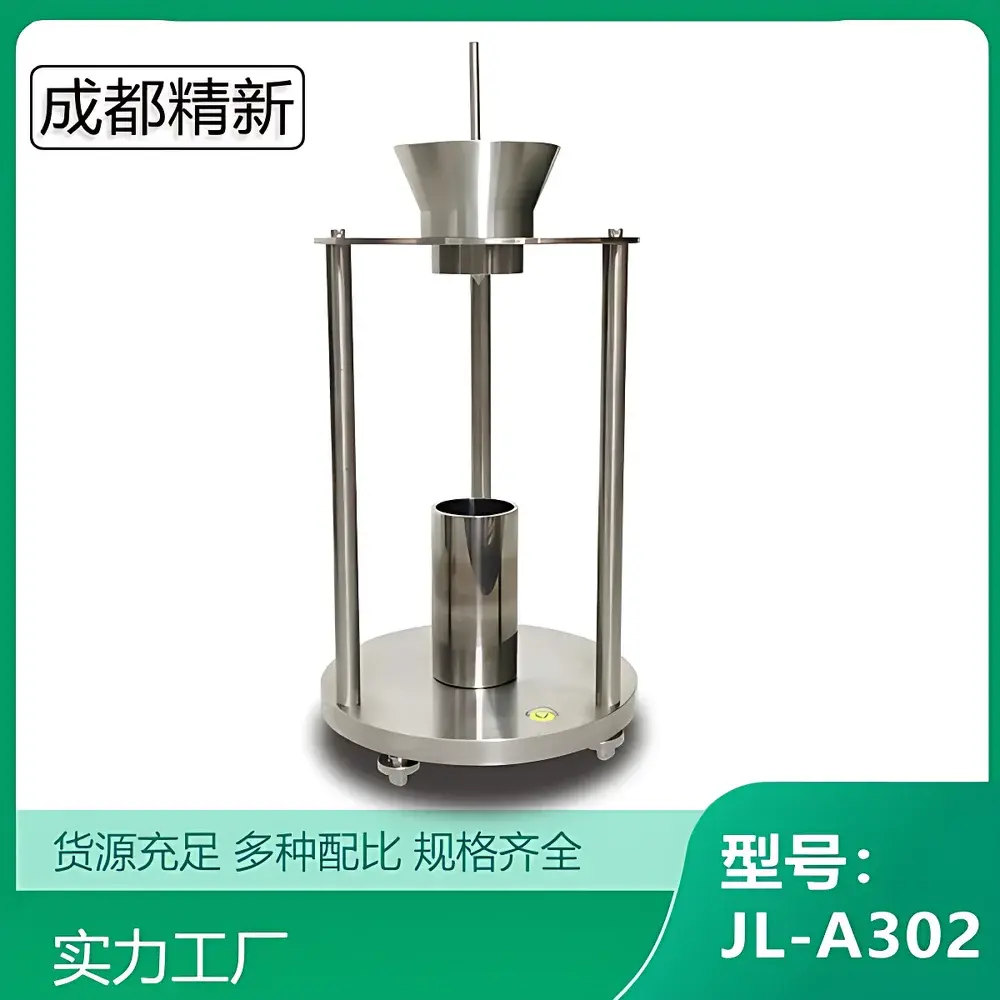
Chengdu Jingxin JL-A302 Bulk Density Tester for Powders and Granular Materials
| Brand | Chengdu Jingxin (CDJX) |
|---|---|
| Origin | Sichuan, China |
| Manufacturer | Yes |
| Type | Bulk Density Tester |
| Model | JL-A302 |
| Design | Portable Benchtop Unit |
| Measurement Principle | Free-Fall Natural Packing Method per GB/T 16913-2008 |
| Funnel Orifice Diameter | 12.7 mm |
| Funnel-to-Cylinder Height | 115 mm ± 2 mm |
| Funnel Angle | 60° |
| Cylinder Volume | 100 mL (AISI 304 Stainless Steel) |
| Scraper Blade | AISI 304, 25 mm wide |
| Stopper Rod | AISI 304 Stainless Steel |
| Overall Dimensions | ~160 × 160 × 300 mm |
| Weight | 3.7 kg |
| Required External Balance | Capacity ≥1000 g, Readability ≤0.02 g |
Overview
The Chengdu Jingxin JL-A302 Bulk Density Tester is a precision-engineered benchtop instrument designed to determine the bulk (loose) density of free-flowing powders and granular solids in accordance with the standardized natural packing method specified in GB/T 16913–2008 — “Test Methods for Dust Properties.” This method relies on gravitational free-fall deposition: powder flows under gravity from a calibrated stainless steel funnel into a fixed-volume cylinder, forming a naturally packed bed without vibration or compaction. The resulting mass per unit volume — expressed in g/cm³ or g/mL — quantifies the material’s bulk density, a critical parameter influencing flowability, storage capacity, blending uniformity, and dosing accuracy across industrial and research settings.
Key Features
- Compliant funnel geometry: 60° conical angle and precisely machined 12.7 mm orifice ensure consistent flow initiation and minimal wall adhesion.
- AISI 304 stainless steel construction throughout — including funnel, cylinder, scraper blade, and stopper rod — guarantees corrosion resistance, mechanical durability, and ease of cleaning between samples.
- Fixed funnel-to-cylinder vertical distance of 115 mm ± 2 mm, maintained via rigid support frame and centered base plate, ensures reproducible drop height — a key variable affecting packing structure.
- 100 mL volumetric cylinder with smooth interior finish and calibrated tolerance supports high repeatability in volume definition.
- Portable form factor (160 × 160 × 300 mm; 3.7 kg) enables deployment in QC labs, pilot-scale facilities, and field testing environments without requiring permanent installation.
- No moving parts or electronic components — operation is fully manual and operator-controlled, eliminating calibration drift, power dependency, or firmware updates.
Sample Compatibility & Compliance
The JL-A302 is suitable for dry, non-cohesive to moderately cohesive powders and granules with particle sizes typically ranging from 10 µm to 2 mm. It accommodates pharmaceutical excipients (e.g., lactose, microcrystalline cellulose), food powders (e.g., flour, sugar, milk powder), battery cathode/anode materials (e.g., LiCoO₂, graphite), catalysts, metal powders, and ceramic precursors. While GB/T 16913–2008 is the primary reference standard, the methodology aligns functionally with ASTM D1895–18 (Standard Test Methods for Apparent Density of Plastic Materials), ISO 697–2017 (Cement — Determination of Bulk Density), and USP (Bulk Density and Tapped Density of Powders). For regulated environments (e.g., GMP-compliant pharmaceutical manufacturing), users are responsible for establishing documented SOPs, operator training records, and periodic verification using traceable reference standards.
Software & Data Management
The JL-A302 operates as a purely mechanical measurement system and does not incorporate embedded electronics, sensors, or software. All data acquisition is performed externally using a calibrated analytical balance (user-supplied, ≥1000 g capacity, ≤0.02 g readability). Calculations — mass/volume — are executed manually or within laboratory information management systems (LIMS) or Excel-based templates. To support audit readiness, laboratories may integrate the device into broader quality systems by documenting test conditions (ambient temperature/humidity), operator ID, sample lot number, replicate count (minimum n=3 recommended), and raw mass readings. No FDA 21 CFR Part 11 compliance features are included, as no electronic records are generated by the instrument itself.
Applications
- Pharmaceutical development: Screening excipient flow behavior during formulation design and assessing batch-to-batch consistency of active pharmaceutical ingredients (APIs).
- Food processing: Evaluating density variations in powdered dairy, spices, and nutritional supplements to optimize packaging fill volume and shelf-life stability.
- Battery materials R&D: Characterizing cathode/anode powders prior to slurry mixing and electrode coating to predict rheology and porosity.
- Chemical manufacturing: Monitoring bulk density shifts in catalysts or pigments after drying, milling, or surface treatment.
- Academic research: Teaching fundamental powder characterization principles in materials science and chemical engineering laboratories.
- Third-party testing labs: Delivering accredited bulk density reports compliant with national standards for product certification and supplier qualification.
FAQ
What standards does the JL-A302 comply with?
It is engineered specifically to meet GB/T 16913–2008. Its physical configuration also supports method equivalence with ASTM D1895–18 and ISO 697–2017.
Is a balance included with the instrument?
No. A balance with ≥1000 g capacity and ≤0.02 g readability must be provided separately by the user.
Can the JL-A302 measure tapped density?
No. It is designed exclusively for loose (untapped) bulk density. Tapped density requires a separate tapping apparatus per GB/T 5162–2006 or ASTM D4781.
How many replicates are recommended per sample?
At least three independent measurements are required to calculate the arithmetic mean, as stipulated in GB/T 16913–2008.
Is calibration required for the JL-A302?
The instrument has no adjustable or drift-prone components. However, periodic verification of funnel orifice diameter (12.7 mm), cylinder volume (100 mL), and funnel height (115 mm) using certified metrology tools is advised for long-term measurement integrity.
Related Products



