
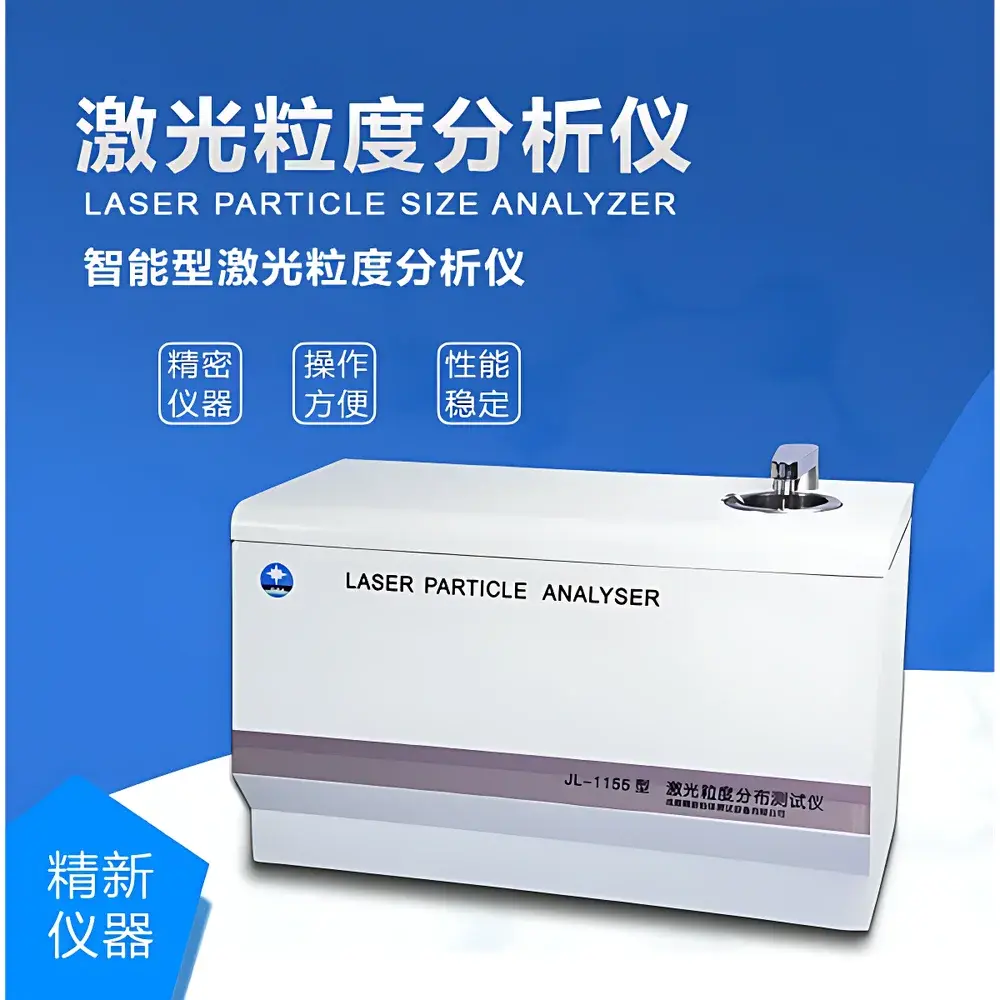
Chengdu Jingxin JL Series Fully Automatic Wet-Dispersion Laser Particle Size Analyzer
| Brand | Chengdu Jingxin (CDJX) |
|---|---|
| Origin | Sichuan, China |
| Manufacturer Type | Direct Manufacturer |
| Regional Category | Domestic (China-made) |
| Model | JL Series |
| Pricing | Available Upon Request |
| Dispersion Method | Wet Dispersion |
| Instrument Type | Laboratory Laser Particle Size Analyzer |
| Measurement Range | 0.1–1000 µm |
| Repeatability | ≥99% |
| Measurement Time | ≤2 minutes |
Overview
The Chengdu Jingxin JL Series Fully Automatic Wet-Dispersion Laser Particle Size Analyzer is an ISO 13320- and GB/T 19077-2016-compliant instrument engineered for high-fidelity particle size distribution (PSD) analysis of suspensions and slurries. It operates on the fundamental principles of Mie scattering theory—optimized for particles with known or estimable optical properties (refractive index and absorption coefficient)—and Fraunhofer diffraction theory for coarse, non-absorbing particles. The system employs an inverted Fourier optical configuration to minimize stray light from multiple reflections between the sample cell and optical surfaces, thereby enhancing signal fidelity across the full angular detection range. With a measurement span from 0.1 µm to 1000 µm and sub-1% repeatability (as verified against NIST-traceable standard reference materials), the JL Series delivers metrologically robust data suitable for R&D validation, QC release testing, and process optimization in regulated and non-regulated environments.
Key Features
- Inverted Fourier optical design with dual-wavelength laser excitation: primary 650 nm (30 mW) and auxiliary 405 nm (20 mW) semiconductor lasers—enabling enhanced resolution in the sub-1 µm region via complementary scattering sensitivity.
- 98-channel multi-element photodetector array covering forward, side, and backward scattering angles; each channel equipped with independent background compensation and high-gain analog signal conditioning for dynamic response stability.
- Integrated wet dispersion module featuring a 500 mL 304 stainless steel dispersion chamber, 60 W ultrasonic probe with dry-run protection, and precision-controlled peristaltic circulation pump ensuring uniform flow velocity and minimal particle settling or re-agglomeration.
- Self-contained fluid handling system with automatic water intake, optical alignment verification, measurement initiation, post-test cleaning, and drain sequencing—reducing operator dependency and inter-test variability.
- Rigid optomechanical architecture with elastomeric optical mountings, minimizing thermal drift and mechanical vibration effects over extended operation cycles; laser lifetime exceeds 70,000 hours.
- Optically bonded 60 mm × 60 mm high-transmittance fused silica sample cell, designed for long-term mechanical integrity and minimal birefringence-induced polarization artifacts.
Sample Compatibility & Compliance
The JL Series supports aqueous and organic dispersions—including deionized water, ethanol, and isopropanol—as test media, accommodating diverse powder chemistries (e.g., metal oxides, carbonates, polymers, pharmaceutical actives, and ceramic precursors). Its wet-dispersion workflow complies with ASTM D4294, ISO 13320, and GB/T 19077-2016 requirements for instrument calibration, validation, and reporting. While not pre-certified for 21 CFR Part 11, the software architecture supports audit trail generation, user access control, and electronic signature readiness—facilitating GLP/GMP-aligned deployment when integrated into validated laboratory information management systems (LIMS). Sample volume requirements range from milligrams to grams per run, dependent on material density, refractive index contrast, and desired signal-to-noise ratio.
Software & Data Management
The embedded analysis software provides bilingual (English/Chinese) interface switching, real-time scatter intensity visualization, and three standardized distribution models: free (non-parametric), Rosin-Rammler, and normal. Output includes cumulative distribution curves, differential histograms, and key metrics—D10, D50, D90, D97, volume-weighted mean diameter (D[4,3]), surface-area-weighted mean (D[3,2]), specific surface area (SSA), and span (D90−D10)/D50. Data export options include CSV, PDF, and XML formats; raw scatter patterns are retained for retrospective reprocessing. Communication occurs via RS-232 serial interface (USB-to-serial adapter supported), with native compatibility across Windows XP through Windows 10 platforms. Software updates are delivered via secure firmware upload protocols without requiring hardware modification.
Applications
This analyzer serves as a primary characterization tool across industries where particle morphology critically influences functional performance: battery cathode/anode materials (e.g., LiCoO2, graphite), pigment dispersion stability in coatings, fillers in papermaking (precipitated calcium carbonate), catalyst support uniformity (zeolites, alumina), ceramic green-body rheology (zirconia, silicon carbide), pharmaceutical granulation intermediates, and sedimentological studies of marine clays. Its rapid two-minute cycle time enables high-throughput batch screening, while its wide dynamic range supports both nano-scale additives and coarse abrasive grains within a single instrument platform—eliminating cross-platform correlation errors.
FAQ
What optical theory does the JL Series use for size calculation?
It applies Mie scattering theory by default, with optional Fraunhofer approximation for particles >50 µm or when optical constants are unknown.
Is the instrument compliant with international regulatory standards?
It meets ISO 13320 and GB/T 19077-2016 physical validation criteria; 21 CFR Part 11 compliance requires site-specific configuration and procedural documentation.
Can the system handle high-viscosity slurries?
Yes—its high-torque stirrer, optimized flow-path geometry, and adjustable ultrasonic duty cycle accommodate viscosities up to 500 cP when diluted appropriately.
How is optical alignment maintained during routine operation?
An automated real-time centering algorithm verifies laser beam position relative to the detector centroid before each measurement cycle.
What maintenance intervals are recommended for long-term reliability?
Ultrasonic transducer inspection every 6 months; optical cell cleaning after every 50 tests; annual calibration verification using NIST-traceable polystyrene latex standards.



