
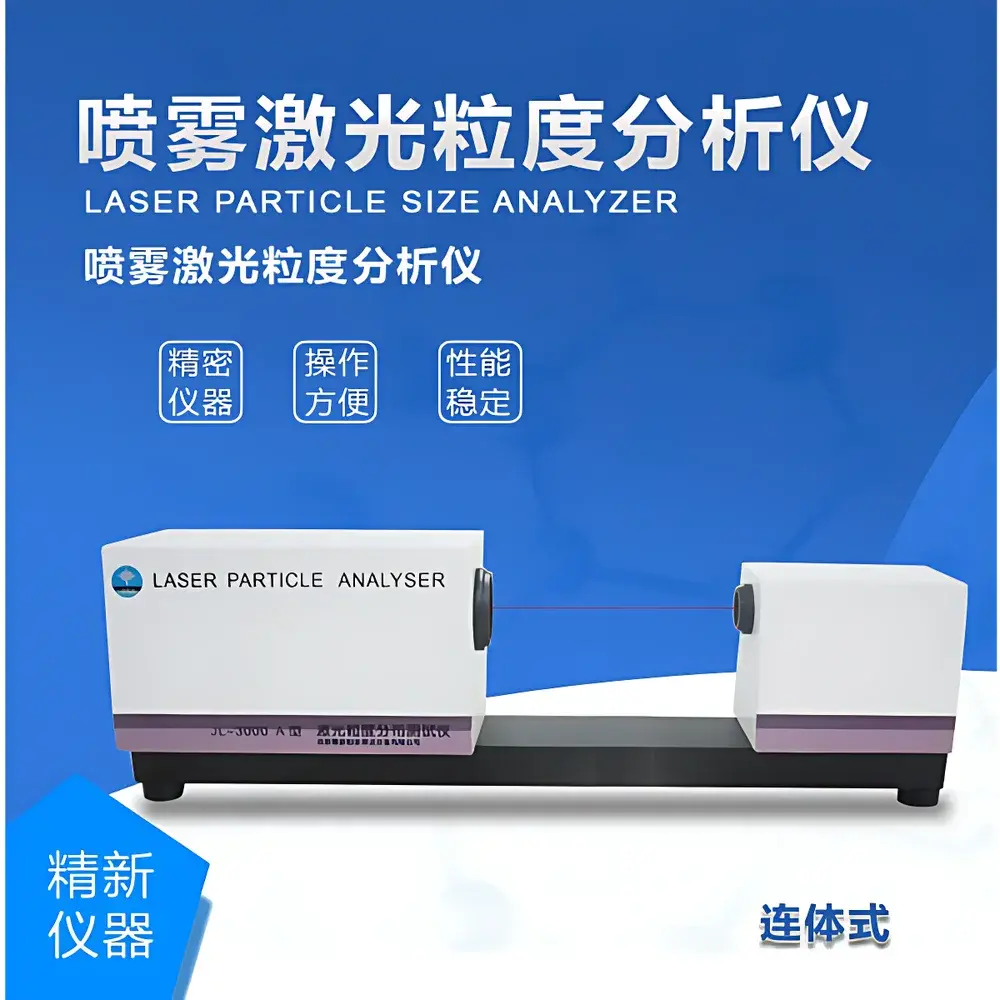
Chengdu Jingxin JL3000 Integrated Spray Laser Particle Size Analyzer
| Brand | Chengdu Jingxin (CDJX) |
|---|---|
| Origin | Sichuan, China |
| Manufacturer Type | Direct Manufacturer |
| Instrument Type | Laboratory Laser Particle Size Analyzer |
| Measurement Principle | Full-Range Mie Scattering Theory |
| Measurement Range | 0.01–3000 µm |
| Measurement Time | 10 s per analysis (single or multi-cycle auto-mode) |
| Dispersion Method | Wet Dispersion |
| Optical System | Fourier Transform with Parallel Beam & Large-Aperture Lens |
| Light Source | Imported 650 nm Semiconductor Laser (30 mW, >70,000 h lifetime) |
| Detector | 128-Channel Multielement Photodiode Array with Independent Background Compensation |
| Repeatability Error | ≤3% (D50 of NIST-traceable standard reference material) |
| Accuracy Error | ≤3% (D50 of NIST-traceable standard reference material) |
| Host-to-Satellite Unit Spacing | 400 mm |
| Data Interface | RS232 + USB (up to 100 m transmission distance) |
| Software Compatibility | Windows XP / 7 / 10 |
| Operating Environment | 5–35 °C, <85% RH |
| Power Supply | AC 220 V ±22 V, 50 Hz ±0.5 Hz |
| Dimensions (L×H×W) | 1130 × 340 × 200 mm |
| Weight | ~50 kg |
Overview
The Chengdu Jingxin JL3000 Integrated Spray Laser Particle Size Analyzer is an engineered solution for high-fidelity, real-time droplet size distribution measurement in low-volume, transient aerosol streams—such as pharmaceutical metered-dose inhalers (MDIs), nasal sprays, ultrasonic humidifiers, and precision micro-nozzles. It operates on full-range Mie scattering theory, rigorously accounting for complex refractive indices of liquid droplets (e.g., aqueous solutions, ethanol-based propellants, oil-based suspensions) without assuming spherical homogeneity or fixed optical models. Unlike conventional laser diffraction systems optimized for static slurries, the JL3000 employs a fixed 400 mm host-satellite configuration, enabling stable alignment and minimal optical drift during dynamic spray characterization. Its parallel-beam Fourier optical design ensures large interrogation volume capture, while the 128-channel detector array—each channel with independent background light compensation—delivers fine-grained resolution across the full 0.01–3000 µm range, critical for resolving multimodal distributions typical of atomization processes.
Key Features
- Integrated dual-unit architecture: Host (laser/detector/optics) and satellite (spray chamber/interface) are mechanically coupled at a fixed 400 mm separation—eliminating realignment needs and ensuring long-term optical stability.
- High-dynamic-range detection: 128-element photodiode array with per-channel analog gain control and real-time background subtraction enables accurate signal capture from sub-micron mist to coarse spray ligaments.
- Adjustable laser power (0–100%): Optimizes signal-to-noise ratio for varying droplet concentrations and optical densities—essential for transparent water mists and opaque oil-based aerosols alike.
- Fourier optical system with large-aperture lens: Maximizes angular scattering collection (up to ±60°), improving data robustness for non-uniform, asymmetric spray plumes.
- RS232 and USB 2.0 interfaces: Support both local PC control and integration into automated test benches; communication distance extends to 100 m via RS232 with optional repeater.
- TTL/switch-triggered high-speed acquisition mode: Enables up to 50 full-size-distribution measurements per second—suitable for time-resolved studies of pulsating nozzles or valve actuation dynamics.
- Optomechanical rigidity: All optical components mounted on stress-relieved aluminum baseplate; no field adjustment required over instrument lifetime.
Sample Compatibility & Compliance
The JL3000 is validated for aqueous, alcoholic, hydrocarbon, and glycol-based aerosols—including USP-compliant saline nebulizer outputs, ethanol-propelled nasal sprays, and mineral-oil humidifier mists. Its open sampling geometry accommodates nozzle diameters from 50 µm to 2 mm, with customizable mounting fixtures. While not certified under ISO 13320:2020 or ASTM E799-22 *per se*, its Mie-based calculation engine aligns with the theoretical framework specified in these standards for laser diffraction particle sizing. The instrument supports GLP/GMP-relevant data integrity practices: all analyses include timestamped metadata (operator ID, environmental conditions, calibration status), and raw scattering patterns are stored in binary format for retrospective reprocessing. Audit trails can be enabled via software configuration to meet internal QA requirements aligned with FDA 21 CFR Part 11 principles.
Software & Data Management
Jingxin’s proprietary ParticleSize Pro v4.x software provides bilingual UI (English/Chinese), compliant with Windows XP through Windows 10 (64-bit). It supports batch processing, statistical comparison of multiple runs, and export of D10/D50/D90, span, specific surface area, and full frequency/cumulative distribution tables. Raw scattering intensity profiles (128 channels × time-stamped) are saved in HDF5 format for third-party spectral analysis. Reports generate directly to PDF or printer; CSV exports include ISO-standardized column headers for LIMS integration. Optional API modules allow scripting via Python or LabVIEW for closed-loop feedback in nozzle development workflows.
Applications
- Pharmaceutical R&D: Quantifying droplet size distributions of pressurized metered-dose inhalers (pMDIs) and soft-mist inhalers (SMIs) per USP and Ph. Eur. 2.9.30 guidelines.
- Nozzle engineering: Correlating geometric parameters (orifice diameter, swirl angle, pressure drop) with Sauter mean diameter (SMD) and distribution width to optimize atomization efficiency.
- Humidification system validation: Verifying compliance with ASHRAE Standard 188 for healthcare facility humidifier output to minimize microbial aerosol generation.
- Aerosol science research: Capturing transient spray evolution during startup/shutdown cycles using TTL-triggered high-speed acquisition.
- Quality control labs: Routine verification of spray consistency across production batches using D50 repeatability metrics (≤3% CV).
FAQ
Does the JL3000 require optical recalibration between tests?
No. Its rigid optomechanical architecture and sealed enclosure eliminate routine recalibration; only annual verification using NIST-traceable polystyrene latex standards is recommended.
Can it measure oil-based sprays without solvent dilution?
Yes—its adjustable laser power and high-dynamic-range detector enable direct measurement of opaque hydrocarbon mists without dilution or carrier gas assistance.
Is the 400 mm spacing configurable?
No—the fixed spacing is integral to the instrument’s alignment stability and Mie modeling fidelity; custom configurations are not supported.
What sample volumes are required for statistically valid results?
For steady-state sprays, ≥5 seconds of continuous acquisition yields reproducible D50 with <2% standard deviation; transient events require TTL-synchronized multi-shot averaging.
Does the software support automated pass/fail reporting against preset specifications?
Yes—user-defined tolerance bands for D10/D50/D90 can be set; the software flags out-of-spec results and logs them with timestamps and operator IDs.



