
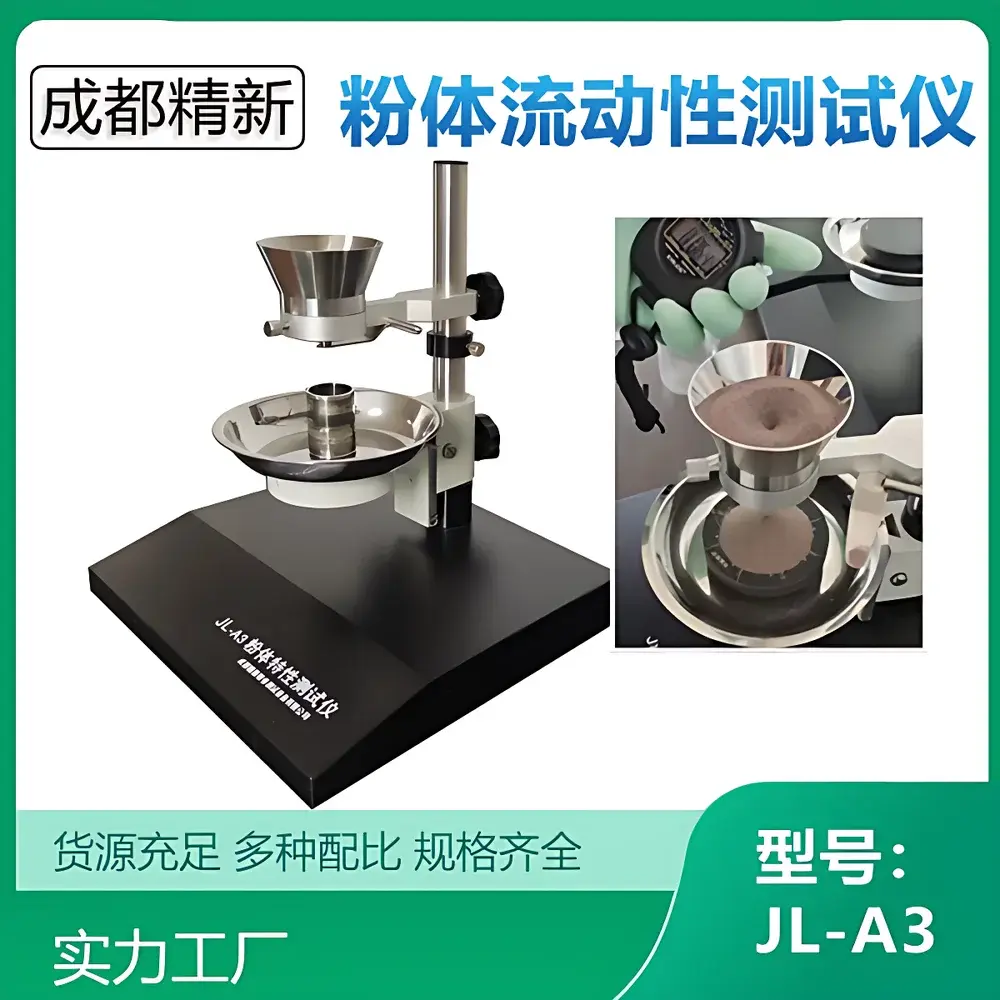
Chengdu Jingxin JLA3 Powder Bulk Density & Flowability Tester
| [Brand | Chengdu Jingxin (CDJX) |
|---|---|
| Origin | Sichuan, China |
| Manufacturer Type | Direct Manufacturer |
| Instrument Type | Angle of Repose Tester, Bulk Density Tester, Powder Flowability Tester |
| Measurable Parameters | Angle of Repose, Bulk Density, Flow Rate (Haller Flow Time) |
| Maximum Sample Cup Capacity | 100 g |
| Minimum Sample Requirement | 50 g |
| Standard Funnel Orifice | 5 mm (optional 2.5 mm or custom) |
| Stainless Steel Cup Volume | 25 mL |
| Funnel Cone Angle | 60° |
| Repose Plate Diameter | 80 mm |
| Scale Ruler Width | 25 mm |
| Dimensions | 300 × 260 × 260 mm |
| Net Weight | ~5 kg] |
Overview
The Chengdu Jingxin JLA3 Powder Bulk Density & Flowability Tester is a manually operated, multi-function benchtop instrument engineered for standardized physical characterization of dry free-flowing powders and granular solids. It implements three fundamental powder property measurements—bulk (loose) density, angle of repose (also termed “angle of rest” or “static angle of repose”), and flow rate via Haller-type funnel flow time—in strict accordance with internationally harmonized national standards including GB/T 1482–2010 (metal powder flow rate), GB/T 1479.1–2017 (bulk density by funnel method), and GB/T 16913–2008 (angle of repose determination). The instrument operates on classical gravitational principles: powder flows under gravity through a precision-machined stainless-steel funnel into either a calibrated cup (for bulk density) or onto a horizontal circular plate (for angle of repose), while flow time is recorded using external timing equipment. Its design prioritizes mechanical stability, repeatability in manual operation, and compliance-ready documentation pathways—making it suitable for routine QC laboratories, R&D centers, and regulatory-compliant environments where ASTM D6393, ISO 4490, and USP <1174> powder flow guidance serve as reference frameworks.
Key Features
- Triple-function architecture: single platform supports bulk density, angle of repose, and Haller flow time measurement without hardware reconfiguration.
- High-grade 304 stainless-steel funnel and 25 mL volumetric cup—precision-machined, surface-polished to minimize wall adhesion and ensure consistent discharge behavior.
- Adjustable vertical positioning system: fine-threaded height adjustment knob enables precise alignment between funnel outlet and receptacle (cup or repose plate), critical for reproducible drop height per GB/T 1479.1 and GB/T 16913.
- Integrated shutter mechanism: spring-loaded stainless steel baffle at funnel base prevents premature powder release; actuated manually prior to test initiation to eliminate operator-dependent sealing variability.
- Dual-scale measurement support: built-in linear ruler (0–100 mm, 1 mm graduations) for direct height reading during repose angle calculation; calibrated cup volume traceable to SI units.
- Modular orifice options: standard 5 mm outlet diameter compliant with GB/T 1482; optional 2.5 mm orifice available for fine or cohesive powders requiring higher sensitivity in flow time differentiation.
Sample Compatibility & Compliance
The JLA3 is validated for use with dry, non-cohesive to moderately cohesive powders across industrial sectors—including battery cathode/anode materials (e.g., LiCoO₂, graphite), metal powders (Al, Ti, Ni alloys), pharmaceutical excipients (microcrystalline cellulose, lactose), food-grade starches and flours, ceramic precursors, and polymer granules. It excludes hygroscopic, electrostatically charged, or highly cohesive materials unless pre-conditioned (e.g., dried at 105 °C per GB/T 1479.1). All test protocols align with Chinese National Standards (GB), which are technically equivalent to ISO 4490 (flow rate), ISO 3953 (bulk density), and ISO 902 (angle of repose). While the instrument itself does not embed electronic sensors or automated data acquisition, its mechanical design and procedural rigor support GLP-aligned documentation when paired with calibrated timers, analytical balances (0.01 g resolution), and validated software reporting.
Software & Data Management
The included Windows-based calculation software (v3.2+) accepts manually entered raw data—flow time (s), repose pile height (mm), repose plate radius (mm), cup mass (g), filled cup mass (g)—and computes final values per standardized equations: bulk density (g/mL) = (filled mass − tare mass) / 25 mL; angle of repose (°) = arctan[h / (r − d/2)], where h = measured pile height, r = 40 mm (half of 80 mm plate diameter), d = funnel orifice diameter; flow rate (g/s) = 50 g / average flow time. Reports generate in bilingual (Chinese/English) format and export natively to Word (.docx), Excel (.xlsx), and PDF (.pdf) with embedded metadata (operator ID, date/time stamp, standard reference, instrument ID). Audit trail functionality is limited to file creation/modification timestamps; for full 21 CFR Part 11 compliance, integration with LIMS or third-party validated electronic lab notebooks is recommended.
Applications
- Quality control of metal powders in additive manufacturing feedstock qualification (ASTM F3049 screening).
- Batch-to-batch consistency verification of pharmaceutical blends prior to tablet compression.
- Evaluation of drying efficiency in spray-dried excipients via comparative bulk density shifts.
- Pre-formulation assessment of battery electrode slurries—correlating flow time with slurry rheology and electrode homogeneity.
- Academic research on powder segregation mechanisms under vibration or shear, using angle of repose as an initial cohesion indicator.
- Regulatory submission support for powder handling safety assessments (e.g., dust explosion risk classification per EN 14042).
FAQ
What standards does the JLA3 comply with?
It conforms to GB/T 1482–2010 (equivalent to ISO 4490), GB/T 1479.1–2017 (equivalent to ISO 3953), and GB/T 16913–2008 (equivalent to ISO 902) for powder flow, bulk density, and angle of repose testing.
Can the instrument be used for cohesive or moist powders?
Not directly—cohesive or damp powders require pre-drying (e.g., 105 °C per GB/T 1479.1) and may necessitate alternative methods such as shear cell or compressibility testing for robust characterization.
Is calibration certification provided with the instrument?
The stainless-steel cup volume (25 mL ± 0.5 mL) and funnel geometry are factory-verified; users must maintain traceable calibration of supporting equipment (balance, timer) per ISO/IEC 17025 requirements.
Does the software support network deployment or database integration?
No—the software operates as a standalone desktop application with local file storage only; no API, SQL, or cloud synchronization capabilities are implemented.
What maintenance is required for long-term accuracy?
Routine cleaning of funnel interior and cup with lint-free cloth and ethanol; periodic inspection of baffle seal integrity and ruler zero-point alignment; avoidance of abrasive cleaning agents that compromise stainless-steel surface finish.



