
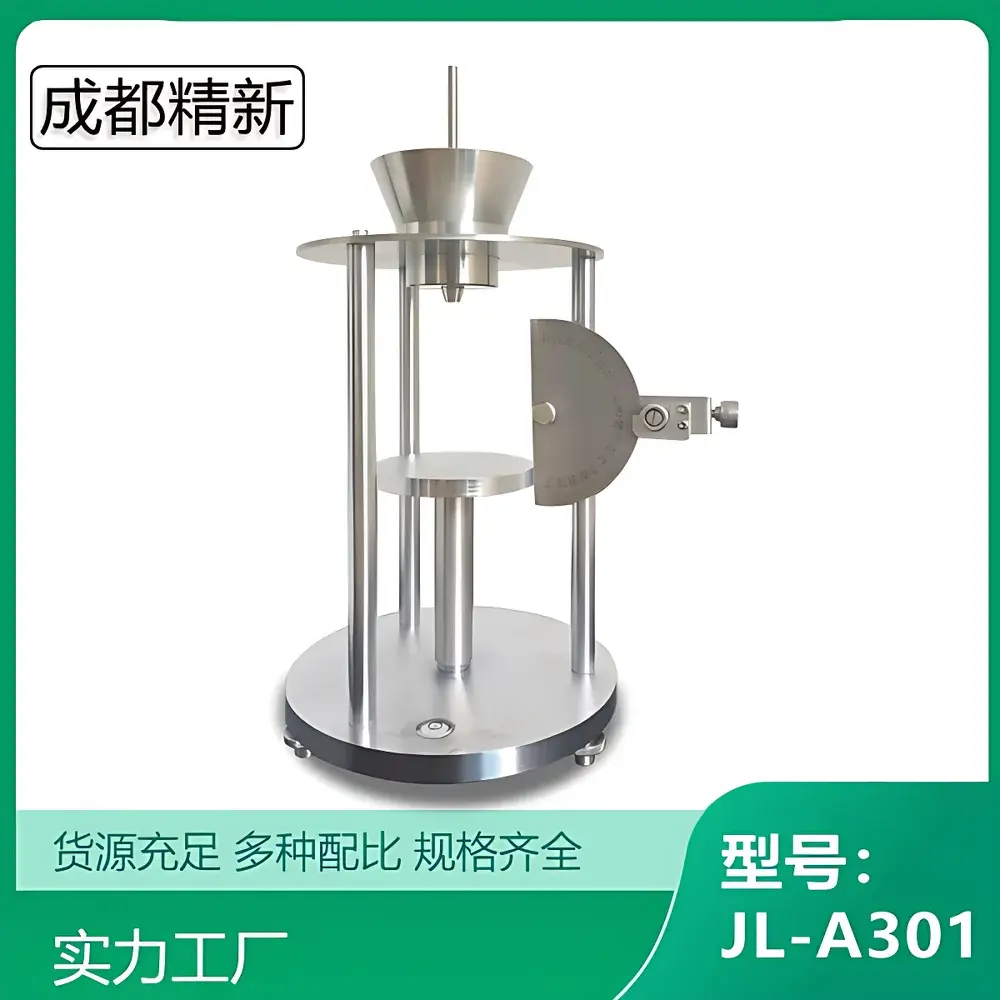
Chengdu Jingxin JLA301 Powder Flow Angle Tester (Repose Angle Analyzer)
| Brand | Chengdu Jingxin (CDJX) |
|---|---|
| Origin | Sichuan, China |
| Manufacturer Type | Direct Manufacturer |
| Country of Origin | China |
| Model | JLA301 |
| Price Range | USD 310 – 395 |
| Standard Compliance | GB/T 16913–2008, GB/T 31057.3–2018 |
| Funnel Cone Angle | 60° ± 0.5° |
| Funnel Orifice Diameter | 5 mm (customizable to 10 mm) |
| Receiving Pan Diameter | 80 mm |
| Vertical Distance Between Funnel Tip and Pan Surface | 80 mm ± 2 mm |
| Protractor Scale Range | 7.5–10 cm |
| Probe Rod Material | Stainless Steel |
| Measurement Principle | Fixed-base funnel deposition method per standardized conical heap geometry |
Overview
The Chengdu Jingxin JLA301 Powder Flow Angle Tester is a precision-engineered instrument designed for the quantitative determination of repose angle (also known as angle of repose) in free-flowing and cohesive powders. It operates on the fixed-base funnel deposition principle defined in GB/T 16913–2008 and GB/T 31057.3–2018—Chinese national standards aligned with internationally recognized methodologies for powder flow characterization. The device enables reproducible formation of a conical powder heap on a horizontal stainless-steel receiving plate by controlled gravitational discharge through a standardized funnel. The repose angle is derived geometrically either directly via angular measurement using an integrated protractor or indirectly via calculation from measured cone height and base diameter. As a fundamental bulk property parameter, repose angle reflects interparticle friction, surface energy, particle shape, and moisture content—critical variables influencing handling behavior in pharmaceutical manufacturing, metallurgical powder processing, additive manufacturing feedstock qualification, and catalyst handling systems.
Key Features
- Compliance-certified mechanical architecture adhering strictly to GB/T 16913–2008 and GB/T 31057.3–2018 dimensional tolerances—including a precision-machined 60° ± 0.5° funnel cone and 5 mm nominal orifice (optional 10 mm variant available for coarse or granular materials)
- Stainless-steel probe rod and funnel assembly ensuring corrosion resistance, long-term dimensional stability, and minimal powder adhesion during repeated testing cycles
- Adjustable vertical alignment system enabling precise 80 mm ± 2 mm funnel-to-pan spacing—critical for eliminating aerodynamic interference and ensuring consistent heap formation kinetics
- Calibrated protractor with 7.5–10 cm arc scale, optimized for high-resolution angular reading across the typical repose range (20°–65°) observed in metal powders, ceramic precursors, and polymer granules
- Modular, tool-free assembly design facilitating rapid setup, cleaning, and verification—reducing operator-induced variability and supporting routine calibration checks
Sample Compatibility & Compliance
The JLA301 is validated for use with dry, non-agglomerated, and moderately cohesive powders including atomized stainless steel, titanium, aluminum, and nickel-based alloys—common feedstocks in powder metallurgy and laser powder bed fusion (LPBF). It accommodates sample volumes up to 100 mL and supports manual flow initiation and gentle mechanical assistance (e.g., light tapping or probe agitation) for low-flowability materials without violating standard test boundary conditions. All physical dimensions, material specifications, and procedural sequences conform to the metrological requirements of GB/T 16913–2008 (equivalent in scope to ISO 4490:2017 for metallic powders) and GB/T 31057.3–2018 (part of the broader GB/T 31057 series covering powder characterization for industrial applications). While not inherently GLP/GMP compliant, its design permits integration into auditable workflows when paired with documented SOPs, equipment logs, and operator training records.
Software & Data Management
The JLA301 is a fully manual, hardware-only instrument requiring no embedded firmware or digital interface. Data acquisition is performed externally using calibrated calipers, digital height gauges, or optical profilometry systems for secondary validation. Users are advised to record raw measurements (cone height, base diameter, direct protractor readings) in laboratory notebooks or LIMS-compatible spreadsheets. For regulated environments, manual entries must include operator ID, date/time stamp, environmental conditions (temperature, RH), and batch identification—supporting traceability under ISO/IEC 17025 or FDA 21 CFR Part 11-compliant documentation practices when implemented with appropriate procedural controls.
Applications
- Pre-sintering quality control of gas-atomized and plasma-rotating-electrode (PREP) metal powders used in MIM and AM processes
- Batch release testing for flow consistency in pharmaceutical excipient blends prior to capsule filling or tablet compression
- Process optimization of pneumatic conveying line design, hopper geometry, and screw feeder settings in metallurgical powder handling systems
- Comparative evaluation of surface modification efficacy (e.g., silane coating, plasma treatment) on powder flow enhancement
- Educational demonstration of granular mechanics principles in materials science and chemical engineering laboratories
FAQ
What standards does the JLA301 comply with?
It conforms to GB/T 16913–2008 and GB/T 31057.3–2018, which are functionally equivalent to ISO 4490 and ASTM D6393 for repose angle determination.
Can the JLA301 be used for wet or hygroscopic powders?
No—this instrument is intended exclusively for dry, free-flowing or marginally cohesive powders. Moisture content must be controlled per GB/T 1479.2 or ISO 4490 conditioning protocols prior to testing.
Is calibration certification included with purchase?
The unit ships with a factory verification report confirming dimensional compliance; users are responsible for periodic verification against traceable angle gauges or certified reference cones.
How many replicate measurements are recommended per sample?
Per GB/T 16913–2008, a minimum of three independent determinations is required, with the arithmetic mean reported as the final repose angle value.
Does the JLA301 support automated data logging?
No—it is a purely mechanical tester. Digital data capture requires external instrumentation and manual transcription into validated electronic records.



