
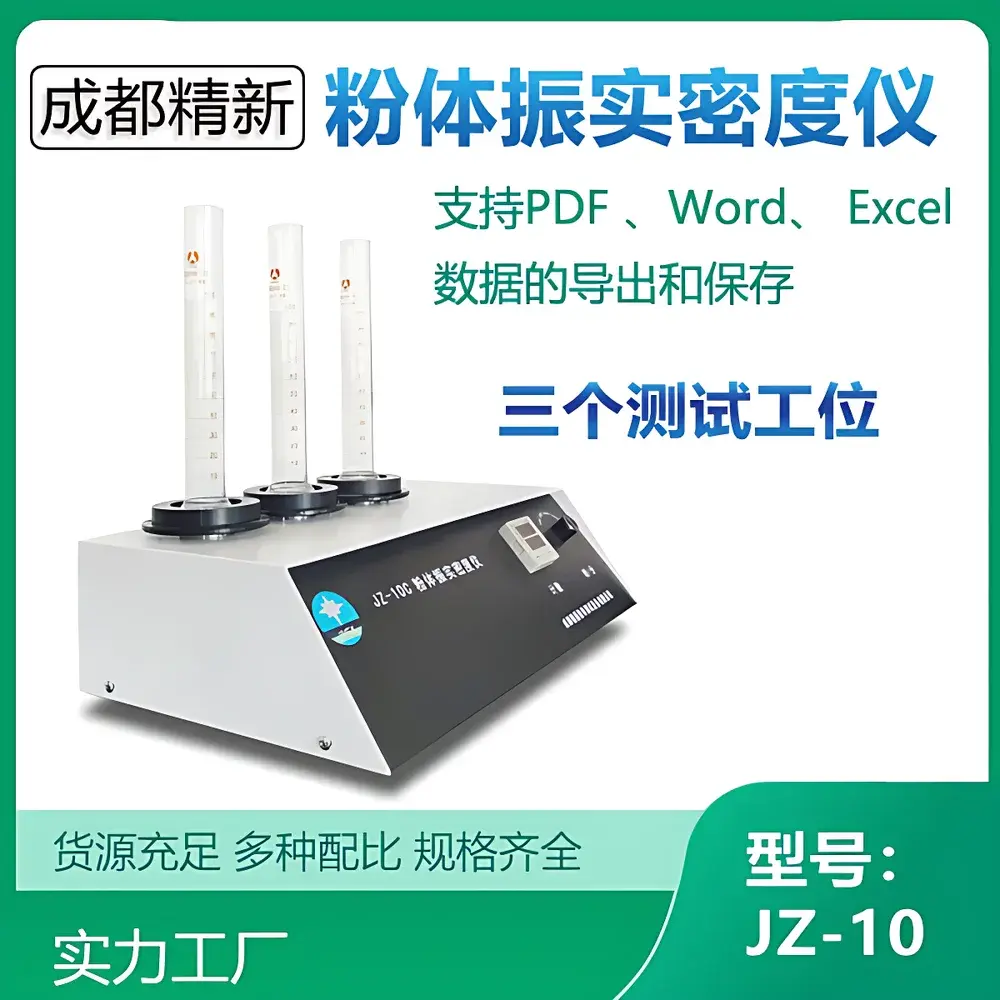
Chengdu Jingxin JZ-10-C Tap Density Tester & Bulk Density Tester
| Brand | Chengdu Jingxin (CDJX) |
|---|---|
| Origin | Sichuan, China |
| Manufacturer Type | Direct Manufacturer |
| Country of Origin | China |
| Model | JZ-10-C |
| Instrument Type | Tap Density Tester |
| Category | Portable Solid Density Analyzer |
| Measurement Range | 0–10 g/cm³ |
| Primary Application | Tap density and bulk density measurement of powders and granular solids |
| Repeatability Error | ≤ ±1% |
| Vibration Amplitude | 3.0 ± 0.2 mm |
| Adjustable Tapping Cycles | 1–9999 |
| Selectable Vibration Frequencies | 100 / 200 / 250 / 300 taps/min |
| Dual Motion Mechanism | Vertical tapping + horizontal rotation |
| Sample Container Options | Three 25 mL and three 100 mL borosilicate glass cylinders (removable) |
| Power Supply | AC 220 V, 110 W |
| Dimensions (L×W×H) | 455 × 280 × 125 mm |
| Weight | ~15 kg |
| Software Output Formats | Word, PDF, Excel |
| Compliance Standards | GB/T 5162–2021, GB/T 31057.2–2018, Chinese Pharmacopoeia 2020 Edition <993>, USP <616> |
Overview
The Chengdu Jingxin JZ-10-C Tap Density Tester & Bulk Density Tester is an engineered solution for standardized measurement of powder compaction behavior under controlled mechanical vibration. It operates on the principle of regulated tap densification—where a precisely defined mass of dry, free-flowing powder is subjected to repetitive vertical impacts combined with synchronized horizontal rotation. This dual-motion protocol ensures uniform particle rearrangement and surface leveling, minimizing void segregation and enhancing measurement reproducibility across heterogeneous particulate systems. Designed in strict alignment with international pharmacopeial and industrial standards—including USP , Chinese Pharmacopoeia , and GB/T 5162–2021—the instrument delivers traceable, audit-ready data for quality control, formulation development, and regulatory documentation in GMP-compliant environments.
Key Features
- Dual-axis motion system: Simultaneous vertical tapping (amplitude 3.0 ± 0.2 mm) and low-speed horizontal rotation ensure consistent powder bed homogenization and eliminate surface irregularities prior to volume reading.
- Programmable tapping parameters: User-selectable tap counts (1–9999) and four discrete tapping frequencies (100, 200, 250, 300 taps/min) enable method customization for diverse material classes—from cohesive pharmaceutical actives to high-density metal powders.
- Modular sample handling: Three removable borosilicate glass cylinders (25 mL and 100 mL, each supplied in triplicate) allow parallel testing, cross-validation, and rapid cleaning without tooling. Cylinder mounting fixtures are precision-machined for repeatable axial alignment.
- Microprocessor-based timing control: Embedded digital timer guarantees cycle accuracy within ±0.1%, eliminating mechanical drift and supporting long-duration stability studies.
- Thermal management architecture: Rear-panel perforated ventilation grid maintains stable motor and electronics temperature during extended operation (>8 hours continuous duty), preserving calibration integrity.
- High-resolution density calculation: Software computes tap density (g/cm³) and bulk density (g/cm³) to two decimal places using calibrated cylinder volumes and net sample mass inputs.
Sample Compatibility & Compliance
The JZ-10-C accommodates a broad spectrum of dry, non-cohesive to moderately cohesive powders and granules, including but not limited to: elemental and alloy metal powders (e.g., Ti-6Al-4V, Inconel 718), ceramic precursors (Al₂O₃, ZrO₂), battery electrode materials (LiCoO₂, graphite anodes), excipients and APIs (lactose, microcrystalline cellulose), food-grade starches and spices, and polymer granules (PE, PP). All test procedures conform to ISO 3953:1993 (Determination of tap density of metal powders), ASTM D4781–22 (Standard Test Method for Tap Density of Catalysts), and FDA-relevant guidance for solid dosage form development. The instrument supports GLP/GMP data traceability through timestamped electronic records and user-accessible audit logs.
Software & Data Management
The included Windows-compatible software provides full lifecycle data handling: raw input entry (mass, cylinder ID, tap count/frequency), automated density calculation, real-time result visualization, and export to industry-standard formats (Microsoft Word, Excel, PDF). Reports include instrument identification, operator ID, date/time stamp, environmental notes (ambient temperature/humidity), and compliance reference fields for GB/T, USP, or Ph. Eur. method citation. No cloud dependency or subscription model—data remains fully local and exportable. Software output meets basic requirements for 21 CFR Part 11 compliance when deployed on validated laboratory workstations with controlled user access.
Applications
This instrument serves critical roles in R&D laboratories and production QA/QC settings across multiple sectors. In pharmaceutical manufacturing, it supports excipient selection, blend uniformity assessment, and capsule/fill weight predictability modeling. Battery material producers use it to correlate tap density with electrode coating density and porosity. Metal additive manufacturing facilities rely on its repeatability for feedstock qualification per ASTM F3049. Food and nutraceutical processors apply it to optimize flowability and dosing consistency. Academic researchers employ it in granulation kinetics, powder rheology benchmarking, and structure–property relationship studies.
FAQ
What standards does the JZ-10-C comply with?
It complies with GB/T 5162–2021, GB/T 31057.2–2018, Chinese Pharmacopoeia 2020 Edition , and USP . Optional validation documentation supports alignment with ISO 3953 and ASTM D4781.
Can the instrument be used for moisture-sensitive powders?
Yes—provided samples are pre-conditioned to constant mass under controlled humidity and tested in inert atmosphere enclosures (optional accessory). The glass cylinders are chemically inert and easily sealed.
Is calibration verification supported?
Yes—reference density standards (certified glass beads or stainless steel spheres) can be run periodically. The software includes a calibration verification module with pass/fail thresholds based on ±1% repeatability.
How is data integrity ensured during export?
All exported files retain embedded metadata (test ID, timestamp, operator, instrument serial number) and are generated as static, uneditable documents—no dynamic links or external dependencies.
Does the JZ-10-C require annual recalibration by the manufacturer?
No—mechanical calibration (amplitude, frequency, cycle count) is user-verifiable via supplied metrology tools. Full factory recalibration is recommended only after physical impact or electrical fault events.



